游戏预览
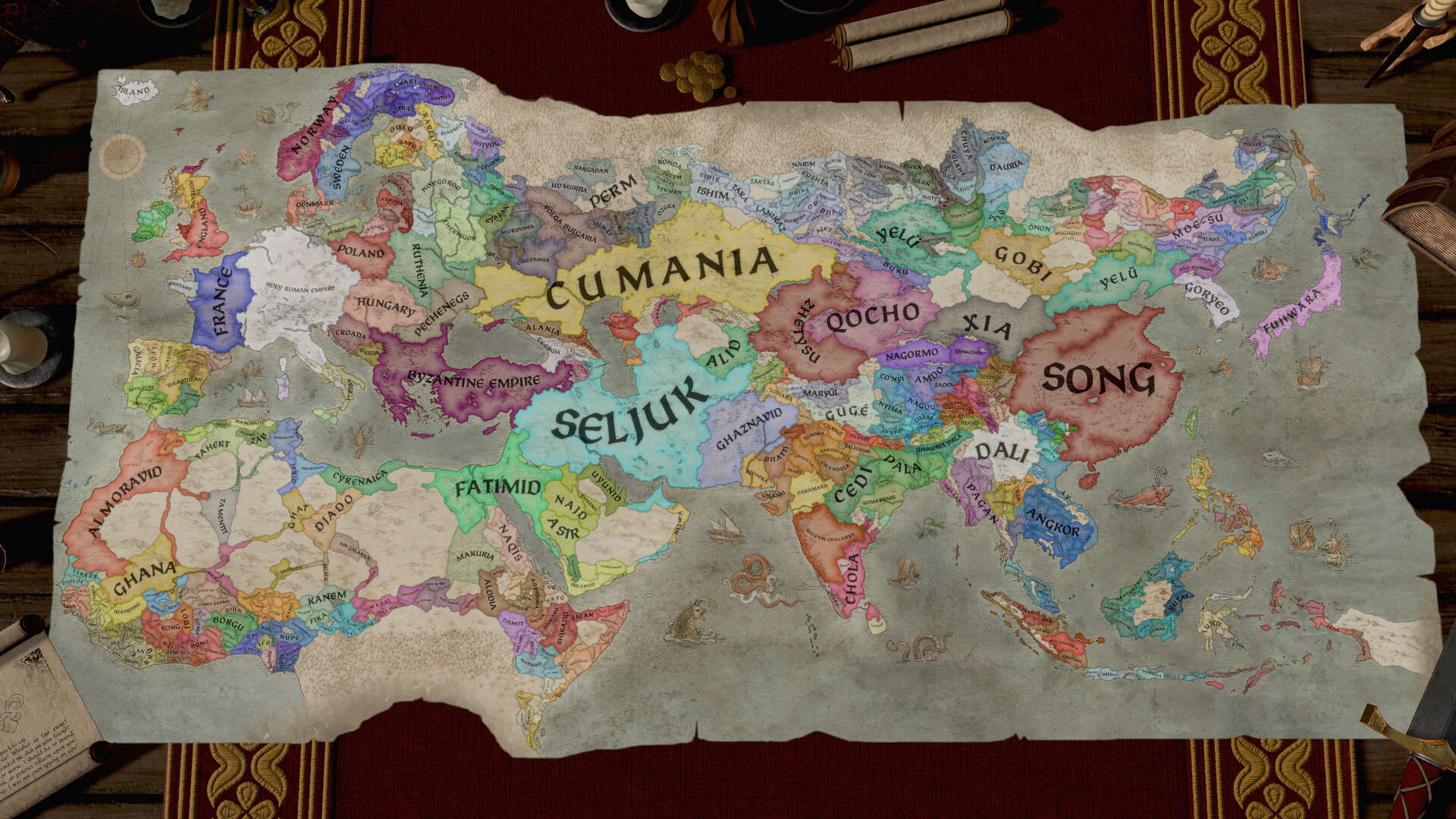
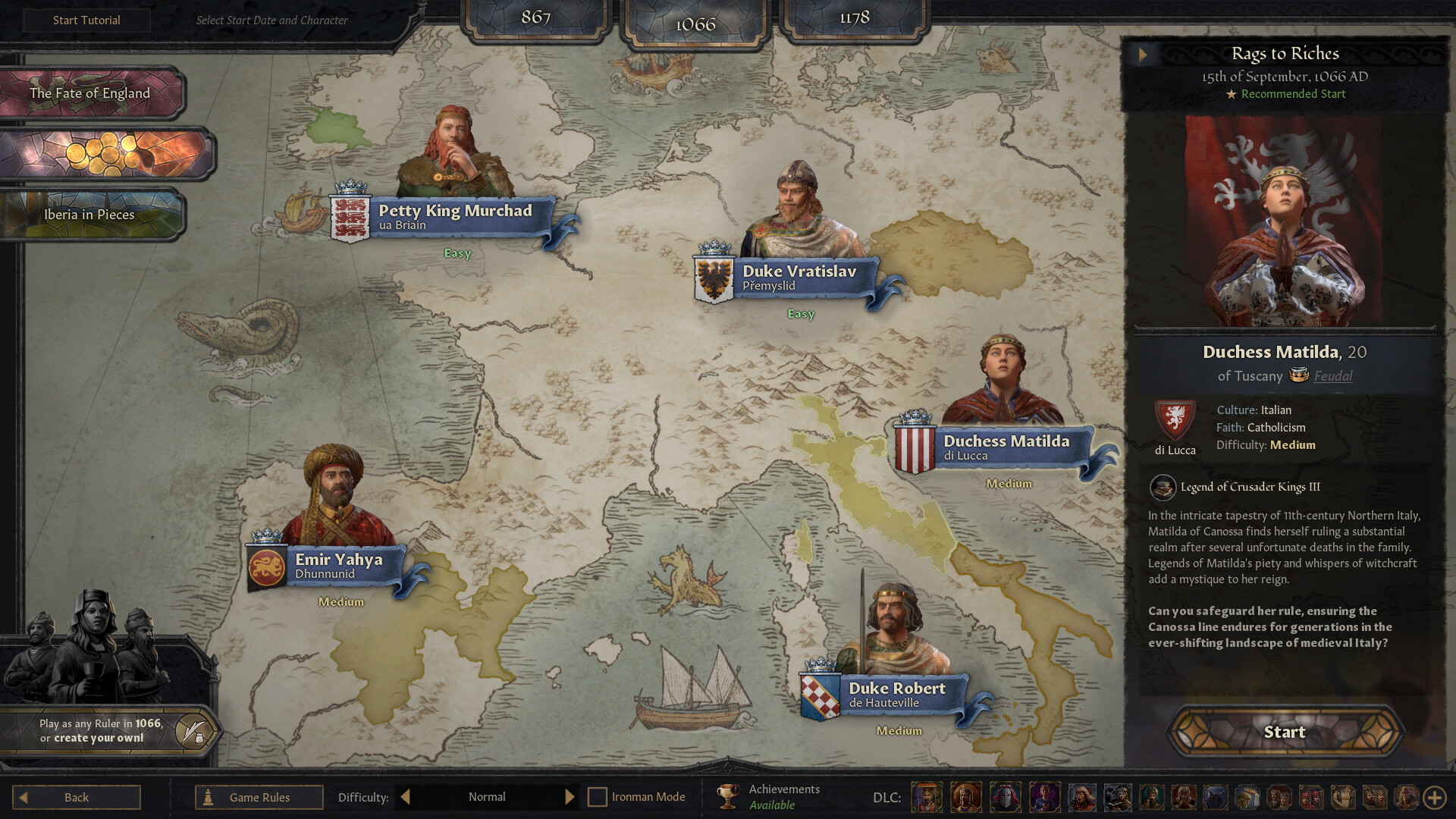
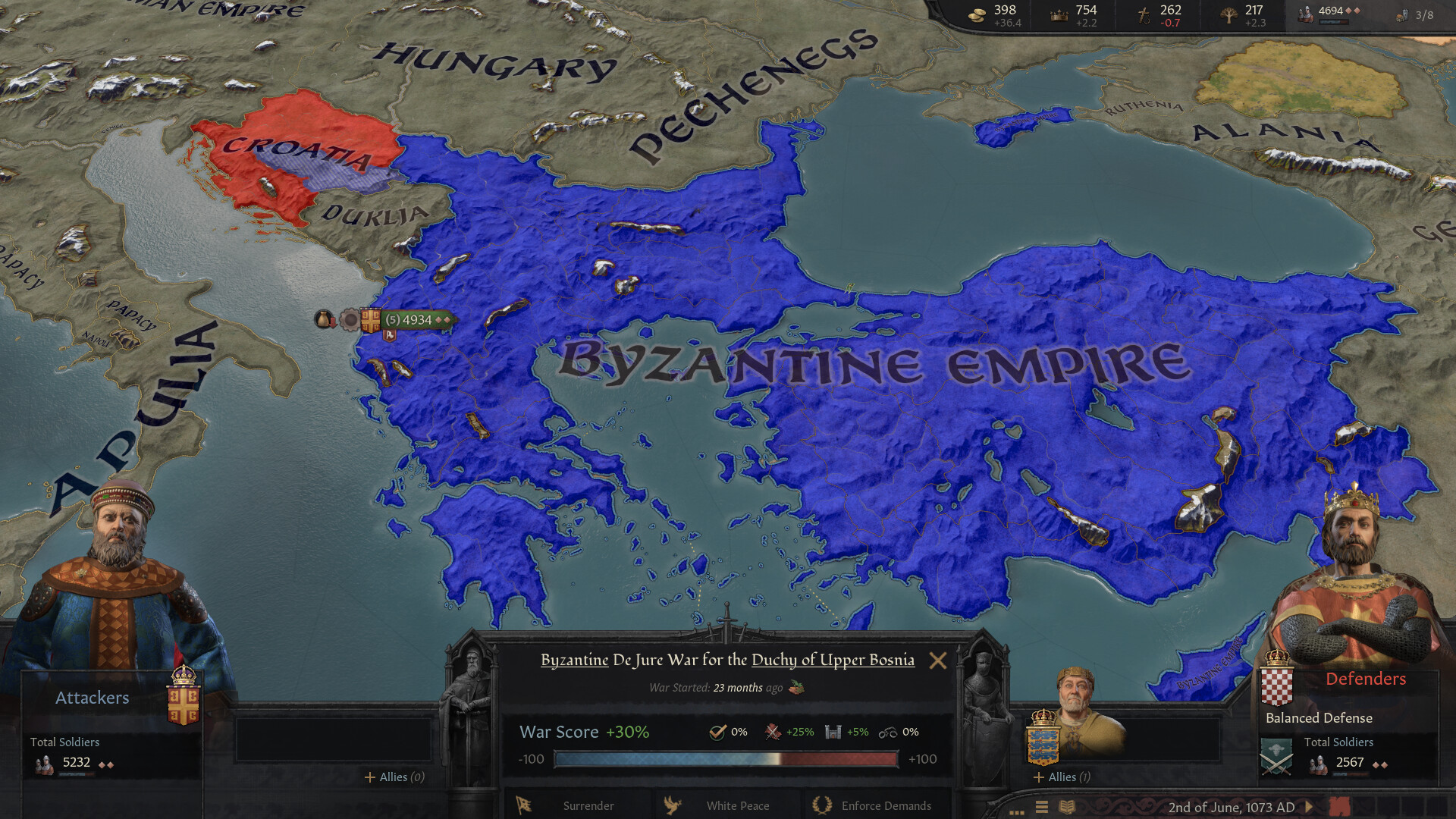

配置要求
最低配置
- 系统
- Windows® 10 Home 64 bit
- CPU
- Intel Core i5-750 | AMD FX 4300
- 内存
- 8 GB RAM
- 显卡
- NVIDIA GeForce GTX 660 | AMD Radeon HD 7870 | Intel Arc A310 | Intel Iris Plus G7 | AMD Radeon Vega 11
- 存储
- 20 GB available space
推荐配置
- 系统
- Windows® 10 Home 64 bit or Windows® 11
- CPU
- Intel Core i5-8400 | AMD Ryzen 5 1600X
- 内存
- 16 GB RAM
- 显卡
- NVIDIA GeForce GTX 970 | AMD Radeon RX 480 | Intel Arc A580
- 存储
- 20 GB available space
在线人数趋势(最近 7 天)
在线人数(7 天)
价格历史(90天)
游戏简介
坠入爱河、投身争斗、策划计谋、成就宏图伟业,在大战略游戏《Crusader Kings III》中书写你的贵族传承。死亡不过是下一场开始——在这个精彩纷呈、跃然纸上的中世纪模拟世界中,延续宗族血脉,谱写王朝史诗。
更新记录
Faith, Power, and the Medieval Church - A Crusader Kings III Documentary
In the latest episode of our ongoing documentary series, medieval historian Eleanor Janega explores the real history at the heart of our upcoming Core Expansion for Crusader Kings III: By God Alone.
Filmed inside one of London’s oldest medieval churches, this video enters a world where the Church did more than shape belief: it helped decide who held power, who could be challenged, and what counted as a rightful claim. For medieval rulers in Christendom, faith and politics were two sides of the same coin.
Filmed inside one of London’s oldest medieval churches, this video enters a world where the Church did more than shape belief: it helped decide who held power, who could be challenged, and what counted as a rightful claim. For medieval rulers in Christendom, faith and politics were two sides of the same coin.
Crusader Kings III × Dogecore: A Collection for the Chronically Medieval
Rule kingdoms. Wear the trauma.
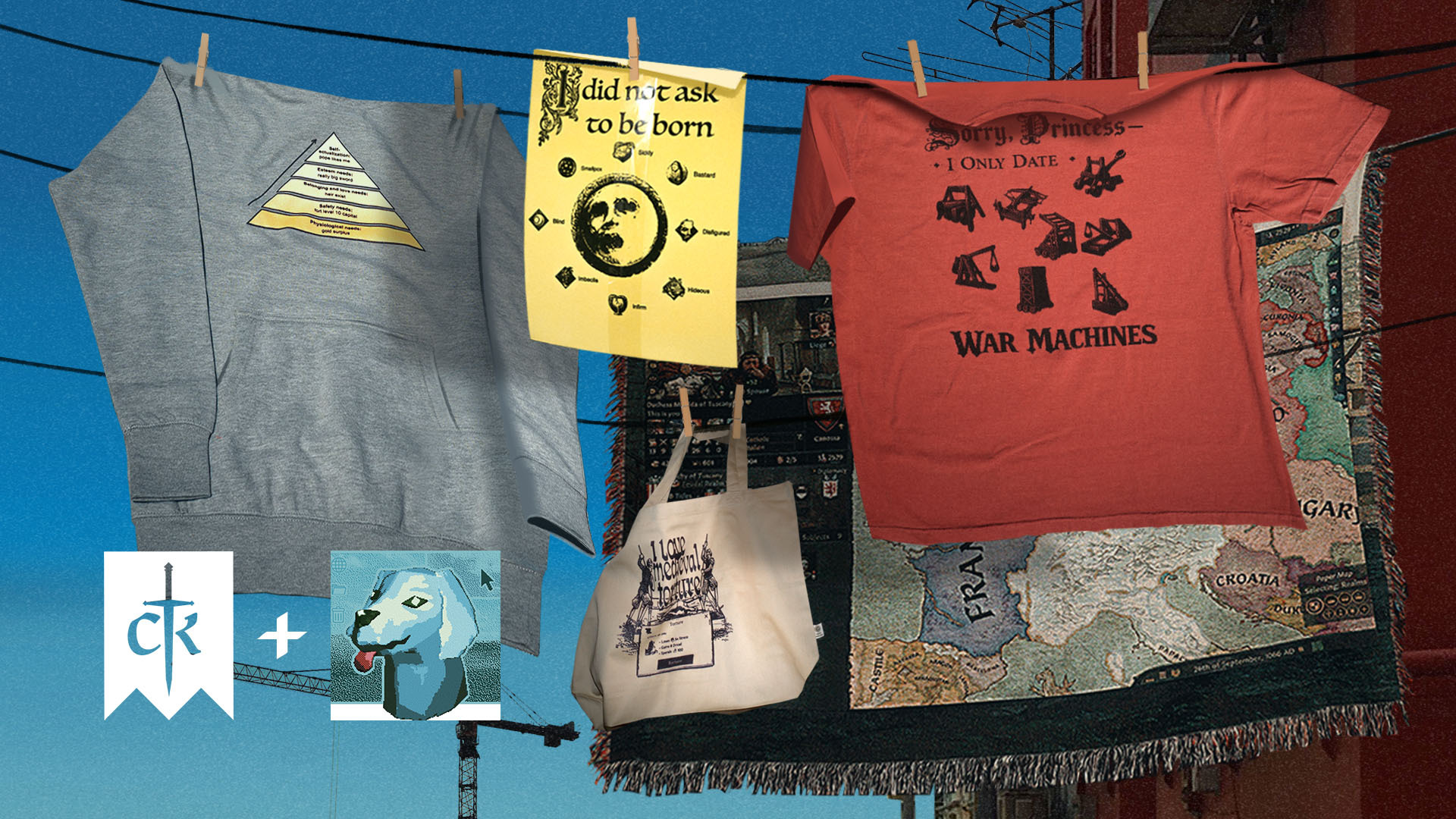
The medieval era wasn't pretty, and neither are you. Crusader Kings III has teamed up with Dogecore to bring you a collection that captures every glorious, cursed corner of the game you know and love.
From hoodies and tees to tote bags and posters, this drop is for the player who's lost an heir to smallpox, tortured a vassal into submission, and somehow still calls it a good Tuesday.
The collection features four original apparel designs:
•
Sorry, Princess — I Only Date War Machines. Because love is a siege engine.
•
Maslow's Hierarchy (CK3 Edition). Self-actualization is the Pope liking you. Physiological needs? Gold surplus. We don't make the rules.
•
I Did Not Ask To Be Born. Blind. Bastard. Imbecile. Hideous. At least you have the genes for it.
•
I Love Medieval Torture. The UI pop-up said it loses stress. You clicked the button. No further questions.
And for those who want to truly commit, the CK3 Woven Map Blanket brings the central europe part of the map to life in woven form, from France to the Holy Roman Empire to the edges of Poland. Wrap yourself in your empire. You've earned it. Probably through medieval shenanigans, but still.
Shop the collection at
https://pdxint.at/4gEkn3D
(By clicking this link you will be redirected to Dogecore's website. Dogecore is an independent retailer selling officially licensed Crusader Kings merchandise. Paradox Interactive is not responsible for Dogecore's website, its content, or its data practices.)
All negative traits. Zero regrets.
The medieval era wasn't pretty, and neither are you. Crusader Kings III has teamed up with Dogecore to bring you a collection that captures every glorious, cursed corner of the game you know and love.
From hoodies and tees to tote bags and posters, this drop is for the player who's lost an heir to smallpox, tortured a vassal into submission, and somehow still calls it a good Tuesday.
The collection features four original apparel designs:
•
Sorry, Princess — I Only Date War Machines. Because love is a siege engine.
•
Maslow's Hierarchy (CK3 Edition). Self-actualization is the Pope liking you. Physiological needs? Gold surplus. We don't make the rules.
•
I Did Not Ask To Be Born. Blind. Bastard. Imbecile. Hideous. At least you have the genes for it.
•
I Love Medieval Torture. The UI pop-up said it loses stress. You clicked the button. No further questions.
And for those who want to truly commit, the CK3 Woven Map Blanket brings the central europe part of the map to life in woven form, from France to the Holy Roman Empire to the edges of Poland. Wrap yourself in your empire. You've earned it. Probably through medieval shenanigans, but still.
Shop the collection at
https://pdxint.at/4gEkn3D
(By clicking this link you will be redirected to Dogecore's website. Dogecore is an independent retailer selling officially licensed Crusader Kings merchandise. Paradox Interactive is not responsible for Dogecore's website, its content, or its data practices.)
All negative traits. Zero regrets.
By God Alone Dev Diary #4 - Christian Church Situation
Greetings! You may remember me from the days of Khans of the Steppe, but today I am here to welcome you to another By God Alone dev diary.
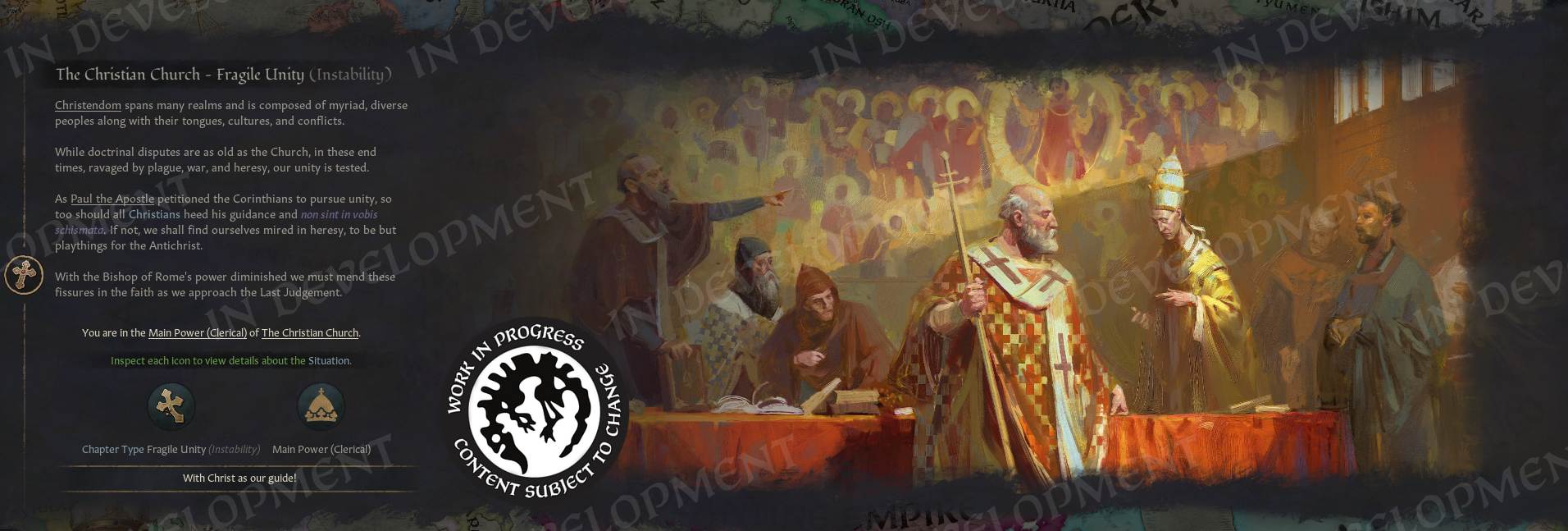
When we set out to rework how Christianity feels in Crusader Kings III, we kept returning to the same question: how do you make a thousand years of Church history feel alive in a sandbox, without turning every playthrough into the same timeline? Our answer is The Christian Church; a new Situation that tracks the spiritual health of Christendom across seven different Chapters.
Today we will walk you through how the Situation works: who participates, how Chapters change, what Catalysts push the Church forward, and what each era means for your ruler, both as a ecclesiastical government or not.
\
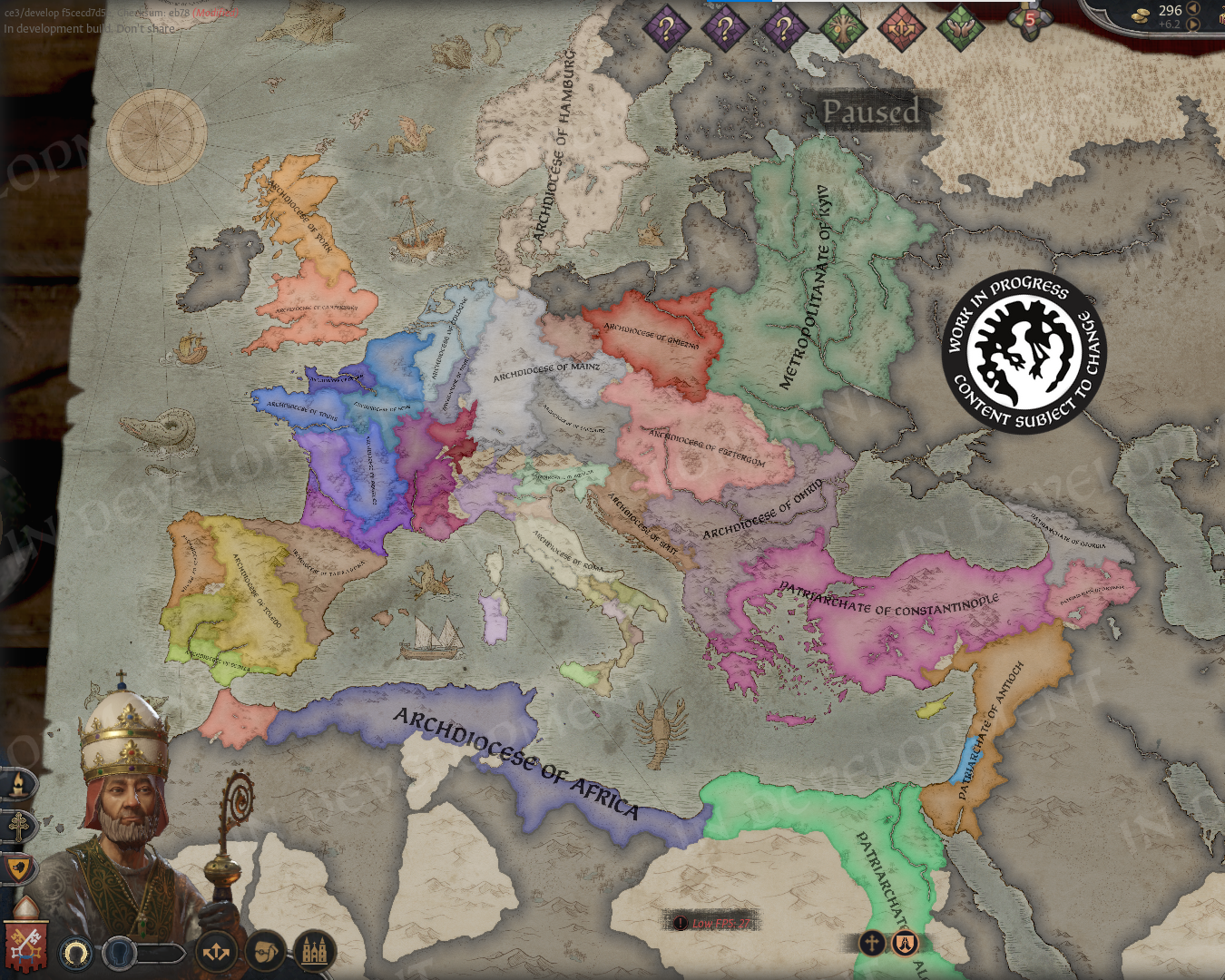
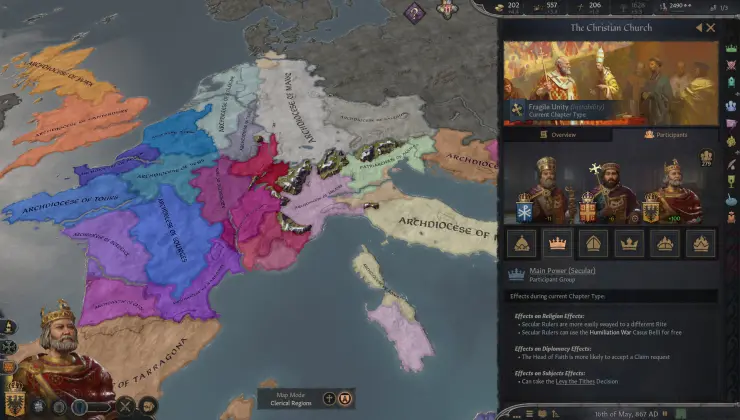
The Situation's sub-region is Christendom: the sum of every independent Christian realm whose lands fall within an archdiocese. The Church may become bigger or smaller as archdioceses are created, expanded, or split.
\
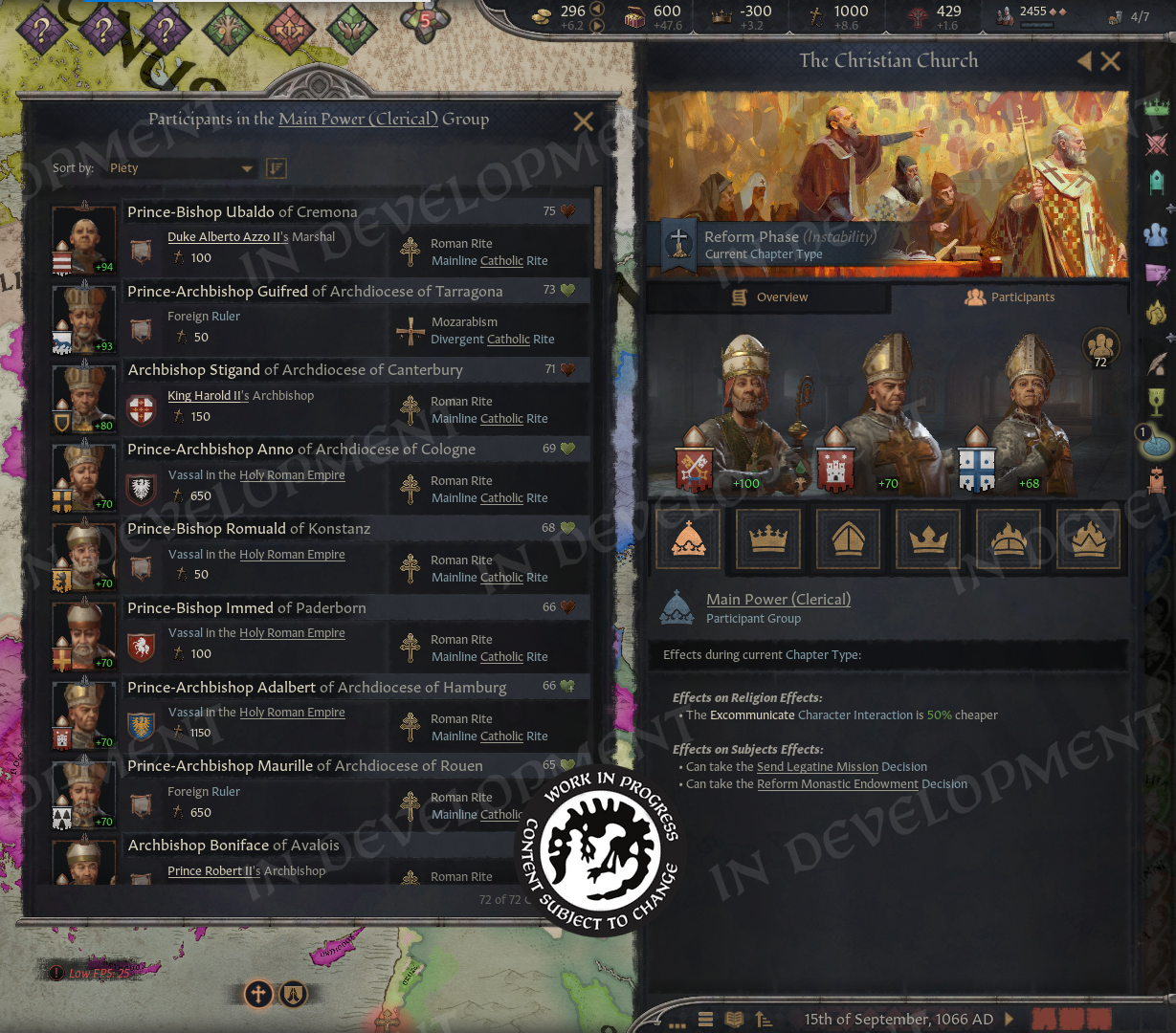
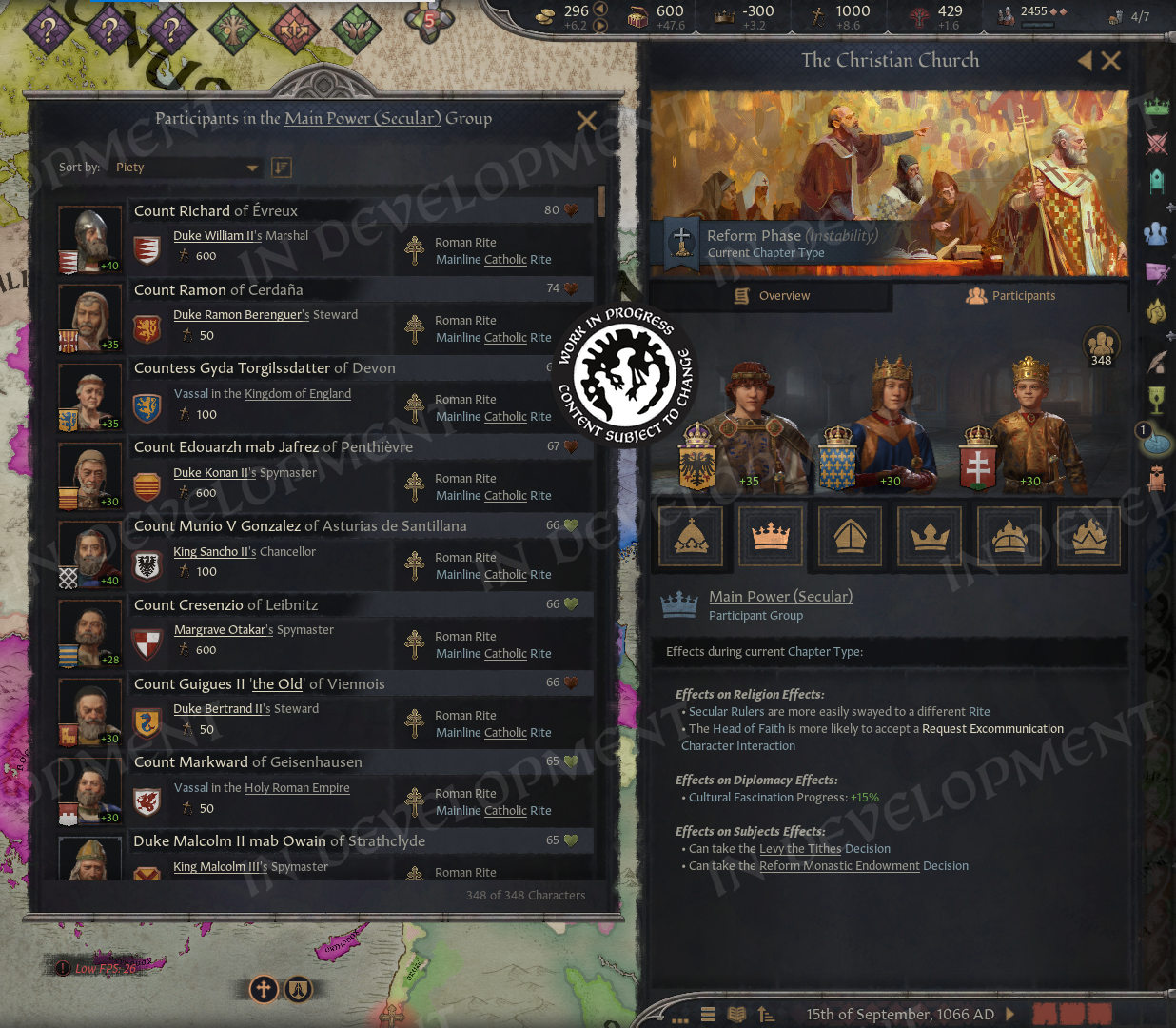
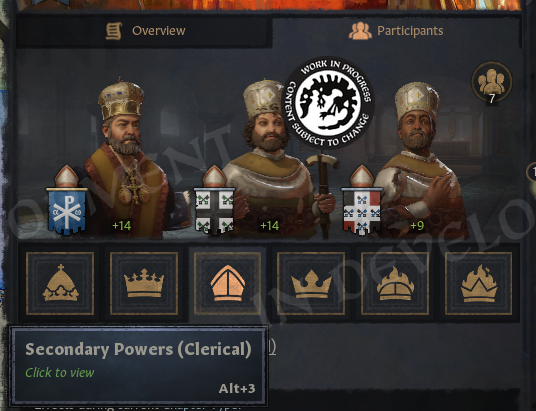
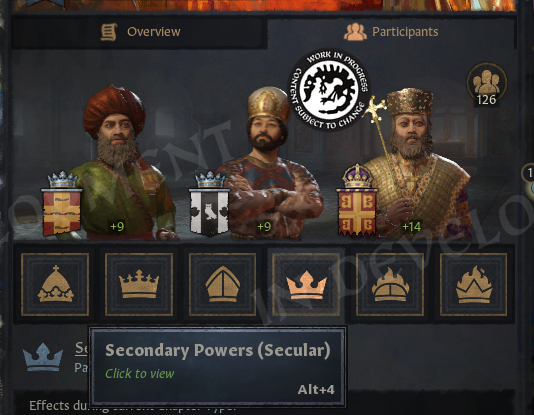
Not every Christian ruler experiences a Chapter (Situation Phase) the same way. Six participant groups split Christendom along three axes:
•
Clerical vs. Secular: are you an ecclesiastical or lay ruler?
•
Main Power vs. Secondary Powers: do you follow the Christian faith that currently holds the most counties in the world?
•
Ecumenical vs. Heretic: does your faith carry the ecumenical Christian doctrine, or are you a heretic?
The Main Power faith is dynamic. It is recalculated whenever county faith changes across Christendom, stored as a Situation variable and refreshed automatically. When the Main Power changes (say, if Catholic counties are overtaken by Orthodox ones) that shift can itself become a Catalyst, and it can instantly push the Church into the Reform Phase.
Orthodox, in this case, would become the Main Power in the Christian Church, and obtain all the benefits that rulers in that group have.
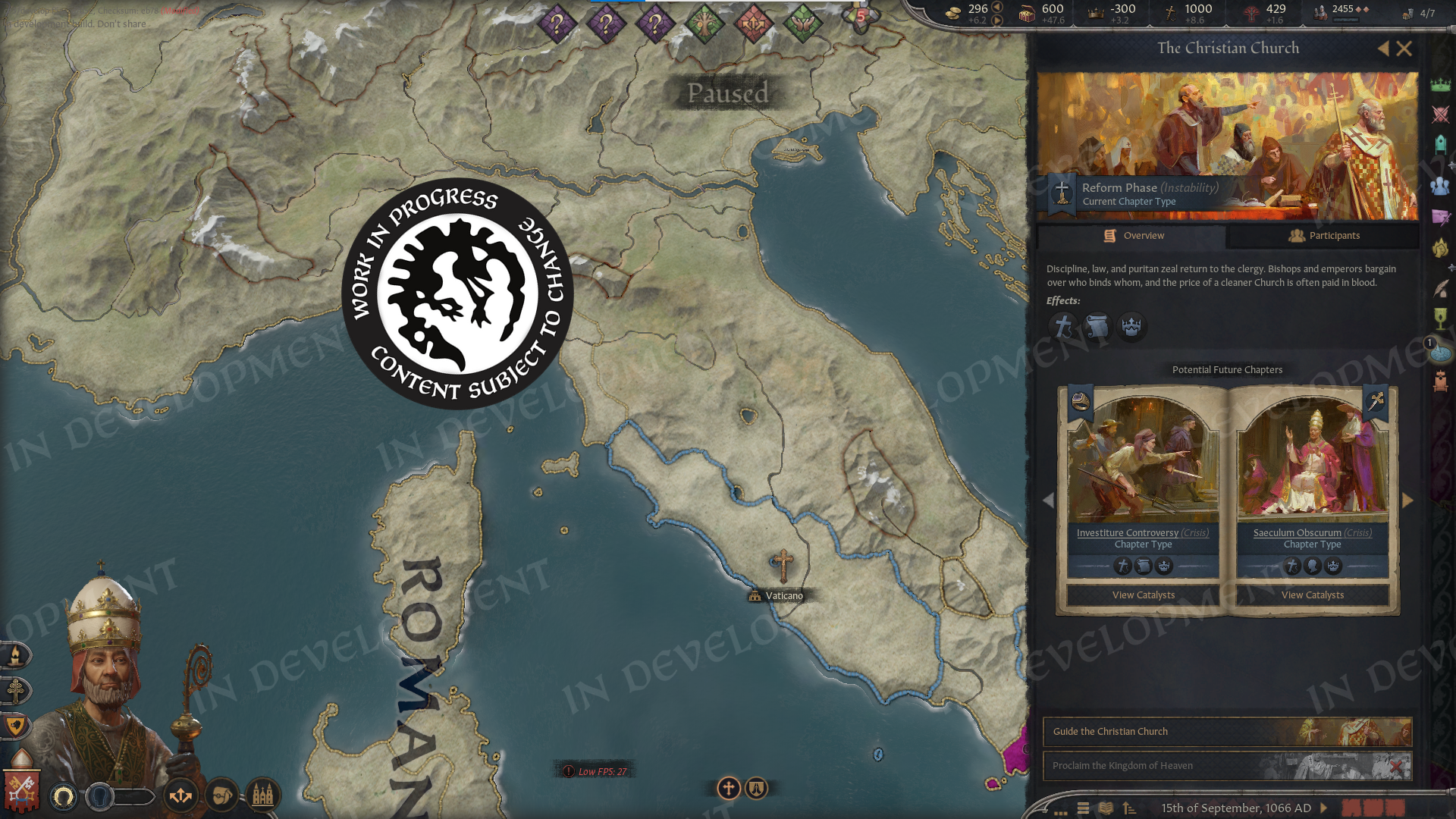
We call the Church's phases Chapters. There are seven in total, each named after a recognizable era of Church history. Every Chapter belongs to one of four Chapter Types, which tell you the broad tone of the era:
•
Instability. Rulers are easier to sway to rites, excommunications fly, and gold has a way of leaving the treasury.
•
Crisis. The Church at its most scorched. Indulgences are cheaper, Ecumenical Councils more frequent, taxes suffer and (depending on the phase) even clergy may be able to marry.
•
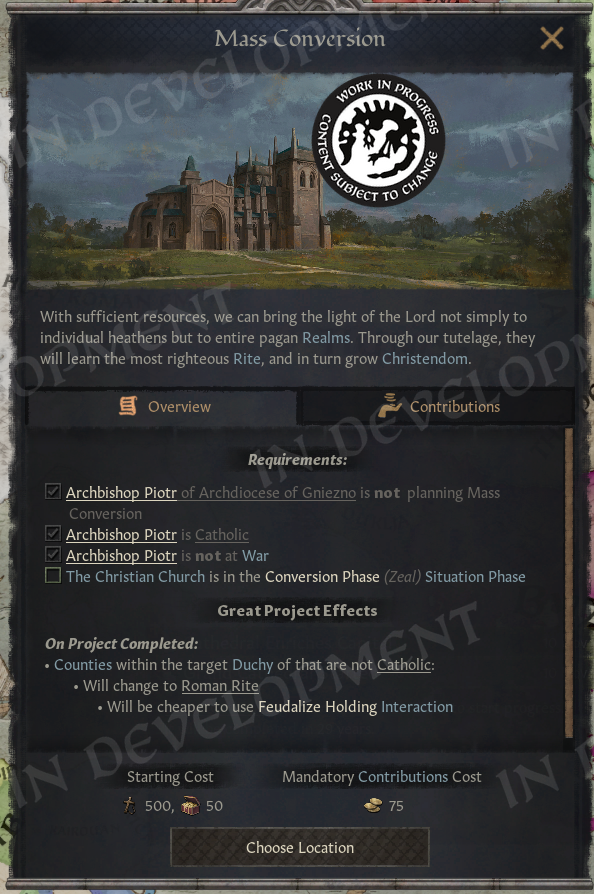
Zeal. Mass conversion, cheaper bulls (more on that later), holy wars, and easier faith conversion.
•
Stability. Grand Cathedrals rise faster, characters take vows more readily, and emperors may even try to mend the Great Schism.
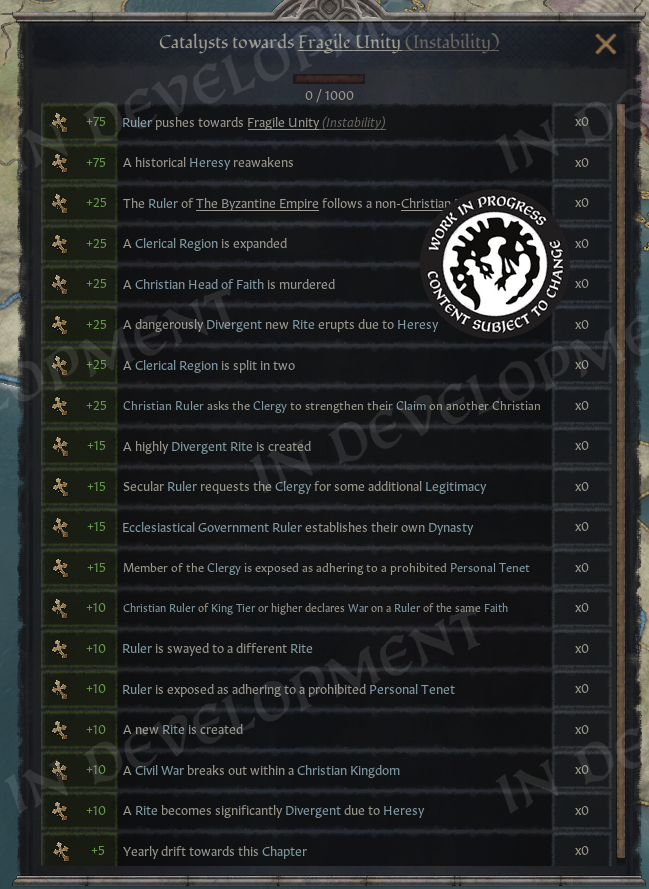
Fragile Unity (Instability)
The 867 opening Chapter. Secular rulers sway more easily between rites; Main Power secular rulers gain a free Humiliation casus belli and easier claim requests from their Head of Faith.
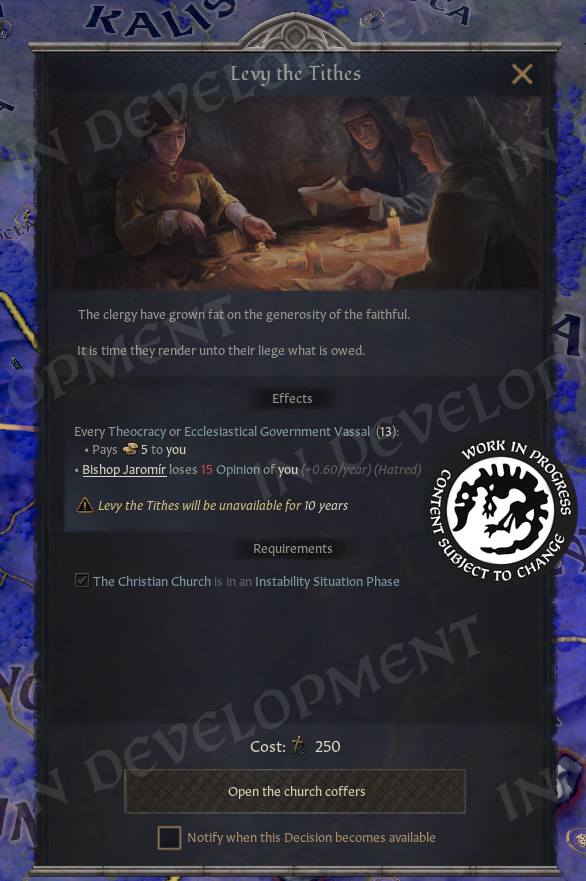
Clergy siphon treasury more effectively, and secular rulers of both Main and Secondary groups may Levy the Tithes through a dedicated decision to extract wealth from their ecclesiastical vassals (at risk of annoying the archbishop of your diocese).
Saeculum Obscurum (Crisis)
Crisis deepens. Ecumenical councils and indulgences are cheaper.
\
\
Unless players have already resolved the schism through dedicated decisions, the Great Schism is created automatically at this Chapter's close, cementing the east–west fracture that will define later centuries.
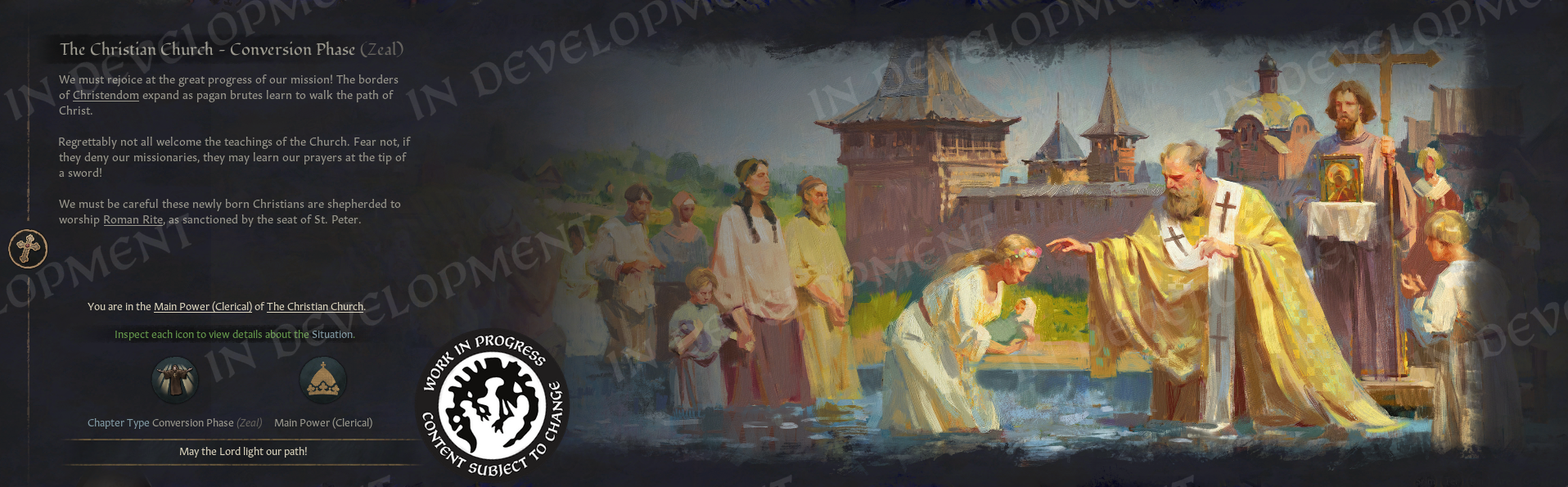
Conversion Phase (Zeal)
The Main Power faith converts counties 50% faster and finds character conversion easier; everyone else converts 25% slower.
Clergy gain an extra personal and hostile scheme slot; bulls are also half price.
\
Reform Phase (Instability)
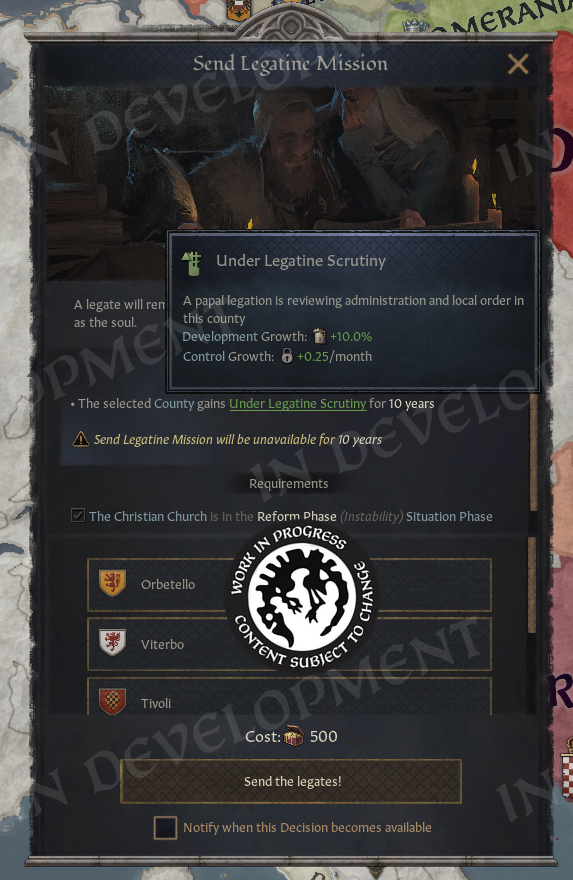
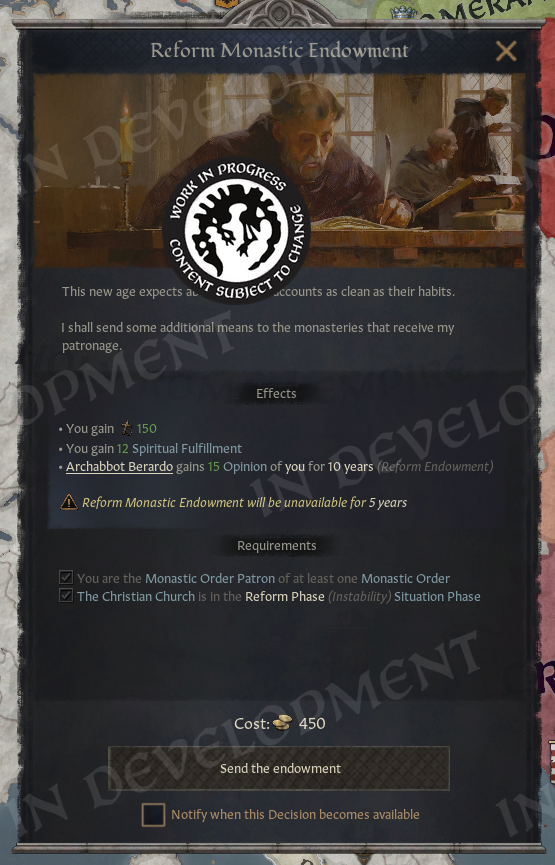
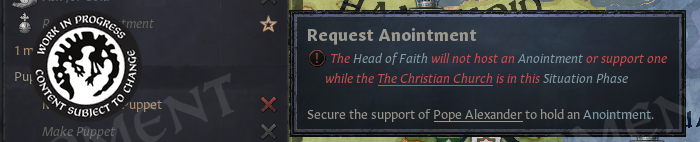
Excommunications are cheaper. Main Power secular rulers gain cultural head fascination.
\
\
Investiture Controversy (Crisis)
As in Saeculum Obscurum, secular rulers may appoint Court Chaplains without papal approval, but they're not the only ones willing to abuse their power…
\
Clerical appointment interactions are cheaper, secular rulers suffer accelerating county control decline and clerical rulers see reduced feudal tax contributions.
Crusade Phase (Zeal)
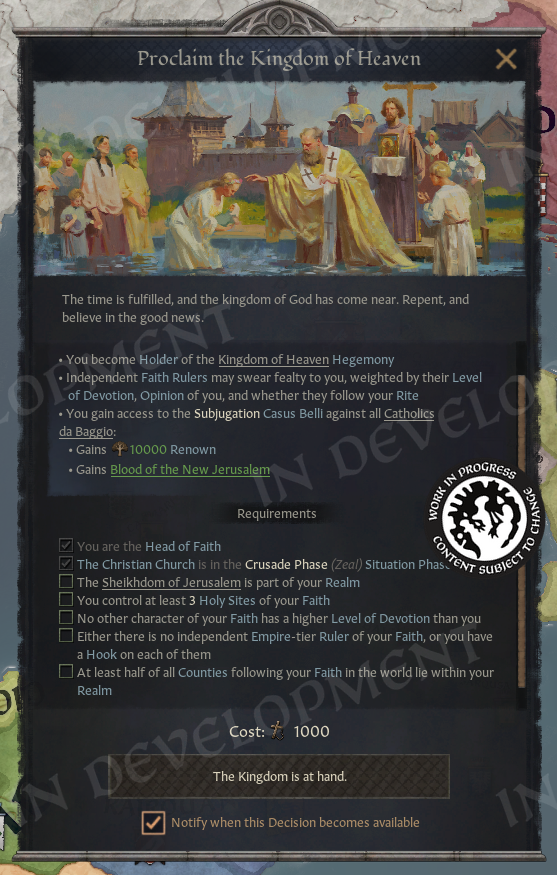
When this Chapter begins, every Christian faith's great holy war cooldown is cleared. Holy site pilgrimages grant learning experience. Hiring Holy Orders is cheaper, and so are bulls; secular rulers gain access to cheaper religious wars and cheaper men-at-arms recruitment.
And…
\
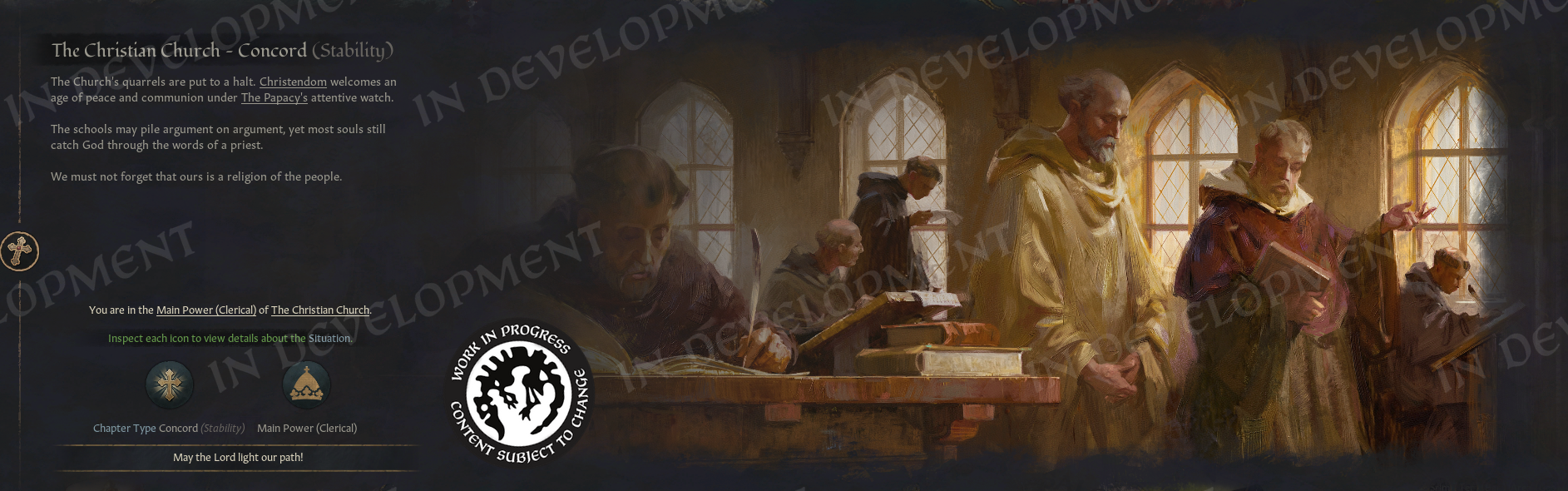
Concord (Stability)
Grand Cathedral construction is faster, characters accept taking vows more readily. Church and domicile building costs fall across the board.
Christian kings or emperors may try to mend the Great Schism, heretics may seek communion. Theocratic heir candidacy is boosted; heads of faith lift excommunications more willingly.
From any current Chapter, only a limited set of future Chapters is available, which are shown as clickable books in the Situation window. Each future Chapter accumulates progress through Catalysts. When a Chapter reaches 1,000 points, it takes over.
Catalysts can be triggered by any eligible Christian ruler, with no limit on how many times each one fires. They are wired into the everyday fabric of CK3: marriages, murders, wars, county conversions, ecumenical councils, pilgrimages, great project contributions, heresy outbreaks, and more.
Some specially important events can also accelerate the pace dramatically.
If the Catholic head of faith does not control the de jure capital of the Papal States while Christendom is in Fragile Unity, Saeculum Obscurum triggers immediately.
Likewise, a change in Main Power faith during Saeculum Obscurum can snap the Church straight into the Reform Phase.
Examples of Catalysts by theme:
•
Clerical scandal: simony, embezzlement, clergy marrying or having children, head of faith murdered or marrying.
•
Secular interference: imprisoning a head of faith, ecclesiastical grant claims, replacing realm priests, lay investiture disputes.
•
Religious changes in the land: county conversions to or from Christianity, new or divergent rites, heresy outbreaks, clerical regions created or split.
•
War and holy sites: Jerusalem lost or reclaimed, great holy wars won or declared against Christians, humiliation wars, excommunication wars.
•
Shows of devotion: pilgrimages completed, cathedrals built, ecumenical councils hosted, mass rite conversion great projects.
•
Deliberate steering: the Guide the Christian Church decision is available to pious, learned, or powerful rulers every ten years at major piety cost. Choose which future Chapter you wish to push toward, and fire a massive Catalyst (+75 points) in that direction.
\
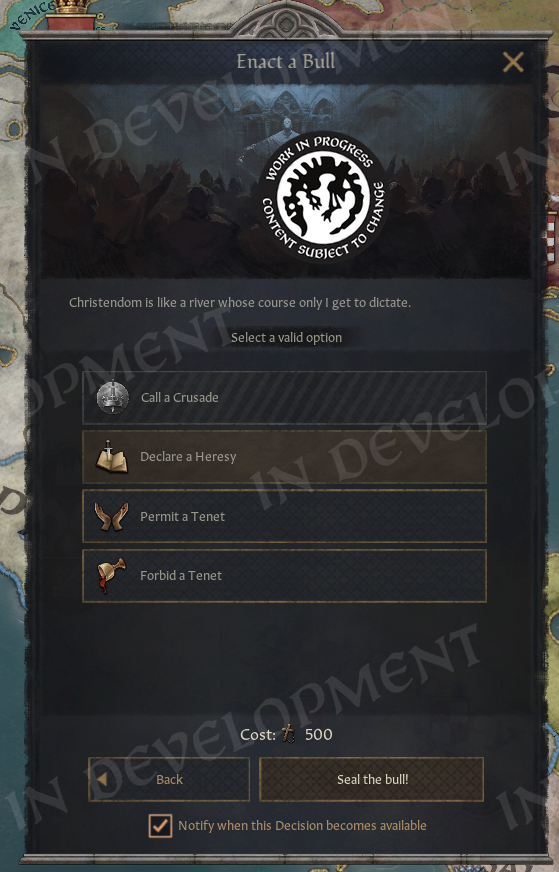
Bulls are the formal instrument by which the Bishop of Rome reshapes the faith without waiting for a council, a war, or a century of drift. They are one of the most direct ways a Catholic head of faith can steer the Church.
\
Servant of the Servants of God
Only the Catholic head of faith may take the Enact a Bull decision. You must hold your head-of-faith title and have at least Limited Church Authority (or higher) as a realm law. The decision costs a major amount of piety and carries a five-year cooldown, so each bull should feel deliberate.
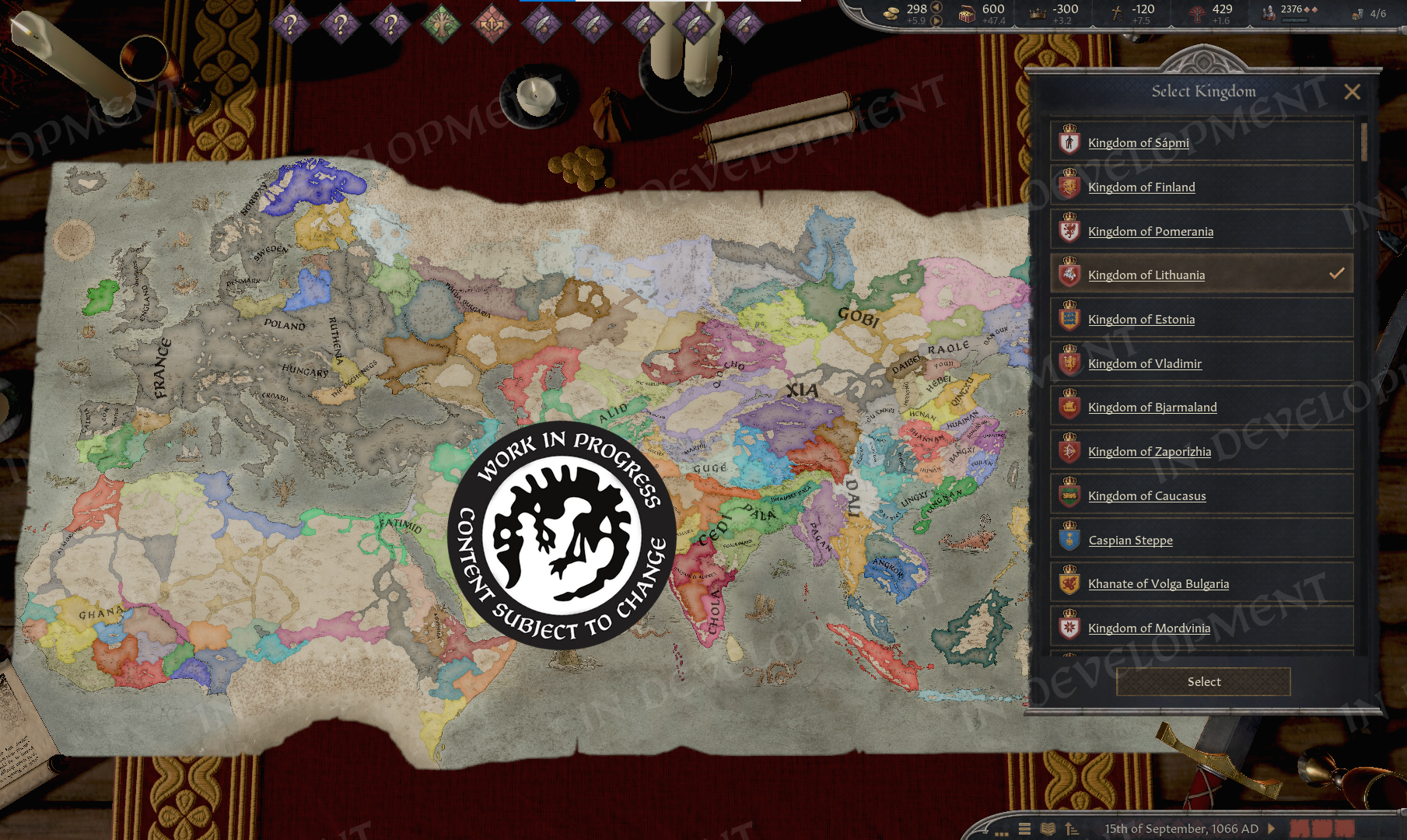
When you enact a bull, you first choose its purpose from four options. Each leads into a follow-up step: picking a crusade target on the map, selecting a rite to condemn, or choosing a tenet to permit or forbid.
Every ruler of the faith then receives a letter notification, so the realm knows what Rome has decreed.
Call a Crusade
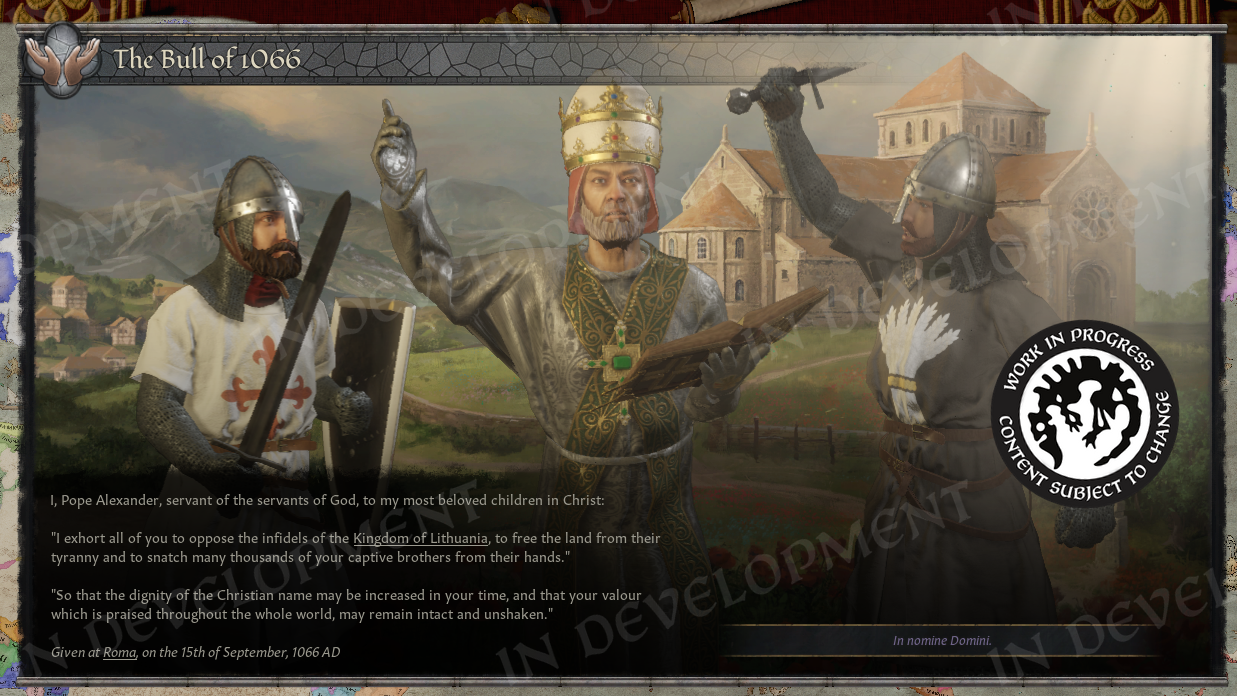
The most dramatic bull. The Pope selects a hostile kingdom on the map as the target of a Great Holy War, then proclaims the crusade. The faith must already allow great holy wars, have a spiritual head, hold at least 60 fervor, and have no GHW already in progress. Of course, there must also be a valid hostile kingdom to target.
\
Normally, calling a crusade by bull requires High Church Authority or better. During the Crusade Phase of the Christian Church Situation, that requirement is waived: when Christendom is already ablaze with crusading fervor, the Pope may call the cross even under looser church authority.
\
Declare a Heresy
When a rite within Catholicism has diverged far enough from the main rite, the Pope may issue a bull condemning it. The condemned rite becomes a new heretical faith, its head is branded a Heresiarch, and ecumenical status is stripped.
Catholic fervor rises; rulers of the condemned rite receive a letter and may choose to convert to the Pope’s rite rather than remain under anathema.
Permit a Tenet
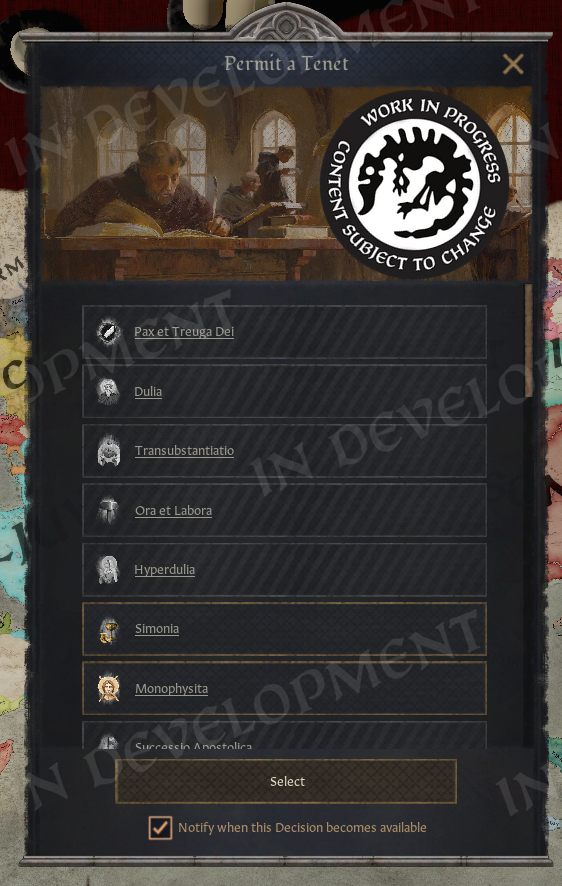
The Pope may elevate a known tenet from obscurity to permitted status within the rite, opening new doctrinal room for the faithful. The faith pays for flexibility with a significant fervor loss.
\
Forbid a Tenet
The reverse: a tenet is declared prohibited, tightening doctrine and granting a notable fervor gain as the Church reaffirms its boundaries.
We hope you enjoy steering (or surviving) the Chapters of Christendom.
As always, we look forward to your feedback (and do keep in mind that extra effects and/or catalysts may still get added)
When we set out to rework how Christianity feels in Crusader Kings III, we kept returning to the same question: how do you make a thousand years of Church history feel alive in a sandbox, without turning every playthrough into the same timeline? Our answer is The Christian Church; a new Situation that tracks the spiritual health of Christendom across seven different Chapters.
Today we will walk you through how the Situation works: who participates, how Chapters change, what Catalysts push the Church forward, and what each era means for your ruler, both as a ecclesiastical government or not.
\
The Situation's sub-region is Christendom: the sum of every independent Christian realm whose lands fall within an archdiocese. The Church may become bigger or smaller as archdioceses are created, expanded, or split.
\
Not every Christian ruler experiences a Chapter (Situation Phase) the same way. Six participant groups split Christendom along three axes:
•
Clerical vs. Secular: are you an ecclesiastical or lay ruler?
•
Main Power vs. Secondary Powers: do you follow the Christian faith that currently holds the most counties in the world?
•
Ecumenical vs. Heretic: does your faith carry the ecumenical Christian doctrine, or are you a heretic?
The Main Power faith is dynamic. It is recalculated whenever county faith changes across Christendom, stored as a Situation variable and refreshed automatically. When the Main Power changes (say, if Catholic counties are overtaken by Orthodox ones) that shift can itself become a Catalyst, and it can instantly push the Church into the Reform Phase.
Orthodox, in this case, would become the Main Power in the Christian Church, and obtain all the benefits that rulers in that group have.
We call the Church's phases Chapters. There are seven in total, each named after a recognizable era of Church history. Every Chapter belongs to one of four Chapter Types, which tell you the broad tone of the era:
•
Instability. Rulers are easier to sway to rites, excommunications fly, and gold has a way of leaving the treasury.
•
Crisis. The Church at its most scorched. Indulgences are cheaper, Ecumenical Councils more frequent, taxes suffer and (depending on the phase) even clergy may be able to marry.
•
Zeal. Mass conversion, cheaper bulls (more on that later), holy wars, and easier faith conversion.
•
Stability. Grand Cathedrals rise faster, characters take vows more readily, and emperors may even try to mend the Great Schism.
Fragile Unity (Instability)
The 867 opening Chapter. Secular rulers sway more easily between rites; Main Power secular rulers gain a free Humiliation casus belli and easier claim requests from their Head of Faith.
Clergy siphon treasury more effectively, and secular rulers of both Main and Secondary groups may Levy the Tithes through a dedicated decision to extract wealth from their ecclesiastical vassals (at risk of annoying the archbishop of your diocese).
Saeculum Obscurum (Crisis)
Crisis deepens. Ecumenical councils and indulgences are cheaper.
\
\
Unless players have already resolved the schism through dedicated decisions, the Great Schism is created automatically at this Chapter's close, cementing the east–west fracture that will define later centuries.
Conversion Phase (Zeal)
The Main Power faith converts counties 50% faster and finds character conversion easier; everyone else converts 25% slower.
Clergy gain an extra personal and hostile scheme slot; bulls are also half price.
\
Reform Phase (Instability)
Excommunications are cheaper. Main Power secular rulers gain cultural head fascination.
\
\
Investiture Controversy (Crisis)
As in Saeculum Obscurum, secular rulers may appoint Court Chaplains without papal approval, but they're not the only ones willing to abuse their power…
\
Clerical appointment interactions are cheaper, secular rulers suffer accelerating county control decline and clerical rulers see reduced feudal tax contributions.
Crusade Phase (Zeal)
When this Chapter begins, every Christian faith's great holy war cooldown is cleared. Holy site pilgrimages grant learning experience. Hiring Holy Orders is cheaper, and so are bulls; secular rulers gain access to cheaper religious wars and cheaper men-at-arms recruitment.
And…
\
Concord (Stability)
Grand Cathedral construction is faster, characters accept taking vows more readily. Church and domicile building costs fall across the board.
Christian kings or emperors may try to mend the Great Schism, heretics may seek communion. Theocratic heir candidacy is boosted; heads of faith lift excommunications more willingly.
From any current Chapter, only a limited set of future Chapters is available, which are shown as clickable books in the Situation window. Each future Chapter accumulates progress through Catalysts. When a Chapter reaches 1,000 points, it takes over.
Catalysts can be triggered by any eligible Christian ruler, with no limit on how many times each one fires. They are wired into the everyday fabric of CK3: marriages, murders, wars, county conversions, ecumenical councils, pilgrimages, great project contributions, heresy outbreaks, and more.
Some specially important events can also accelerate the pace dramatically.
If the Catholic head of faith does not control the de jure capital of the Papal States while Christendom is in Fragile Unity, Saeculum Obscurum triggers immediately.
Likewise, a change in Main Power faith during Saeculum Obscurum can snap the Church straight into the Reform Phase.
Examples of Catalysts by theme:
•
Clerical scandal: simony, embezzlement, clergy marrying or having children, head of faith murdered or marrying.
•
Secular interference: imprisoning a head of faith, ecclesiastical grant claims, replacing realm priests, lay investiture disputes.
•
Religious changes in the land: county conversions to or from Christianity, new or divergent rites, heresy outbreaks, clerical regions created or split.
•
War and holy sites: Jerusalem lost or reclaimed, great holy wars won or declared against Christians, humiliation wars, excommunication wars.
•
Shows of devotion: pilgrimages completed, cathedrals built, ecumenical councils hosted, mass rite conversion great projects.
•
Deliberate steering: the Guide the Christian Church decision is available to pious, learned, or powerful rulers every ten years at major piety cost. Choose which future Chapter you wish to push toward, and fire a massive Catalyst (+75 points) in that direction.
\
Bulls are the formal instrument by which the Bishop of Rome reshapes the faith without waiting for a council, a war, or a century of drift. They are one of the most direct ways a Catholic head of faith can steer the Church.
\
Servant of the Servants of God
Only the Catholic head of faith may take the Enact a Bull decision. You must hold your head-of-faith title and have at least Limited Church Authority (or higher) as a realm law. The decision costs a major amount of piety and carries a five-year cooldown, so each bull should feel deliberate.
When you enact a bull, you first choose its purpose from four options. Each leads into a follow-up step: picking a crusade target on the map, selecting a rite to condemn, or choosing a tenet to permit or forbid.
Every ruler of the faith then receives a letter notification, so the realm knows what Rome has decreed.
Call a Crusade
The most dramatic bull. The Pope selects a hostile kingdom on the map as the target of a Great Holy War, then proclaims the crusade. The faith must already allow great holy wars, have a spiritual head, hold at least 60 fervor, and have no GHW already in progress. Of course, there must also be a valid hostile kingdom to target.
\
Normally, calling a crusade by bull requires High Church Authority or better. During the Crusade Phase of the Christian Church Situation, that requirement is waived: when Christendom is already ablaze with crusading fervor, the Pope may call the cross even under looser church authority.
\
Declare a Heresy
When a rite within Catholicism has diverged far enough from the main rite, the Pope may issue a bull condemning it. The condemned rite becomes a new heretical faith, its head is branded a Heresiarch, and ecumenical status is stripped.
Catholic fervor rises; rulers of the condemned rite receive a letter and may choose to convert to the Pope’s rite rather than remain under anathema.
Permit a Tenet
The Pope may elevate a known tenet from obscurity to permitted status within the rite, opening new doctrinal room for the faithful. The faith pays for flexibility with a significant fervor loss.
\
Forbid a Tenet
The reverse: a tenet is declared prohibited, tightening doctrine and granting a notable fervor gain as the Church reaffirms its boundaries.
We hope you enjoy steering (or surviving) the Chapters of Christendom.
As always, we look forward to your feedback (and do keep in mind that extra effects and/or catalysts may still get added)






Crusader Kings III - By God Alone expansion coming September 30
Crusader Kings III from Paradox Interactive is set to get even bigger, with the By God Alone expansion coming September 30th bringing new ways to play.
Read the full article here: https://www.gamingonlinux.com/2026/06/crusader-kings-iii-by-god-alone-expansion-coming-september-30/
Read the full article here: https://www.gamingonlinux.com/2026/06/crusader-kings-iii-by-god-alone-expansion-coming-september-30/
The next Crusader Kings 3 expansion is finally giving religion a complete makeover
I certainly wouldn't accuse Crusader Kings 3 of feeling shallow; Paradox's medieval grand strategy game continues to spawn fresh tales of political intrigue and family drama almost six years on from launch. One aspect core to the era that has always felt ripe for expansion, however, is the way it handles religion and faith, and it's finally time for developer Paradox to do just that. New Crusader Kings 3 DLC By God Alone promises many more ways that belief systems can influence your journey through the ages, and even lets you step into the Papacy for yourself.
Read the full story on PCGamesN: The next Crusader Kings 3 expansion is finally giving religion a complete makeover
Read the full story on PCGamesN: The next Crusader Kings 3 expansion is finally giving religion a complete makeover

Crusader Kings III: By God Alone - Available September 30th
Navigate through a medieval era with a rich religious life in Crusader Kings III: By God Alone, our latest Core Expansion releasing on September 30th! Wrestle with sin as your rulers try to live up to the tenets of their faith and tangle with church authorities who have power on earth, as well as heaven. Instigate or settle religious debates, negotiate the limits of crown and Papal authority, and ponder the afterlife.
Coming to Crusader Kings III in By God Alone:
•
Playable Theocracies
•
Take control of landed realms headed by an archbishop or even the Pope himself. As the Papacy, new resources of power and wealth will be at your disposal.
•
The Christian “Situation”
•
A new persistent Situation for Christian realms, allowing actions and decisions connected to the development and progress of the Faith.You can participate in Ecumenical Councils to decide on religious tenets and beliefs.
•
Rites & Heresies
•
Religious rites that diverge too much from the standard Faith steal power and wealth from the Church and may be declared heretical, forcing you to either conform or rebel.
•
The Great Schism
•
In the 867 game start, the Christian church will eventually reach a crossroads for the faith. This can result in the Great Schism, separating Western Catholicism from Eastern Orthodoxy.
•
Monastic Holy Orders
•
Centers of both research and theological power, Monastic Holy Orders offer potent bonuses to those who host their headquarters. Chief among their offerings is spiritual fulfilment, for their prayers protect secular rulers from eternal damnation.
•
Changes to Religious Tenets
•
Revisions to the tenet system in Crusader Kings III now center characters’ relationships to their faith and what is appropriate behavior within that faith. Follow heretical beliefs that push the boundary of what is accepted or have your personal preferences adopted and accepted through internal church politics.
•
Spiritual Fulfilment system
•
Traits, actions and religious tenets work together to paint portraits of characters’ inner spirit and spiritual life. Sinful or virtuous actions are not merely a concern for stress, but can also affect relationships with God and concerns about the afterlife.
•
Archdioceses
•
New clerical titles that have religious authority over a geographical region independent of the secular rulers' lands.
•
College of Cardinals
•
The Pope can appoint cardinals across Christendom. But, the struggle between secular and religious authority never ends - secular rulers can use their power to influence the appointment of Cardinals and the direction of the Church.
•
Dynamic Holy Sites
•
Faiths can now dynamically change their holy sites as they grow and change over time.
•
Cathedrals
•
Cathedrals can become the focal point for reverence of specific saints or other holy figures, leading to them becoming Holy Sites.
•
Puppets
•
In order to interact with the political machinery of the church, secular rulers will be able to puppet clerical characters so they can act on their behalf.
•
And more!
You can pre-purchase now as part of Crusader Kings III: Chapter V and receive By God Alone instantly when it releases, or pick up the core expansion on its own on September 30th.
Coming to Crusader Kings III in By God Alone:
•
Playable Theocracies
•
Take control of landed realms headed by an archbishop or even the Pope himself. As the Papacy, new resources of power and wealth will be at your disposal.
•
The Christian “Situation”
•
A new persistent Situation for Christian realms, allowing actions and decisions connected to the development and progress of the Faith.You can participate in Ecumenical Councils to decide on religious tenets and beliefs.
•
Rites & Heresies
•
Religious rites that diverge too much from the standard Faith steal power and wealth from the Church and may be declared heretical, forcing you to either conform or rebel.
•
The Great Schism
•
In the 867 game start, the Christian church will eventually reach a crossroads for the faith. This can result in the Great Schism, separating Western Catholicism from Eastern Orthodoxy.
•
Monastic Holy Orders
•
Centers of both research and theological power, Monastic Holy Orders offer potent bonuses to those who host their headquarters. Chief among their offerings is spiritual fulfilment, for their prayers protect secular rulers from eternal damnation.
•
Changes to Religious Tenets
•
Revisions to the tenet system in Crusader Kings III now center characters’ relationships to their faith and what is appropriate behavior within that faith. Follow heretical beliefs that push the boundary of what is accepted or have your personal preferences adopted and accepted through internal church politics.
•
Spiritual Fulfilment system
•
Traits, actions and religious tenets work together to paint portraits of characters’ inner spirit and spiritual life. Sinful or virtuous actions are not merely a concern for stress, but can also affect relationships with God and concerns about the afterlife.
•
Archdioceses
•
New clerical titles that have religious authority over a geographical region independent of the secular rulers' lands.
•
College of Cardinals
•
The Pope can appoint cardinals across Christendom. But, the struggle between secular and religious authority never ends - secular rulers can use their power to influence the appointment of Cardinals and the direction of the Church.
•
Dynamic Holy Sites
•
Faiths can now dynamically change their holy sites as they grow and change over time.
•
Cathedrals
•
Cathedrals can become the focal point for reverence of specific saints or other holy figures, leading to them becoming Holy Sites.
•
Puppets
•
In order to interact with the political machinery of the church, secular rulers will be able to puppet clerical characters so they can act on their behalf.
•
And more!
You can pre-purchase now as part of Crusader Kings III: Chapter V and receive By God Alone instantly when it releases, or pick up the core expansion on its own on September 30th.
Crusader Kings 3 devs Paradox will make the roaming mercenary lifestyle of playing as a landless adventurer free for everyone later this year
While Crusader Kings 3 typically deals in the fantasy of sitting on a big chair in one place and shouting at underlings, roaming its world as a the unlanded leader of a band of travelling adventurers is just as fun and arguably the best way to kick off a custom dynasty. Up to now, the freedom to pursue the life of a ruthless mercenary, valiant knight, or stuffy bureaucrat surviving off of favours for rulers while searching for the ideal title or throne to claim as their own once they're ready has been locked behind 2024's Roads to Power expansion. Thankfully, Paradox plan to whisk it out from behind that curtain and make it a free part of the base game later this year.
Read more
Read more
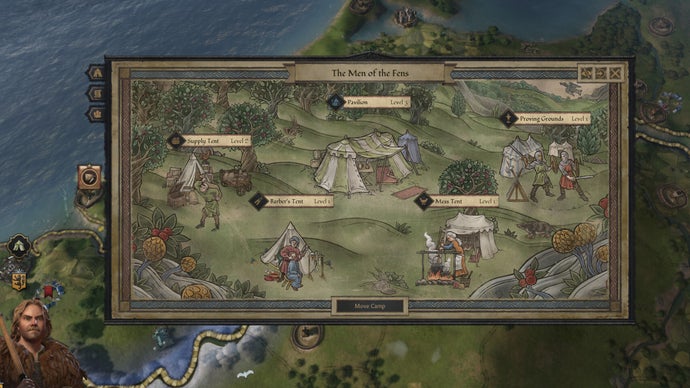
Dev Diary #203 - Adventurer Changes
Greetings! Alexander Oltner here, Game Director for Crusader Kings III. Today's diary is a little different from our recent ones, in that it's not about a new mechanic we're building for an expansion, but about something we've already made.
So, let's talk about Landless Adventurers!
When we first designed Landless Adventurers, we envisioned them as a transition state, something you'd hop into for a bit and then hop back out of. A deposed ruler licking their wounds, a dynasty member off making their name before claiming a title, a brief interlude between two different, landed lives. We included them as a tertiary feature in Roads to Power with exactly that in mind.
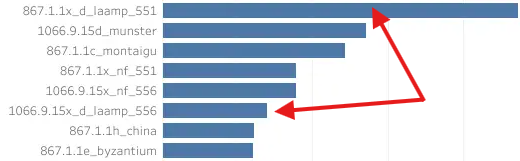
Well, we underestimated how powerful the player fantasy of working your way up from nothing ultimately was. The Adventurer playstyle has resonated with players far beyond what we expected, and we've been very pleasantly surprised by it: a custom 867-start Landless Adventurer is now the single most popular campaign starting point, by a significant margin.
\
That success does present a problem however, and to explain why, it helps to share how we think about DLC.
A healthy base game is the foundation everything else rests on. It should be complete and satisfying in its own right, the version of Crusader Kings III we'd be perfectly happy for a brand-new player to pick up cold. Expansions, in turn, are for going deeper on the aspects of the game you already enjoy, never something you feel you have to buy just to have a whole game. That distinction matters a great deal to us.
It's a balance we keep an eye on, and we weigh it case by case. Every so often a piece of content stops feeling like an enhancement and starts feeling like a prerequisite, and when that happens we ask ourselves whether something needs to change.
In the specific case of Landless Adventurers, we think it does. They've become popular enough that many new players buy the game expecting them to be there, and truth be told: we’d like that too!
So we're addressing it head-on: with the release of Silk & Silver later this year, the Landless Adventurer character type is moving into the base game, free for everyone. This rectifies the situation and puts a feature that players consider a core part of the experience where it belongs: in the core.
There's a second benefit, and it's just as important to us. By decoupling Adventurers from Roads to Power, we remove the rigidity that comes from them being packaged alongside a specific, thematic DLC. Today, anything we build for them has to be thematically tied to Roads to Power. Once they live in the base game, that constraint goes away, and we allow ourselves to dedicate far more time and resources to Adventurers as a concept; building more content for it and developing the playstyle on its own terms, wherever our ideas (and yours) take it.
We want to be upfront that the precise dividing line is still being decided as we work through the details. Here is where we currently stand:
•
The Landless Adventurer character type will be unlocked for everyone with the free update accompanying Silk & Silver.
•
We are looking at retaining certain camp purposes and contract types as part of Roads to Power where thematically appropriate.
In other words, the foundation of landless play, being a character without land, roaming the world with your camp and followers, becomes something every player can do. Some of the more specialized purposes and contracts may remain as Roads to Power content. As we lock down exactly what sits on either side of that line, we'll communicate it clearly so there are no surprises.
And to be clear for our Roads to Power owners: you keep everything that shipped with that expansion. Administrative government, Byzantine flavor, and every other Roads to Power feature remain yours. This change is about lifting the baseline for everyone, not taking anything away from the people who supported the DLC.
To better set expectations: for now, this is purely about moving the Landless Adventurer character type into the base game. We are not using this diary to announce a rework or new content for Adventurers. That kind of work becomes more feasible once Landless Adventurers are part of the base game, and it's something we're now actively exploring for the future; just not something we're shipping with this change.
In other words, expect new Adventurer content at some point, but not just yet.
And that's it for today's dev diary. It's admittedly shorter than the ones we usually put out, but we think it's a meaningful one for the long-term health of the game. Making Landless Adventurers free is both an acknowledgement of how our players embraced them and an investment in where we want to take the playstyle next.
We also have other important news coming this week regarding Chapter V, so keep an eye out: you won't want to miss it.
As always, leave your comments and questions below, and we'll do our best to answer what we can.
So, let's talk about Landless Adventurers!
When we first designed Landless Adventurers, we envisioned them as a transition state, something you'd hop into for a bit and then hop back out of. A deposed ruler licking their wounds, a dynasty member off making their name before claiming a title, a brief interlude between two different, landed lives. We included them as a tertiary feature in Roads to Power with exactly that in mind.
Well, we underestimated how powerful the player fantasy of working your way up from nothing ultimately was. The Adventurer playstyle has resonated with players far beyond what we expected, and we've been very pleasantly surprised by it: a custom 867-start Landless Adventurer is now the single most popular campaign starting point, by a significant margin.
\
That success does present a problem however, and to explain why, it helps to share how we think about DLC.
A healthy base game is the foundation everything else rests on. It should be complete and satisfying in its own right, the version of Crusader Kings III we'd be perfectly happy for a brand-new player to pick up cold. Expansions, in turn, are for going deeper on the aspects of the game you already enjoy, never something you feel you have to buy just to have a whole game. That distinction matters a great deal to us.
It's a balance we keep an eye on, and we weigh it case by case. Every so often a piece of content stops feeling like an enhancement and starts feeling like a prerequisite, and when that happens we ask ourselves whether something needs to change.
In the specific case of Landless Adventurers, we think it does. They've become popular enough that many new players buy the game expecting them to be there, and truth be told: we’d like that too!
So we're addressing it head-on: with the release of Silk & Silver later this year, the Landless Adventurer character type is moving into the base game, free for everyone. This rectifies the situation and puts a feature that players consider a core part of the experience where it belongs: in the core.
There's a second benefit, and it's just as important to us. By decoupling Adventurers from Roads to Power, we remove the rigidity that comes from them being packaged alongside a specific, thematic DLC. Today, anything we build for them has to be thematically tied to Roads to Power. Once they live in the base game, that constraint goes away, and we allow ourselves to dedicate far more time and resources to Adventurers as a concept; building more content for it and developing the playstyle on its own terms, wherever our ideas (and yours) take it.
We want to be upfront that the precise dividing line is still being decided as we work through the details. Here is where we currently stand:
•
The Landless Adventurer character type will be unlocked for everyone with the free update accompanying Silk & Silver.
•
We are looking at retaining certain camp purposes and contract types as part of Roads to Power where thematically appropriate.
In other words, the foundation of landless play, being a character without land, roaming the world with your camp and followers, becomes something every player can do. Some of the more specialized purposes and contracts may remain as Roads to Power content. As we lock down exactly what sits on either side of that line, we'll communicate it clearly so there are no surprises.
And to be clear for our Roads to Power owners: you keep everything that shipped with that expansion. Administrative government, Byzantine flavor, and every other Roads to Power feature remain yours. This change is about lifting the baseline for everyone, not taking anything away from the people who supported the DLC.
To better set expectations: for now, this is purely about moving the Landless Adventurer character type into the base game. We are not using this diary to announce a rework or new content for Adventurers. That kind of work becomes more feasible once Landless Adventurers are part of the base game, and it's something we're now actively exploring for the future; just not something we're shipping with this change.
In other words, expect new Adventurer content at some point, but not just yet.
And that's it for today's dev diary. It's admittedly shorter than the ones we usually put out, but we think it's a meaningful one for the long-term health of the game. Making Landless Adventurers free is both an acknowledgement of how our players embraced them and an investment in where we want to take the playstyle next.
We also have other important news coming this week regarding Chapter V, so keep an eye out: you won't want to miss it.
As always, leave your comments and questions below, and we'll do our best to answer what we can.




Makeship | Genius & Lunatic Pin Pack - Last Chance
A Genius would have claimed this weeks ago. A Lunatic would have forgotten entirely. Either way, your last chance is here.
We partnered with Makeship to bring two of CK3's most iconic traits to life as a dual pin set. Whether you're the calculated ruler who schemes three wars ahead, or the unpredictable wildcard your council fears, there's a pin for you.
The Genius & Lunatic Pin Pack limited campaign closes on Thursday. No extensions. No second claims.
Secure your legacy:
https://pdxint.at/43iXafz
We partnered with Makeship to bring two of CK3's most iconic traits to life as a dual pin set. Whether you're the calculated ruler who schemes three wars ahead, or the unpredictable wildcard your council fears, there's a pin for you.
The Genius & Lunatic Pin Pack limited campaign closes on Thursday. No extensions. No second claims.
Secure your legacy:
https://pdxint.at/43iXafz
Crusader Kings 3's new republics get to the heart of its politics at a more manageable size
Upcoming Crusader Kings 3 expansion Silk and Silver promises to "rework the economy of the entire game," from the widespread integration of trade across the world to the introduction of merchant governments and republics. These allow you to run what are effectively small city-states, inspired by (but not limited to) the likes of Venice, Florence, and the free cities of the Holy Roman Empire. Size isn't everything, and these tightly packed hotspots can quickly escalate into bubbling cauldrons of internal politics and schemes.
Read the full story on PCGamesN: Crusader Kings 3's new republics get to the heart of its politics at a more manageable size
Read the full story on PCGamesN: Crusader Kings 3's new republics get to the heart of its politics at a more manageable size

Silk & Silver Dev Diary #4 - Republics Vision
Hello there!
Today, we are going to take a look at republics. We talked a little bit about them in both the announcement video and the original Silk & Silver vision dev diary, but today we will go a bit more into the weeds. Without further ado, let’s get started.
\
To start us off, what are republics? Republics in Silk & Silver are effectively small city-states, with all the “relevant” people who live there. That means whoever is the current ruler, and all patricians of the city. The patricians are landless nobility and burghers who are part of the assembly of the city, who can vote on matters, and who are (possibly) aiming to become the next head of the republic themselves. In other words, the patricians aren’t landed, but they are all rooted to the city and the politics of the realm.
These city-states are inspired by many historical city-states of the Middle Ages, including republics such as Venice, Florence, the Swiss Republics, and the free cities of the Holy Roman Empire. There are different types of republics, but all of them will have patricians who trade in some fashion to fund their political endeavors. As a fun little side note, we also split the Vatican from the city of Rome, so if you want to play as a little manipulative controlling Roman Republic under the Pope, that is now a neat little opportunity in Silk & Silver.
In real life, many of our more well-known republics had a tendency to start off as communal city-states, eventually turning into signorias, semi-tyrannical city-states led by a single family. That was our starting point as we went into this, and we wanted to depict this in the game. These smaller entities often punched above their weight in very specific, limited ways.
We wanted families in the city-state to matter, and to both quabble and plot together. It was supposed to be a playstyle for people who didn’t want to go wide and build a huge realm, but rather focus on internal politicking, scheming, changing laws, and trade. The idea being that all patricians would have access to trade to fund their political schemes and careers. You would have the opportunity to start out in a small commune and, over time, turn it into your personal city-state, one you control entirely in all but name.
House Ambitions
We’re adding house ambitions, a type of house attribute (think like the Mandala Aspects or the House Aspiration in Japan) that defines the kind of idea your house has for the republic. It was one of the things we wanted early on, so we could get that immediate feel for what different houses care about. The idea being that as you set out on your republic journey, you’d have several “actors” in the republic (irrelevant of the characters themselves), so over time you’d start knowing specific families for their values and stances: “Ah, the Zorzi family, they always foil my plans!”
Popular Opinion
We wanted Popular Opinion to play an important and special role in republics, serving as a way for the public to interact with the republic's ruler, which we felt was more important for republics than for most other landed forms of government in the game. As we are reworking the mechanic anyway, it seemed like a prime opportunity to do something extra.
As you might imagine, being a very unpopular ruler in a republic might have some consequences for your health.
As you are intrinsically linked to the city-state, so is progression in some ways. A smaller count-tier city-state can only sustain one family and have a limited amount of laws (more on them soon), and they don’t really become proper republics until they become duke-tier. Unlike regular rulers, republics don’t really use DeJure per se; they build their own titles as they grow in importance, but these are locked behind the prestige of their rulers, the size of their settlements (see vision dev diary for more about settlement size), and other factors.
As they become a duke tier, more families will join the republic, and squabbling will begin in earnest to form the republic in whatever way the patricians want. And as they continue to grow, they will be able to spread their roots and become smaller merchant empires akin to Venice in real life.
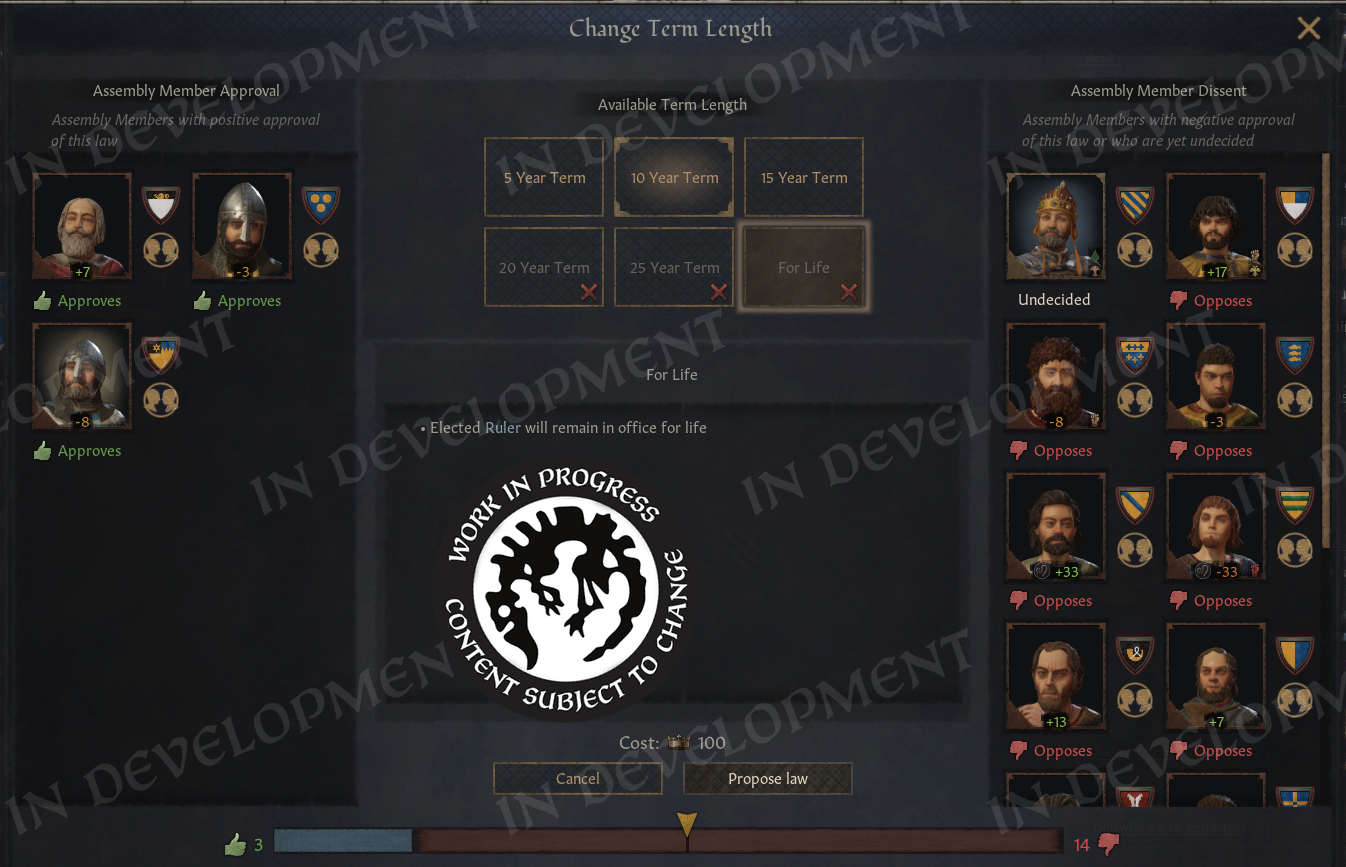
Now, before we move on to anything else, we should discuss the politics of the republic a little bit, and the Assembly mechanic we are adding in Silk & Silver. The Assembly is where the republic votes on public matters and the mechanics of the republic itself. Any assembly member can step up and propose law changes at any given time, and the whole assembly will then proceed to vote on said matter for the next 6 months.
Before we move on, we should also mention that in the republic, we usually have elections as the succession law. Meaning that, similar to e.g. the Holy-Roman Empire, the title passes based on votes. If you are somewhat tyrannical, you can change it to a despot succession down the line, if you feel like your family is the only one fit to rule.
Now, most parts of this assembly are in themselves put together by laws. So who is actually a part of the Assembly? Well, that’s a law. Currently, these are the alternatives:
•
Patrician Assembly: All patrician house heads
•
Governing Council: The ruler’s council members
•
General Assembly: All patrician house heads and republican vassals
•
Parliament: All patrician house heads and vassals (in general)
Now, how many votes do you need for something to pass? You guessed it, that’s a law. So it can be either a simple majority, a two-thirds majority, or a unanimous vote. That means that as you pass, you can, in theory, make a law setup that you are happy with, and then try to pass a unanimous vote to ensure that it sticks around in perpetuity.
Another part is, of course, what the Assembly can actually vote for. Yet again, that is another law. At most, they can vote on Laws, Decrees (more on that later), and Election Laws. At the very least, they can always vote for Election Laws.
Some other laws we have at the moment, though I don’t expect it to be final by the time we release Silk & Silver, as we are still looking into things to hook it into.
•
Term Length - How long the current ruler is going to sit (Minimum 5 years, maximum for life)
•
War Declaration - Whether the ruler has to have assembly approval for it or not
•
Title Revocation - If you can revoke titles from vassals
•
Vassal Retraction - If you can retract vassals from vassals
•
Vassal Refusal - If declining a revocation or retraction is considered criminal for the vassal
I Do Decree
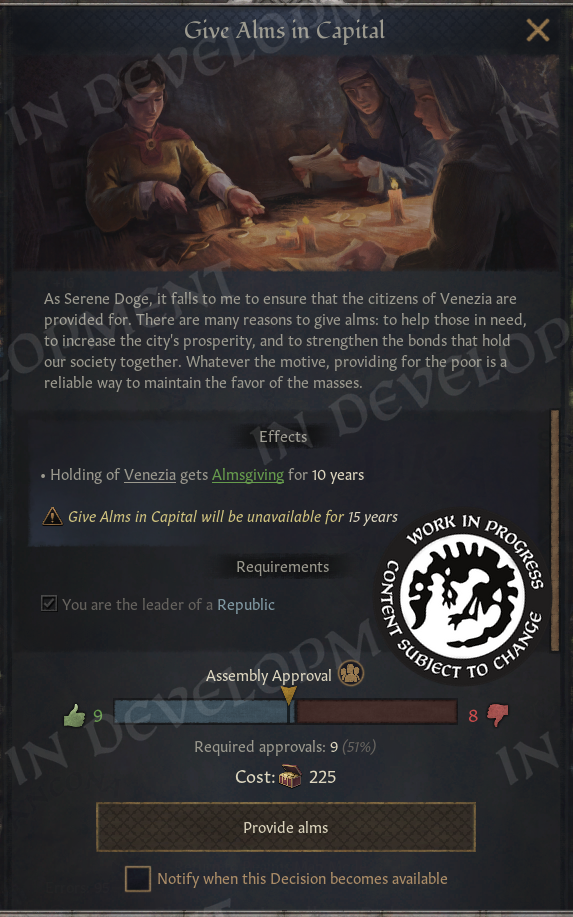
We mentioned decrees a bit earlier, but let’s go into what they actually are. Decrees are effectively government-specific decisions for republics that depend on the Assembly, usually detailing the use of the government treasury. For republics, treasuries will be used only by the head of the republic, and they will be used for buildings, decrees, and title men-at-arms, and gained by buildings and decrees.
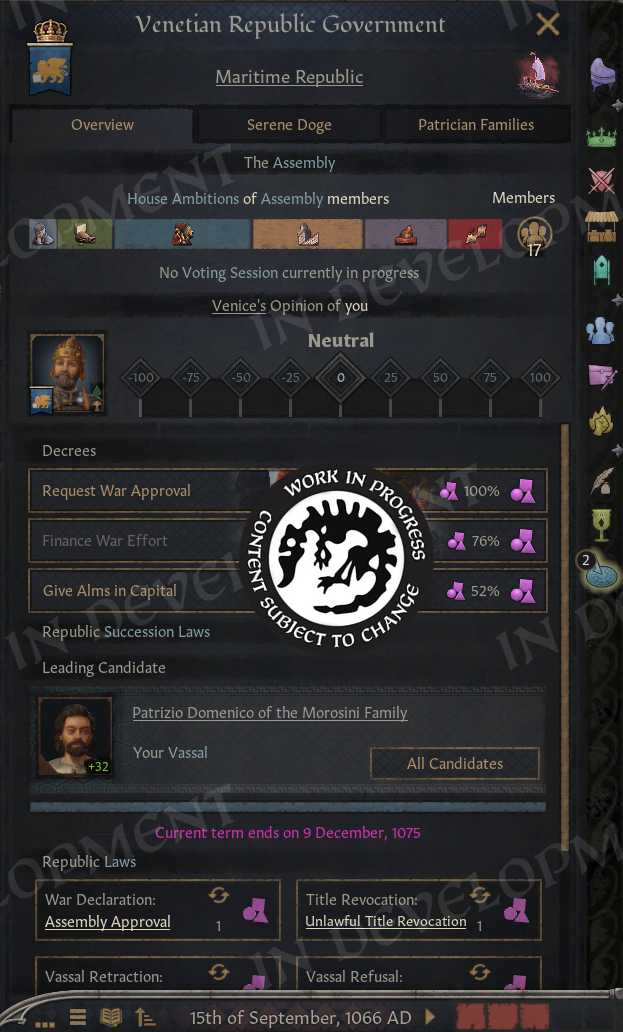
For a decree, as shown in the picture, you will usually be able to use the government treasury with the Assembly's approval. Of course, it comes down, yet again, to the laws of your republic, how many votes you need, who can vote, etc. But if you get approval, the decree is effectively like enacting a decision in the game, with a cost, an effect, and some requirements for it to be chosen.
In the vision Dev Diary, we talked a little bit about the new district & building system, and as part of that, we have also added a new district specific to Republics: the Trade Post. These are inspired by the Hanseatic Kontors and the Italian Fondachi, and they are effectively districts you hold in someone else’s lands. Every Patrician has a limit to how many trade posts they can hold at any given time, and every county in the world can have one trade post. Some areas, usually those far away from any republic character, will not see any, whereas other areas will have several characters flock and scheme to take trade posts from one another.
As republics are quite limited in how much land they can hold, this is another avenue where they can effectively expand to gain some more power, and it also gives them some neat benefits in other people’s lands, which can help them in different ways.
Within this district, we have some regular buildings that will just increase sell prices and decrease buy prices, for those who want to synergize with their ongoing trade routes or just increase their money-making in different ways. Besides those more simplistic ones, we also have buildings that let you negotiate an alliance with a local ruler, recruit culturally locked local men-at-arms, or increase your mercenary limit. Say, speaking of mercenary limits…
With Silk & Silver, we are introducing a new mercenary limit that caps the number of mercenaries that can be employed at any given time. It was always curious that people who had a lot of money could, in theory, just “money” away wars, by tossing enough of it at the problem. We have added a mercenary limit, so people who are actually good at war will be able to use and organize mercenaries more effectively than their richer counterparts, if they can afford them.
Like most modifiers, this can be adjusted by most places we hand out modifiers in the game, such as government types, cultural traditions, and lifestyles. For republics, they will start with a somewhat higher mercenary limit than regular rulers do, as they are otherwise a bit weaker militarily.
One of the republic fantasies of our time period is, of course, to be able to become the Hanseatic League. It was a powerful trade league that controlled trade through the Baltic Sea and had a significant impact on all its neighbors and trade partners.
Trade Leagues are confederations of republics that come together to pool their resources and monopolies, and ensure wealth for all participants. They are the ones who out-compete the regular merchants and the smaller republics in the area. As the league continues to grow more powerful and cohesive, it will eventually become more competitive and make a singular title through a new decision.
The idea is that forming large trade leagues should be a goal for players to achieve, which, in some ways, puts them at the very top of the food chain among merchants and republics.
Thanks for taking the time to read the dev diary about republics. There’s still a lot of work remaining. Of course, we will come back with more details later. One thing of note is that this is our last Silk & Silver dev diary planned before summer, so we will be back with more dev diaries in early August after our summer break. I hope you have all enjoyed our latest dev diaries on the work we are putting into the expansions this year, and that you are as stoked to play them as we are to release them!
Today, we are going to take a look at republics. We talked a little bit about them in both the announcement video and the original Silk & Silver vision dev diary, but today we will go a bit more into the weeds. Without further ado, let’s get started.
\
To start us off, what are republics? Republics in Silk & Silver are effectively small city-states, with all the “relevant” people who live there. That means whoever is the current ruler, and all patricians of the city. The patricians are landless nobility and burghers who are part of the assembly of the city, who can vote on matters, and who are (possibly) aiming to become the next head of the republic themselves. In other words, the patricians aren’t landed, but they are all rooted to the city and the politics of the realm.
These city-states are inspired by many historical city-states of the Middle Ages, including republics such as Venice, Florence, the Swiss Republics, and the free cities of the Holy Roman Empire. There are different types of republics, but all of them will have patricians who trade in some fashion to fund their political endeavors. As a fun little side note, we also split the Vatican from the city of Rome, so if you want to play as a little manipulative controlling Roman Republic under the Pope, that is now a neat little opportunity in Silk & Silver.
In real life, many of our more well-known republics had a tendency to start off as communal city-states, eventually turning into signorias, semi-tyrannical city-states led by a single family. That was our starting point as we went into this, and we wanted to depict this in the game. These smaller entities often punched above their weight in very specific, limited ways.
We wanted families in the city-state to matter, and to both quabble and plot together. It was supposed to be a playstyle for people who didn’t want to go wide and build a huge realm, but rather focus on internal politicking, scheming, changing laws, and trade. The idea being that all patricians would have access to trade to fund their political schemes and careers. You would have the opportunity to start out in a small commune and, over time, turn it into your personal city-state, one you control entirely in all but name.
House Ambitions
We’re adding house ambitions, a type of house attribute (think like the Mandala Aspects or the House Aspiration in Japan) that defines the kind of idea your house has for the republic. It was one of the things we wanted early on, so we could get that immediate feel for what different houses care about. The idea being that as you set out on your republic journey, you’d have several “actors” in the republic (irrelevant of the characters themselves), so over time you’d start knowing specific families for their values and stances: “Ah, the Zorzi family, they always foil my plans!”
Popular Opinion
We wanted Popular Opinion to play an important and special role in republics, serving as a way for the public to interact with the republic's ruler, which we felt was more important for republics than for most other landed forms of government in the game. As we are reworking the mechanic anyway, it seemed like a prime opportunity to do something extra.
As you might imagine, being a very unpopular ruler in a republic might have some consequences for your health.
As you are intrinsically linked to the city-state, so is progression in some ways. A smaller count-tier city-state can only sustain one family and have a limited amount of laws (more on them soon), and they don’t really become proper republics until they become duke-tier. Unlike regular rulers, republics don’t really use DeJure per se; they build their own titles as they grow in importance, but these are locked behind the prestige of their rulers, the size of their settlements (see vision dev diary for more about settlement size), and other factors.
As they become a duke tier, more families will join the republic, and squabbling will begin in earnest to form the republic in whatever way the patricians want. And as they continue to grow, they will be able to spread their roots and become smaller merchant empires akin to Venice in real life.
Now, before we move on to anything else, we should discuss the politics of the republic a little bit, and the Assembly mechanic we are adding in Silk & Silver. The Assembly is where the republic votes on public matters and the mechanics of the republic itself. Any assembly member can step up and propose law changes at any given time, and the whole assembly will then proceed to vote on said matter for the next 6 months.
Before we move on, we should also mention that in the republic, we usually have elections as the succession law. Meaning that, similar to e.g. the Holy-Roman Empire, the title passes based on votes. If you are somewhat tyrannical, you can change it to a despot succession down the line, if you feel like your family is the only one fit to rule.
Now, most parts of this assembly are in themselves put together by laws. So who is actually a part of the Assembly? Well, that’s a law. Currently, these are the alternatives:
•
Patrician Assembly: All patrician house heads
•
Governing Council: The ruler’s council members
•
General Assembly: All patrician house heads and republican vassals
•
Parliament: All patrician house heads and vassals (in general)
Now, how many votes do you need for something to pass? You guessed it, that’s a law. So it can be either a simple majority, a two-thirds majority, or a unanimous vote. That means that as you pass, you can, in theory, make a law setup that you are happy with, and then try to pass a unanimous vote to ensure that it sticks around in perpetuity.
Another part is, of course, what the Assembly can actually vote for. Yet again, that is another law. At most, they can vote on Laws, Decrees (more on that later), and Election Laws. At the very least, they can always vote for Election Laws.
Some other laws we have at the moment, though I don’t expect it to be final by the time we release Silk & Silver, as we are still looking into things to hook it into.
•
Term Length - How long the current ruler is going to sit (Minimum 5 years, maximum for life)
•
War Declaration - Whether the ruler has to have assembly approval for it or not
•
Title Revocation - If you can revoke titles from vassals
•
Vassal Retraction - If you can retract vassals from vassals
•
Vassal Refusal - If declining a revocation or retraction is considered criminal for the vassal
I Do Decree
We mentioned decrees a bit earlier, but let’s go into what they actually are. Decrees are effectively government-specific decisions for republics that depend on the Assembly, usually detailing the use of the government treasury. For republics, treasuries will be used only by the head of the republic, and they will be used for buildings, decrees, and title men-at-arms, and gained by buildings and decrees.
For a decree, as shown in the picture, you will usually be able to use the government treasury with the Assembly's approval. Of course, it comes down, yet again, to the laws of your republic, how many votes you need, who can vote, etc. But if you get approval, the decree is effectively like enacting a decision in the game, with a cost, an effect, and some requirements for it to be chosen.
In the vision Dev Diary, we talked a little bit about the new district & building system, and as part of that, we have also added a new district specific to Republics: the Trade Post. These are inspired by the Hanseatic Kontors and the Italian Fondachi, and they are effectively districts you hold in someone else’s lands. Every Patrician has a limit to how many trade posts they can hold at any given time, and every county in the world can have one trade post. Some areas, usually those far away from any republic character, will not see any, whereas other areas will have several characters flock and scheme to take trade posts from one another.
As republics are quite limited in how much land they can hold, this is another avenue where they can effectively expand to gain some more power, and it also gives them some neat benefits in other people’s lands, which can help them in different ways.
Within this district, we have some regular buildings that will just increase sell prices and decrease buy prices, for those who want to synergize with their ongoing trade routes or just increase their money-making in different ways. Besides those more simplistic ones, we also have buildings that let you negotiate an alliance with a local ruler, recruit culturally locked local men-at-arms, or increase your mercenary limit. Say, speaking of mercenary limits…
With Silk & Silver, we are introducing a new mercenary limit that caps the number of mercenaries that can be employed at any given time. It was always curious that people who had a lot of money could, in theory, just “money” away wars, by tossing enough of it at the problem. We have added a mercenary limit, so people who are actually good at war will be able to use and organize mercenaries more effectively than their richer counterparts, if they can afford them.
Like most modifiers, this can be adjusted by most places we hand out modifiers in the game, such as government types, cultural traditions, and lifestyles. For republics, they will start with a somewhat higher mercenary limit than regular rulers do, as they are otherwise a bit weaker militarily.
One of the republic fantasies of our time period is, of course, to be able to become the Hanseatic League. It was a powerful trade league that controlled trade through the Baltic Sea and had a significant impact on all its neighbors and trade partners.
Trade Leagues are confederations of republics that come together to pool their resources and monopolies, and ensure wealth for all participants. They are the ones who out-compete the regular merchants and the smaller republics in the area. As the league continues to grow more powerful and cohesive, it will eventually become more competitive and make a singular title through a new decision.
The idea is that forming large trade leagues should be a goal for players to achieve, which, in some ways, puts them at the very top of the food chain among merchants and republics.
Thanks for taking the time to read the dev diary about republics. There’s still a lot of work remaining. Of course, we will come back with more details later. One thing of note is that this is our last Silk & Silver dev diary planned before summer, so we will be back with more dev diaries in early August after our summer break. I hope you have all enjoyed our latest dev diaries on the work we are putting into the expansions this year, and that you are as stoked to play them as we are to release them!








"Silk & Silver" Dev Diary #3 - Merchants Vision
Hi all! I’m PinkAxelotl. Today, we’re taking a look at our vision for Merchants in Silk and Silver. Who are they, what is the experience they provide, which are the relationships that matters to them the most, and what specific systems are used to support their gameplay?
For the purposes of this Development Diary, the term “Merchant” only includes the new landless Merchant government. We won’t delve into details about their administrative-focused counterparts, i.e. Patricians or Republics. That’s a topic for another time.
Let’s get an important disclaimer out of the way: We’re right in the thick of development and all of this is subject to change.
By introducing Merchants we have an unique opportunity to provide a new playstyle that covers a previously untapped historical fantasy around trade and wealth-based power dynamics. Fight other Merchant families over important Trade Goods, win the favor of your Patron, and most importantly – keep caravans moving.
The focus of the Merchant experience is that of the family Company. This means that we’re not creating a peddler fantasy. You have family members and Associates (Courtiers) working the caravans on behalf of the Company.
Merchant gameplay is a constant trade-off between Gold and Prestige. As a Merchant, you are highly capable at Trade, but constantly hindered by not being a noble. Throughout this document, you will see that this interplay between Prestige and Gold pervades all mechanics we introduce for this playstyle.
Career Path
So who exactly can be a Merchant? We’ve added the option to “Create your own Merchant” on game start, which can be done anywhere in the world. You will also be able to become a Merchant via a Decision when playing as a Duke or Count, as long as your Culture allows it. Patricians and Adventurers will also be able to take this Decision.
As you progress your Company, you might eventually want to settle down somewhere. The problem of getting to the very top is that everyone wants a piece of the pie. Being the biggest Merchant should not mean that no one challenges you. Rather the opposite. Acquiring land and “settling down” in the traditional sense should be an appealing way to mitigate risks and “tie down” assets. You can accomplish this by either purchasing land from your Patron, or choosing to either join or form a Republic.
Monopolies & Trade Expertise
Building Trade Expertise in a Primary Good of your choosing and acquiring Monopolies are integral to a Merchant’s Company progression (i.e. becoming the wine salesman of Italy). These have been covered extensively in the latest Silk & Silver Dev Diary on Trade, so for brevity’s sake we will move right along.
Company Size
Your Monopolies and Trade Expertise tells the world what you are, while your Company Size is all about who you are as a Company.
\
Your Acumen represents the amount of gold your company has accumulated through Trade. For progression, it is used to gate the different Company Sizes, which you can spend Prestige to unlock (the first being an “Aspiring Business” and the last being “Trade Empire”).
For all intents and purposes, you can view these as your Company status. If you have a Trade Empire, most interactions will be easier for you to accomplish successfully, especially if you are looking to acquire a Trade Monopoly.
The different Size tiers boost a Company’s Competitiveness, which helps handle trade competition. They also unlock Merchant Charters from increasingly higher-tiered characters (i.e. dukes at tier 2, kings at tier 3, and so on). We will cover these Charters later in the document.
Company Purposes
We can’t talk about Merchant fantasies without covering Company Purposes. Right from the get-go, we knew we wanted to put a lot of emphasis on the role-playing possibilities of playing as a Merchant, to fill the day-to-day activities of being the head of a Company, so that you’re not simply sitting around waiting for gold to trickle in. This is especially important for balancing against the number-heavy Trade feature.
\
Company Purposes are different paths to pursue. Will you become a skilled craftsperson, lend gold at exuberant rates, trade in weapons, or reach for distant riches?
The different Purposes are:
•
Reputable: Default starting Purpose, increasing family and Patron opinion.
•
Artisan: Focus on Artifacts and Inspiration.
•
Creditor: Lend gold and get strong hooks.
•
War Profiteer: Sponsor wars with either Men at Arms or Mercenaries.
•
Caravaneer: Get strong cultural bonuses and unlock Luxury Contracts.
You can pursue many of these actions regardless of what Purpose you have. We’re not limiting the amount of tools you have to engage with while playing as a Merchant character. The goal of these Purposes is to allow you to be significantly better at a particular playstyle, not limiting you to one.
As you will have noticed, all Purposes reference Opportunities and Contracts, and so let’s get into those next.
\
\
\
\
\
Trade Contracts
Similar to landless Adventurers, Merchants have access to a variety of contracts. The purpose of Merchant Contracts is primarily to either gain Prestige or Trade bonuses.
\
When taking on a Contract, you will be required to do a bit of legwork to improve the markets along your Trade Route, travelling far abroad to secure luxury goods, and build your Prestige to eventually be able to compete with the big traders.
\
Our current list of Merchant Contract Types are:
•
Trade Opportunities:
•
Used to maintain existing Trade Routes. When going on a Trade Opportunity, you travel to a market for a variety of purposes, such as increasing the sell price of specific trade goods, and promoting your business so as to make the market more attractive.
•
Trade Opportunities are also an avenue into fighting competing Merchant Families in your markets.
•
Unity Contracts:
•
These are urgent situations that require your immediate attention. You must address irregularities in your business dealings, or run the risk of losing face. Most often one of your family members has been accused of misconduct. Can you assuage every party involved?
•
Luxury Contracts
•
Undertake expeditions abroad and bring home wealth that significantly bolster your reputation. But the higher reward, the higher the risk. Will you be able to capture and reliably move live exotic animals back home?
•
Luxury Contracts unlock Domicile Artifacts and are the only way of acquiring them.
Trade Opportunities trigger schemes that you have to complete. To make these more active and engaging, we’re adding a button that allows you to gain Advantages at an increased risk.
On top of that, we are adding an option for you to chain Trade Opportunities, so that you don’t need to go home in-between. Or, you can choose to send a dedicated Associate to handle the situation in your place.
\
Company Palace
As a Merchant, your Company Palace (Domicile) is your base of operations. All your Trade Routes start here. A bigger and better Palace increases the max number of Trade Routes you can set up as well, which makes upgrading your Palace integral to progressing your Company.
\
One noteworthy characteristic of the Palace is that this Domicile type is fully integrated into the city where you are located. This means that if you upgrade a domicile building, you are investing in the holding at large. The main and external buildings cost Prestige in addition to Gold, since you are technically constructing in a landed ruler’s realm.
\
With very few steady Prestige incomes, your Palace is also a place you can show off the exotic artifacts you’ve obtained through Luxury Contracts. These can be assigned to your Palace’s own artifact inventory.
A Merchant’s family members are key to components in managing Trade successfully. Family members will be responsible for managing specific trade routes, and have abilities that directly improve the market abilities of that route. As the House Head, you decide how far to push your family, and whether or not the individual interests must be sacrificed for the sake of the Company, which is where House Unity comes in.
Traders
You can assign either Family or Associates to oversee and manage Trade Routes. These characters will handle the menial tasks associated with the buying and selling of goods, so that you can focus on the bigger picture for the Company.
The Trader tasks are:
•
Manage Competition: Raises Competitiveness
•
Negotiate Deals: Improves Acumen gain
•
Oversee Caravans: Gives Trade Capacity
\
House Unity
As the Merchant government is heavily family-oriented, we also made the decision to implement House Unity for it. This offers a lot of opportunities for the tension and cohesion of family members.
Merchant House Unity has a distinct trade off: High House Unity is all about blood ties and presenting like a Noble Family (i.e. high focus on Prestige, at the cost of a competitive trade edge). Meanwhile, low House Unity centers around profit and getting skilled characters involved in the Trade, no matter the blood ties (i.e. high focus on Competitiveness, at the cost of Prestige).
\
\
\
\
Patron
To manage your business, you are wholly dependent on your Patron, who is the holder of the County where your Palace is located. This character allows you to conduct trade in their land, with the expectation that you will supply the needs of their holding. The relationship between you is a new tributary type, where you become their Beneficiary.
You have a special interaction that targets your Patron, from which you can ask for a range of favors, including marrying into low nobility. Engaging with your Patron is the primary way to spend gold to get Prestige. And Prestige, as we’ve learnt, is how to improve your Trade.
Merchant Charter
If you schmooze your Patron well enough, you can also request a Charter from them. This opens up a whole new level of Decisions for you, where you can either use the Charter in defiance of your Patron to vastly boost your Prestige, or reinvest some of your gold into your Patron’s lands to develop buildings and increase Prosperity. The latter of which will boost the trade output of your local market. Win win.
\
Any Patron can only have one active Charter at a time, while having a number of Beneficiaries vying for it at the same time.
Working with or against your Patron has its own risks/rewards. Use the Charter to support them, and you might eventually be rewarded. Use the Charter against them, and you might eventually be punished, at the risk of imprisonment and the destruction of the artifact.
\
Competition
House Relations play an important part in keeping track of a Merchant’s main competition. As soon as you start creating Trade Routes, your relationship with merchants in those markets will start to deteriorate. Obtaining a Monopoly that another merchant is vying for also deteriorates the relationship. Basically, if you are competing over the same resources, the relationship between your Houses will become increasingly fraught.
You can use the Charter and Trade Opportunities to put a real dent in the Competitiveness of your competitors, along with all the regular scheming and plotting of the regular Crusader Kings 3 experience.
Here you have the Merchant experience: one where familial duty is posed against company profit, where a lowborn character might hope to rise above their station by building a lasting trade empire.
For the purposes of this Development Diary, the term “Merchant” only includes the new landless Merchant government. We won’t delve into details about their administrative-focused counterparts, i.e. Patricians or Republics. That’s a topic for another time.
Let’s get an important disclaimer out of the way: We’re right in the thick of development and all of this is subject to change.
By introducing Merchants we have an unique opportunity to provide a new playstyle that covers a previously untapped historical fantasy around trade and wealth-based power dynamics. Fight other Merchant families over important Trade Goods, win the favor of your Patron, and most importantly – keep caravans moving.
The focus of the Merchant experience is that of the family Company. This means that we’re not creating a peddler fantasy. You have family members and Associates (Courtiers) working the caravans on behalf of the Company.
Merchant gameplay is a constant trade-off between Gold and Prestige. As a Merchant, you are highly capable at Trade, but constantly hindered by not being a noble. Throughout this document, you will see that this interplay between Prestige and Gold pervades all mechanics we introduce for this playstyle.
Career Path
So who exactly can be a Merchant? We’ve added the option to “Create your own Merchant” on game start, which can be done anywhere in the world. You will also be able to become a Merchant via a Decision when playing as a Duke or Count, as long as your Culture allows it. Patricians and Adventurers will also be able to take this Decision.
As you progress your Company, you might eventually want to settle down somewhere. The problem of getting to the very top is that everyone wants a piece of the pie. Being the biggest Merchant should not mean that no one challenges you. Rather the opposite. Acquiring land and “settling down” in the traditional sense should be an appealing way to mitigate risks and “tie down” assets. You can accomplish this by either purchasing land from your Patron, or choosing to either join or form a Republic.
Monopolies & Trade Expertise
Building Trade Expertise in a Primary Good of your choosing and acquiring Monopolies are integral to a Merchant’s Company progression (i.e. becoming the wine salesman of Italy). These have been covered extensively in the latest Silk & Silver Dev Diary on Trade, so for brevity’s sake we will move right along.
Company Size
Your Monopolies and Trade Expertise tells the world what you are, while your Company Size is all about who you are as a Company.
\
Your Acumen represents the amount of gold your company has accumulated through Trade. For progression, it is used to gate the different Company Sizes, which you can spend Prestige to unlock (the first being an “Aspiring Business” and the last being “Trade Empire”).
For all intents and purposes, you can view these as your Company status. If you have a Trade Empire, most interactions will be easier for you to accomplish successfully, especially if you are looking to acquire a Trade Monopoly.
The different Size tiers boost a Company’s Competitiveness, which helps handle trade competition. They also unlock Merchant Charters from increasingly higher-tiered characters (i.e. dukes at tier 2, kings at tier 3, and so on). We will cover these Charters later in the document.
Company Purposes
We can’t talk about Merchant fantasies without covering Company Purposes. Right from the get-go, we knew we wanted to put a lot of emphasis on the role-playing possibilities of playing as a Merchant, to fill the day-to-day activities of being the head of a Company, so that you’re not simply sitting around waiting for gold to trickle in. This is especially important for balancing against the number-heavy Trade feature.
\
Company Purposes are different paths to pursue. Will you become a skilled craftsperson, lend gold at exuberant rates, trade in weapons, or reach for distant riches?
The different Purposes are:
•
Reputable: Default starting Purpose, increasing family and Patron opinion.
•
Artisan: Focus on Artifacts and Inspiration.
•
Creditor: Lend gold and get strong hooks.
•
War Profiteer: Sponsor wars with either Men at Arms or Mercenaries.
•
Caravaneer: Get strong cultural bonuses and unlock Luxury Contracts.
You can pursue many of these actions regardless of what Purpose you have. We’re not limiting the amount of tools you have to engage with while playing as a Merchant character. The goal of these Purposes is to allow you to be significantly better at a particular playstyle, not limiting you to one.
As you will have noticed, all Purposes reference Opportunities and Contracts, and so let’s get into those next.
\
\
\
\
\
Trade Contracts
Similar to landless Adventurers, Merchants have access to a variety of contracts. The purpose of Merchant Contracts is primarily to either gain Prestige or Trade bonuses.
\
When taking on a Contract, you will be required to do a bit of legwork to improve the markets along your Trade Route, travelling far abroad to secure luxury goods, and build your Prestige to eventually be able to compete with the big traders.
\
Our current list of Merchant Contract Types are:
•
Trade Opportunities:
•
Used to maintain existing Trade Routes. When going on a Trade Opportunity, you travel to a market for a variety of purposes, such as increasing the sell price of specific trade goods, and promoting your business so as to make the market more attractive.
•
Trade Opportunities are also an avenue into fighting competing Merchant Families in your markets.
•
Unity Contracts:
•
These are urgent situations that require your immediate attention. You must address irregularities in your business dealings, or run the risk of losing face. Most often one of your family members has been accused of misconduct. Can you assuage every party involved?
•
Luxury Contracts
•
Undertake expeditions abroad and bring home wealth that significantly bolster your reputation. But the higher reward, the higher the risk. Will you be able to capture and reliably move live exotic animals back home?
•
Luxury Contracts unlock Domicile Artifacts and are the only way of acquiring them.
Trade Opportunities trigger schemes that you have to complete. To make these more active and engaging, we’re adding a button that allows you to gain Advantages at an increased risk.
On top of that, we are adding an option for you to chain Trade Opportunities, so that you don’t need to go home in-between. Or, you can choose to send a dedicated Associate to handle the situation in your place.
\
Company Palace
As a Merchant, your Company Palace (Domicile) is your base of operations. All your Trade Routes start here. A bigger and better Palace increases the max number of Trade Routes you can set up as well, which makes upgrading your Palace integral to progressing your Company.
\
One noteworthy characteristic of the Palace is that this Domicile type is fully integrated into the city where you are located. This means that if you upgrade a domicile building, you are investing in the holding at large. The main and external buildings cost Prestige in addition to Gold, since you are technically constructing in a landed ruler’s realm.
\
With very few steady Prestige incomes, your Palace is also a place you can show off the exotic artifacts you’ve obtained through Luxury Contracts. These can be assigned to your Palace’s own artifact inventory.
A Merchant’s family members are key to components in managing Trade successfully. Family members will be responsible for managing specific trade routes, and have abilities that directly improve the market abilities of that route. As the House Head, you decide how far to push your family, and whether or not the individual interests must be sacrificed for the sake of the Company, which is where House Unity comes in.
Traders
You can assign either Family or Associates to oversee and manage Trade Routes. These characters will handle the menial tasks associated with the buying and selling of goods, so that you can focus on the bigger picture for the Company.
The Trader tasks are:
•
Manage Competition: Raises Competitiveness
•
Negotiate Deals: Improves Acumen gain
•
Oversee Caravans: Gives Trade Capacity
\
House Unity
As the Merchant government is heavily family-oriented, we also made the decision to implement House Unity for it. This offers a lot of opportunities for the tension and cohesion of family members.
Merchant House Unity has a distinct trade off: High House Unity is all about blood ties and presenting like a Noble Family (i.e. high focus on Prestige, at the cost of a competitive trade edge). Meanwhile, low House Unity centers around profit and getting skilled characters involved in the Trade, no matter the blood ties (i.e. high focus on Competitiveness, at the cost of Prestige).
\
\
\
\
Patron
To manage your business, you are wholly dependent on your Patron, who is the holder of the County where your Palace is located. This character allows you to conduct trade in their land, with the expectation that you will supply the needs of their holding. The relationship between you is a new tributary type, where you become their Beneficiary.
You have a special interaction that targets your Patron, from which you can ask for a range of favors, including marrying into low nobility. Engaging with your Patron is the primary way to spend gold to get Prestige. And Prestige, as we’ve learnt, is how to improve your Trade.
Merchant Charter
If you schmooze your Patron well enough, you can also request a Charter from them. This opens up a whole new level of Decisions for you, where you can either use the Charter in defiance of your Patron to vastly boost your Prestige, or reinvest some of your gold into your Patron’s lands to develop buildings and increase Prosperity. The latter of which will boost the trade output of your local market. Win win.
\
Any Patron can only have one active Charter at a time, while having a number of Beneficiaries vying for it at the same time.
Working with or against your Patron has its own risks/rewards. Use the Charter to support them, and you might eventually be rewarded. Use the Charter against them, and you might eventually be punished, at the risk of imprisonment and the destruction of the artifact.
\
Competition
House Relations play an important part in keeping track of a Merchant’s main competition. As soon as you start creating Trade Routes, your relationship with merchants in those markets will start to deteriorate. Obtaining a Monopoly that another merchant is vying for also deteriorates the relationship. Basically, if you are competing over the same resources, the relationship between your Houses will become increasingly fraught.
You can use the Charter and Trade Opportunities to put a real dent in the Competitiveness of your competitors, along with all the regular scheming and plotting of the regular Crusader Kings 3 experience.
Here you have the Merchant experience: one where familial duty is posed against company profit, where a lowborn character might hope to rise above their station by building a lasting trade empire.

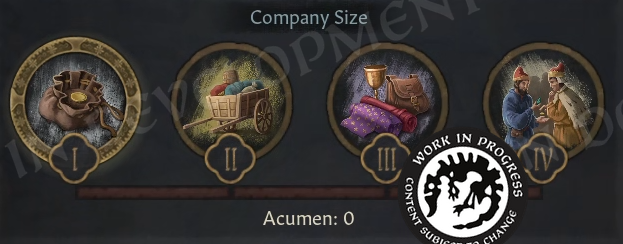
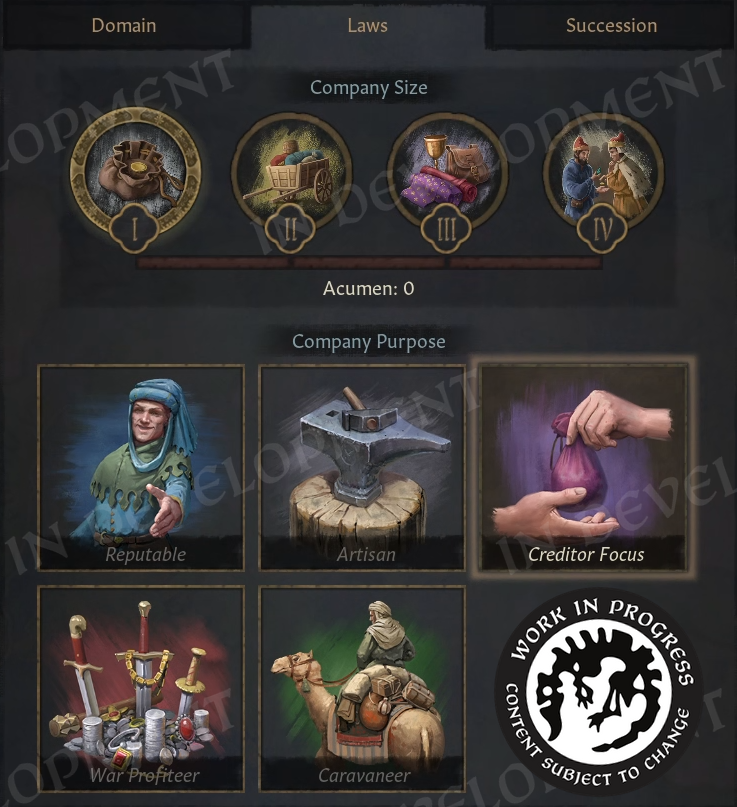
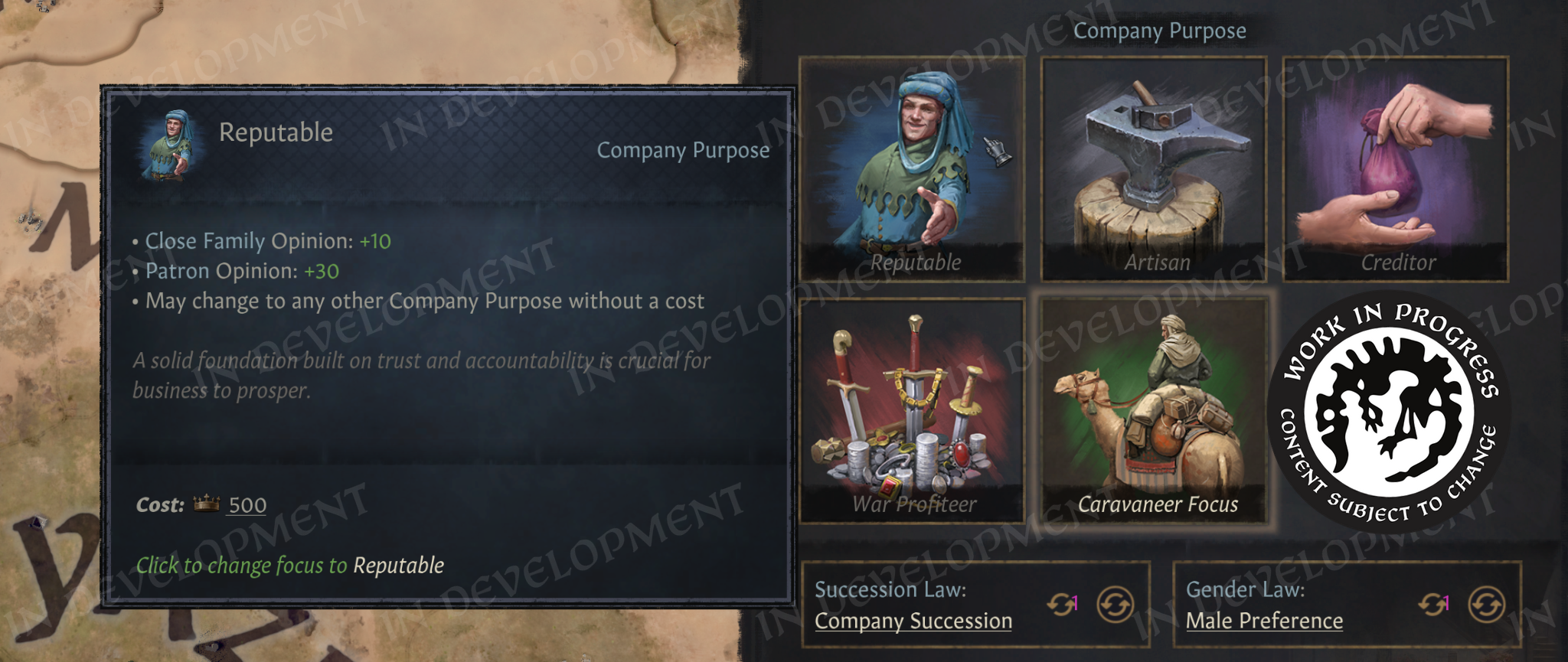
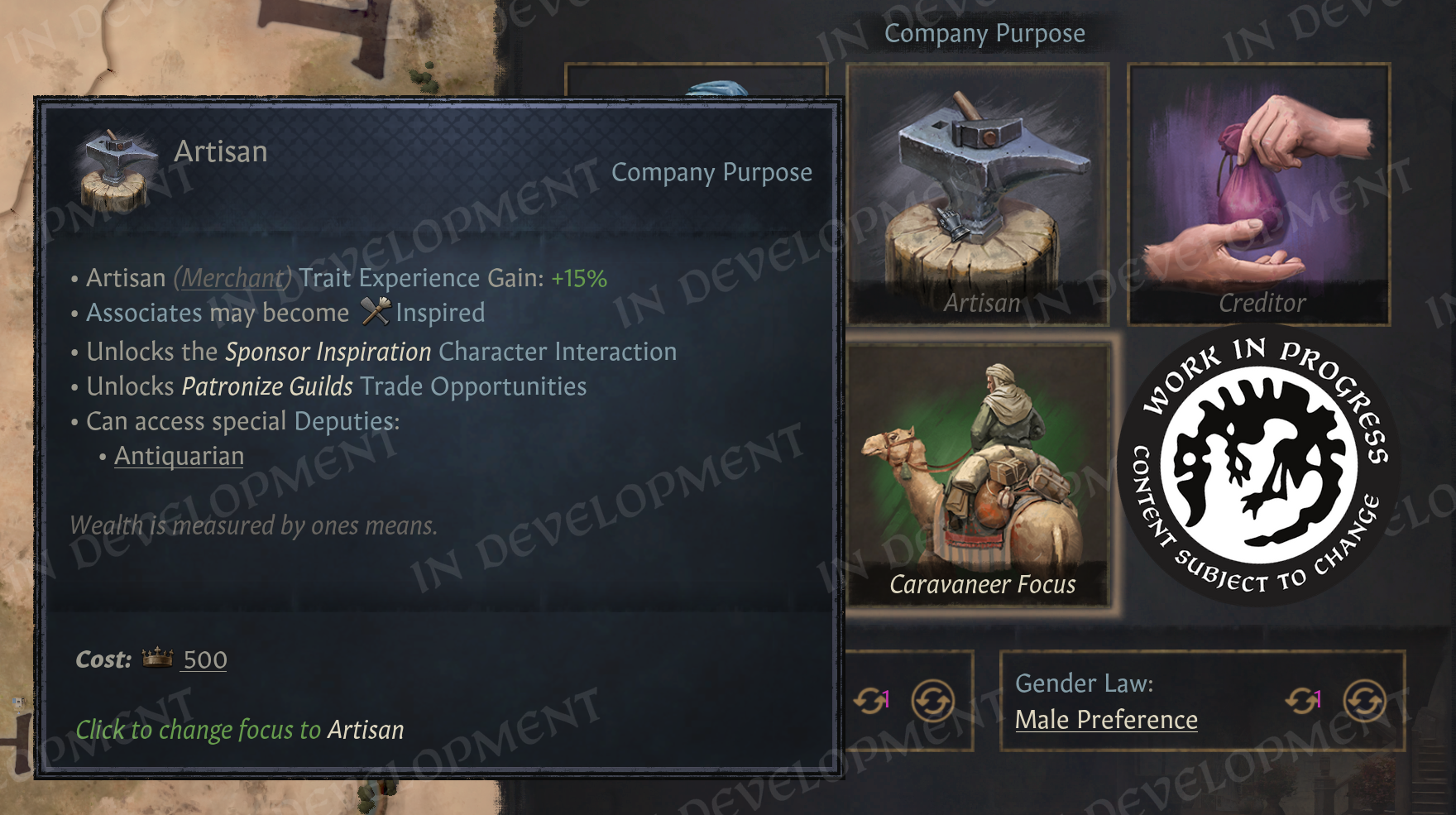
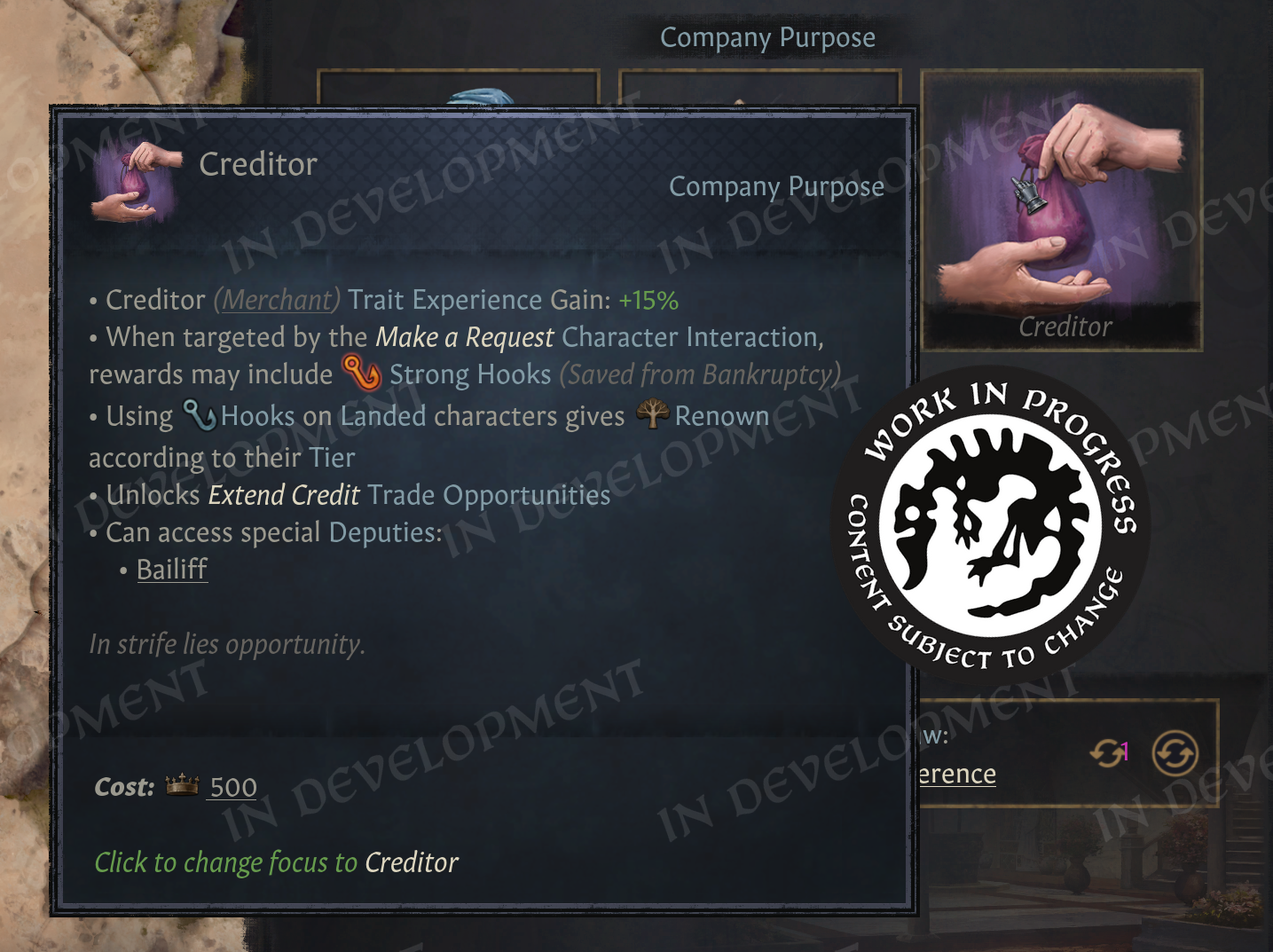
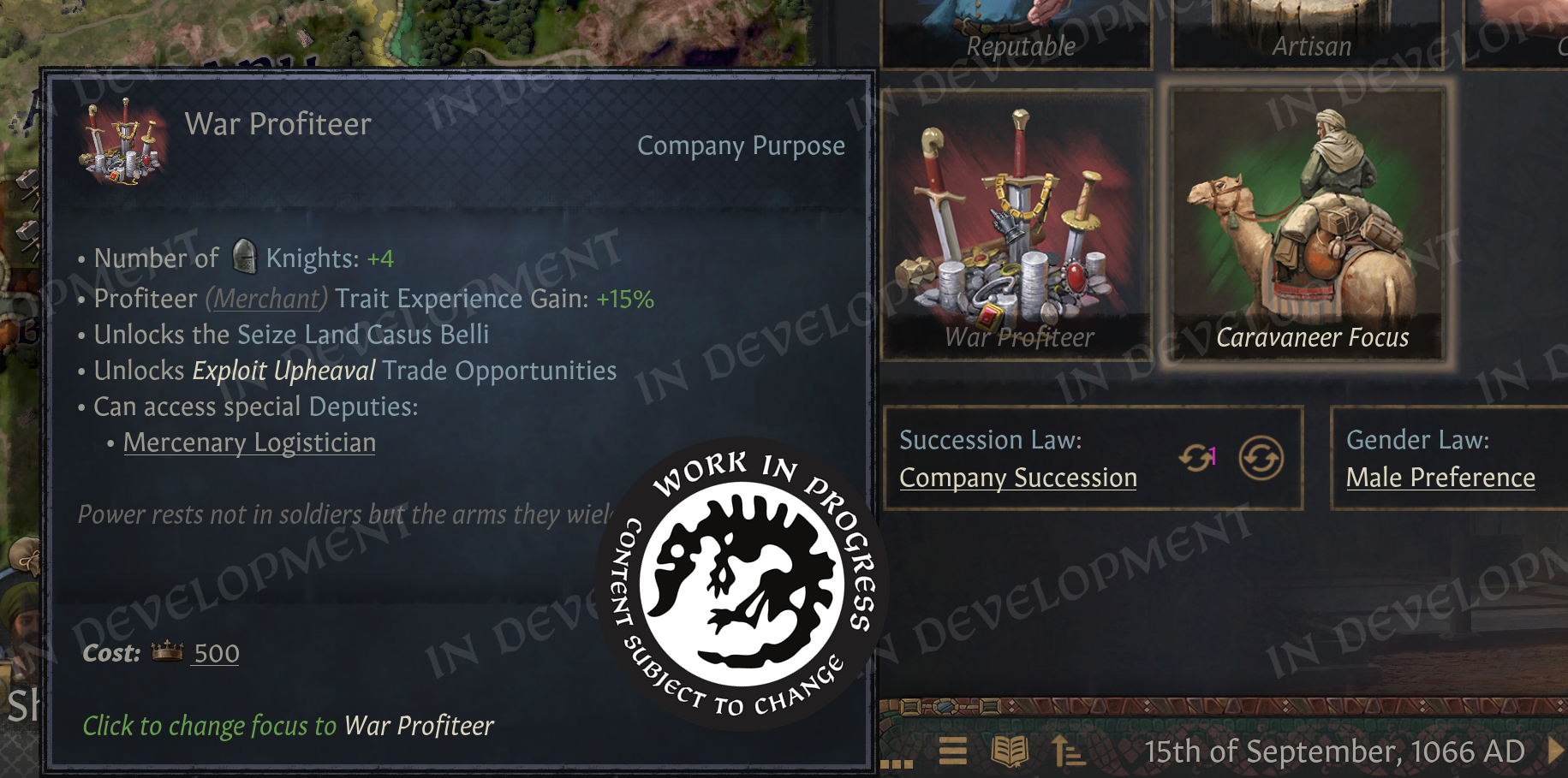
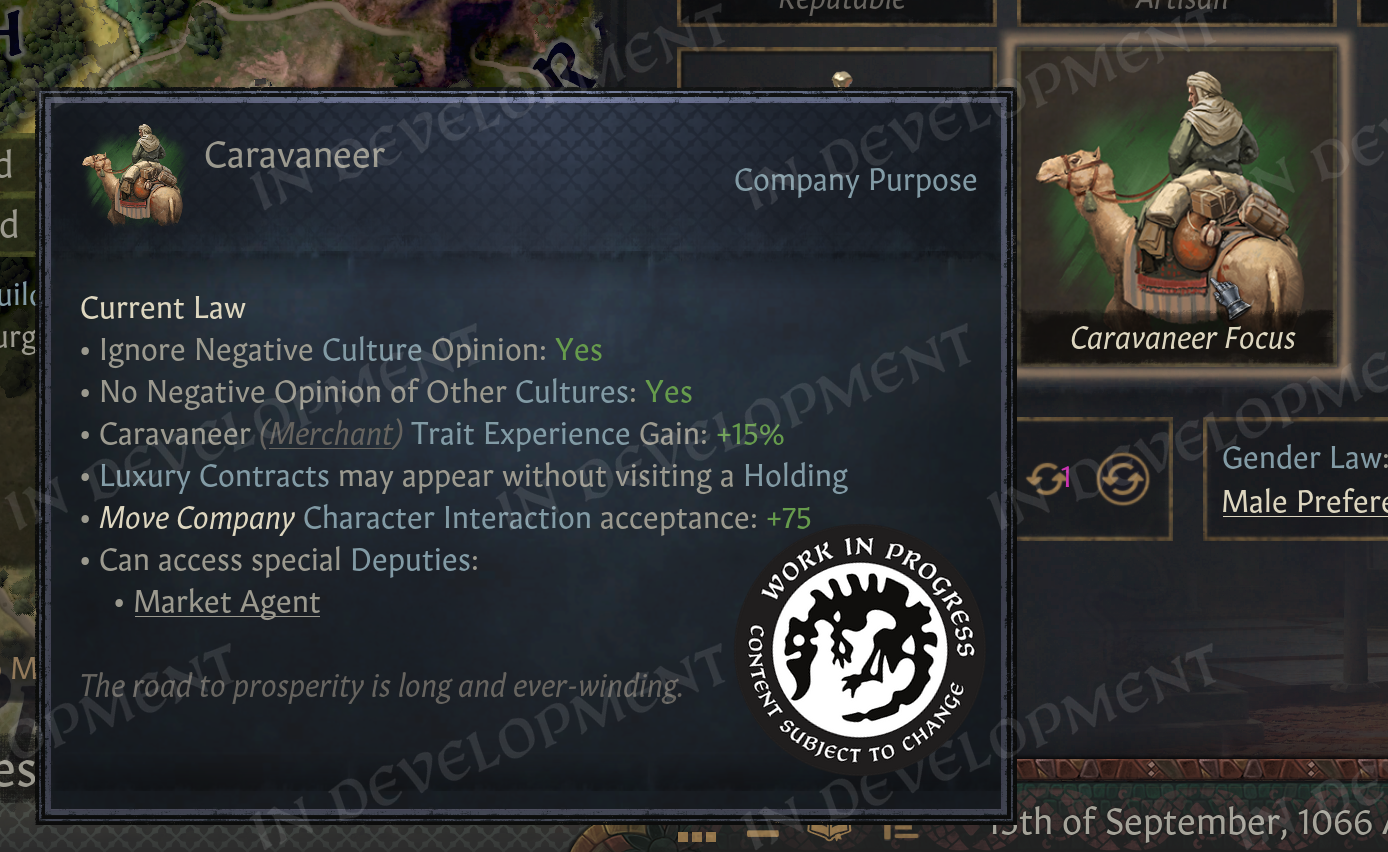
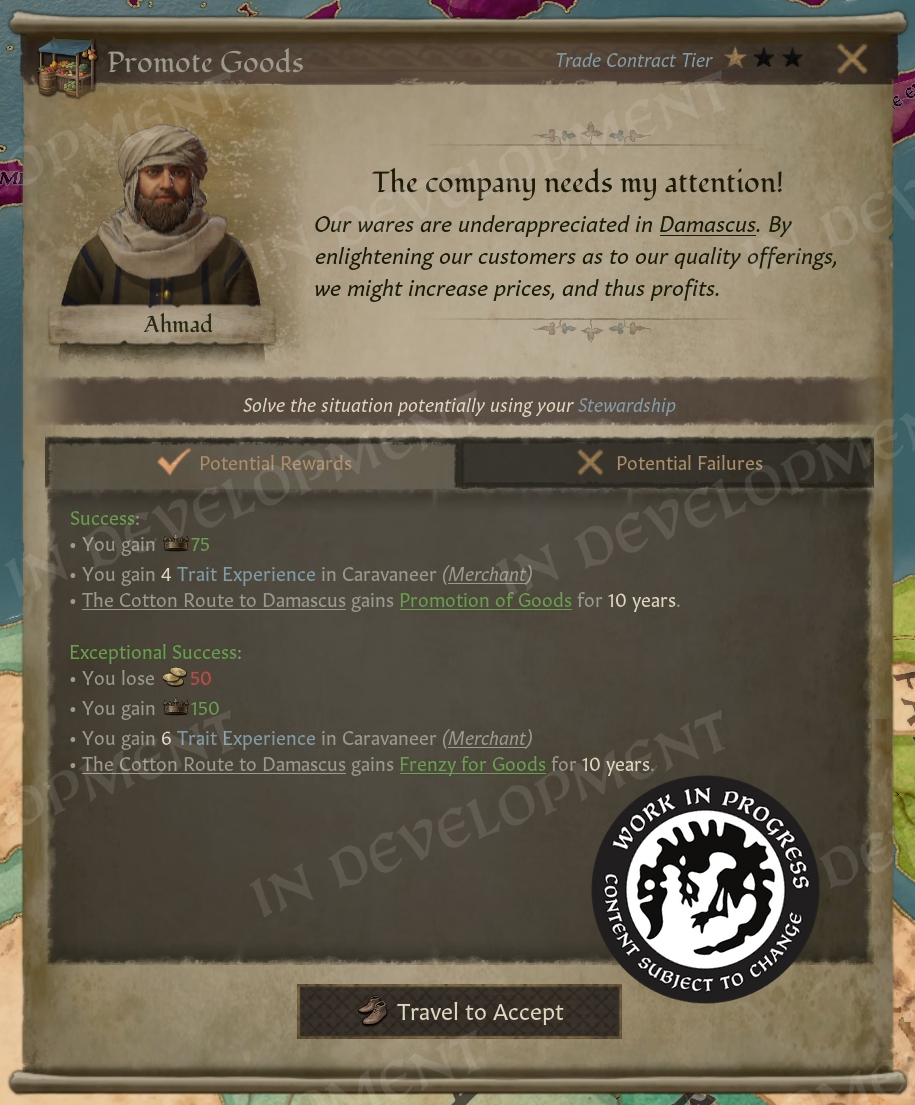
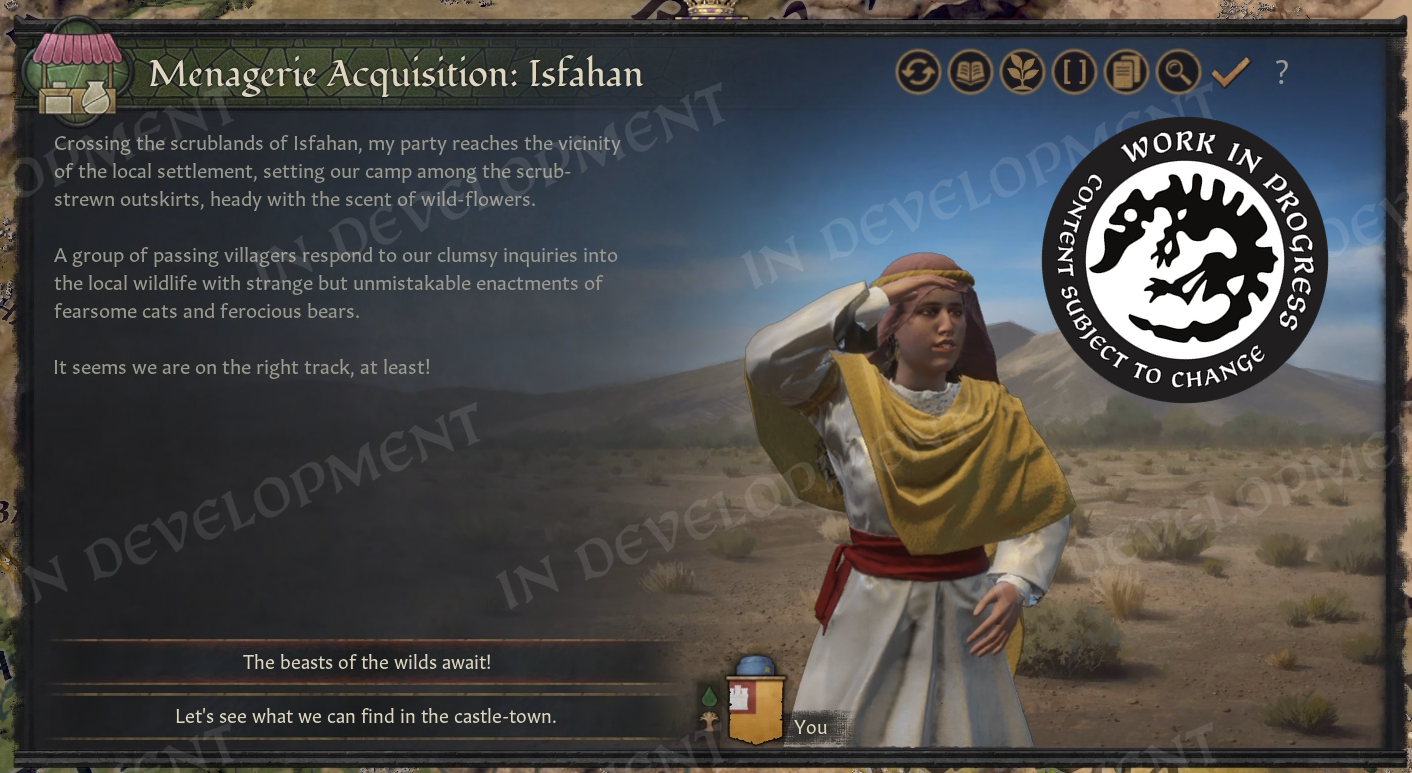
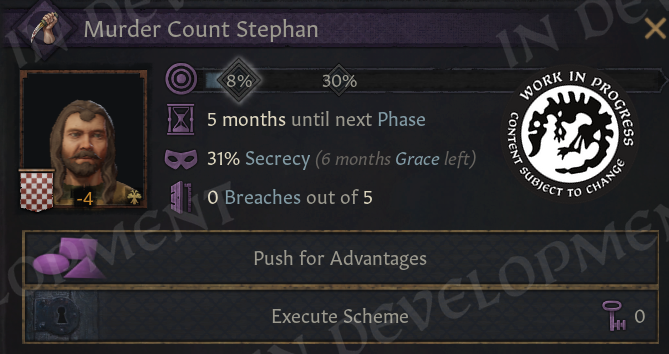
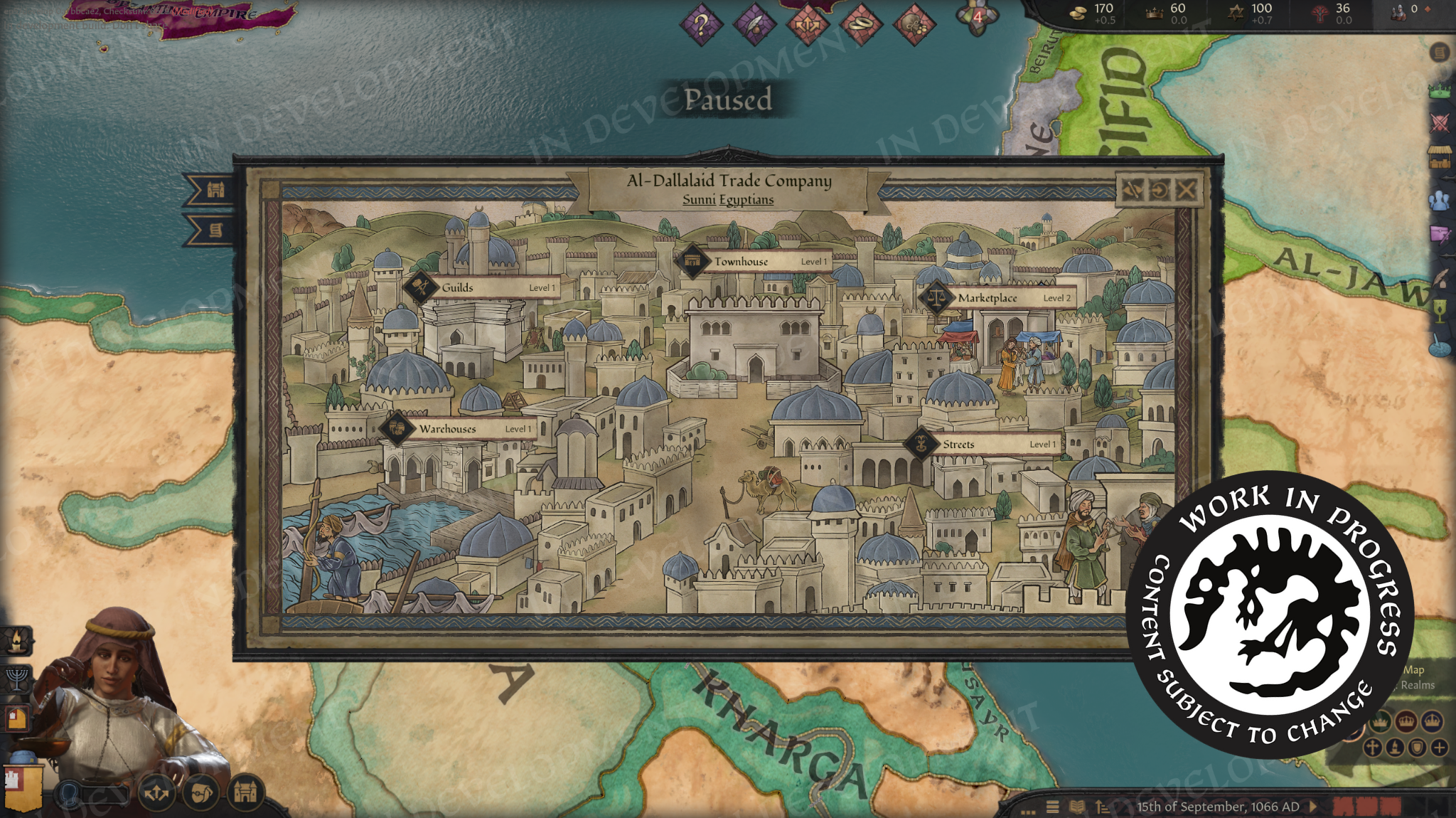
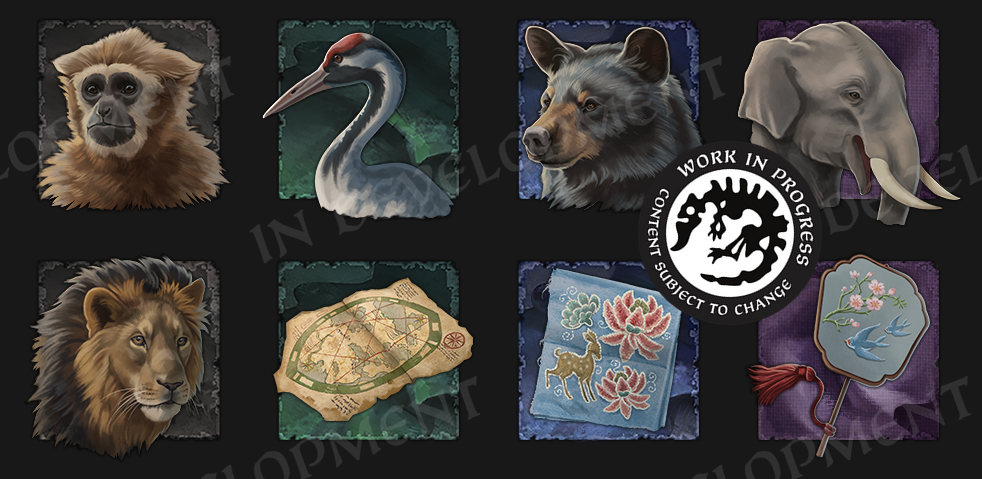

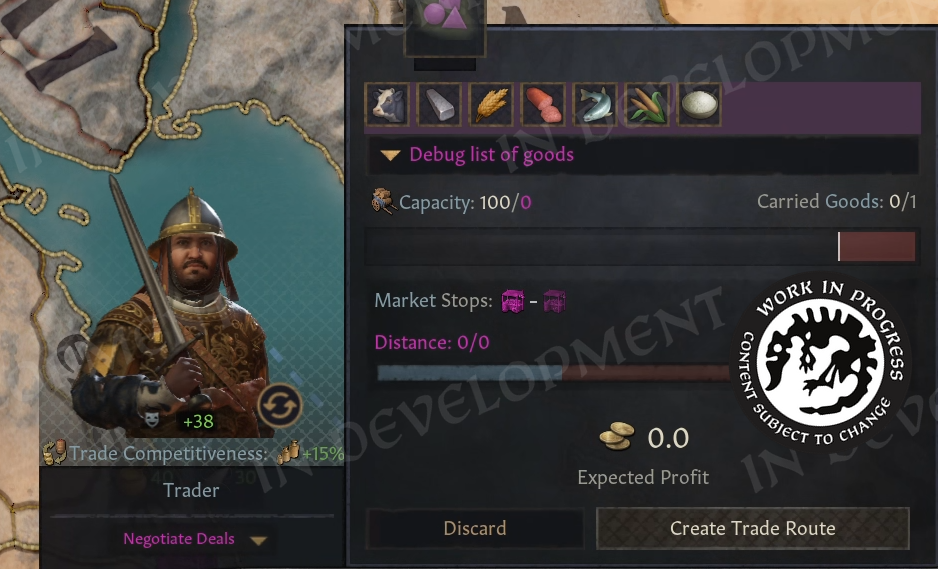
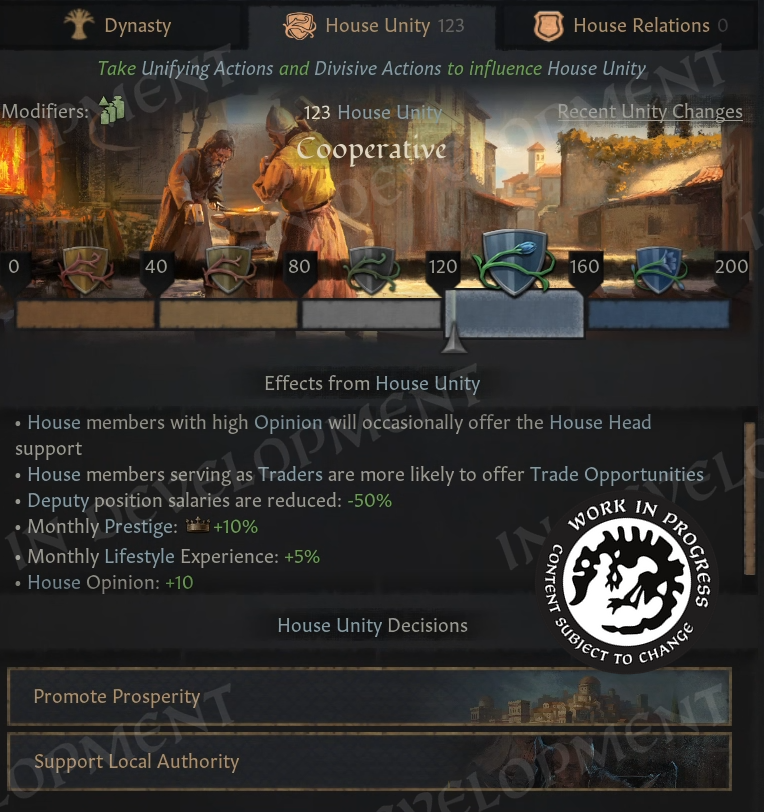
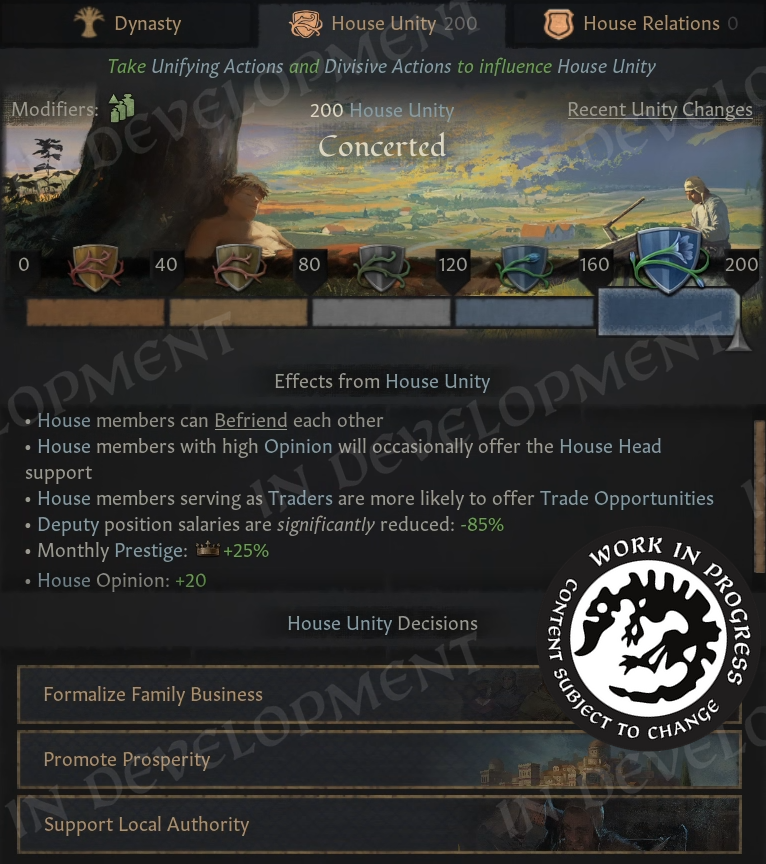
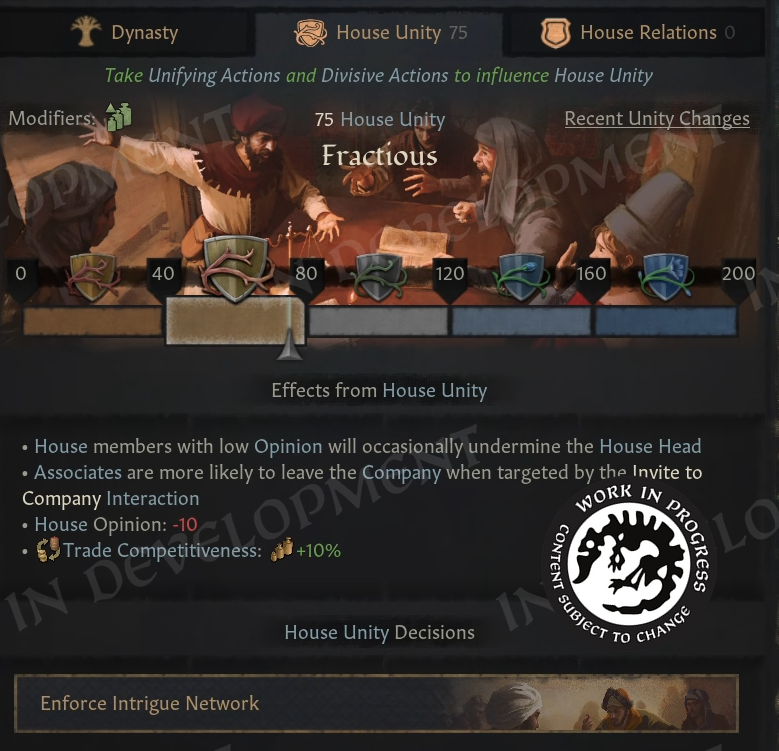
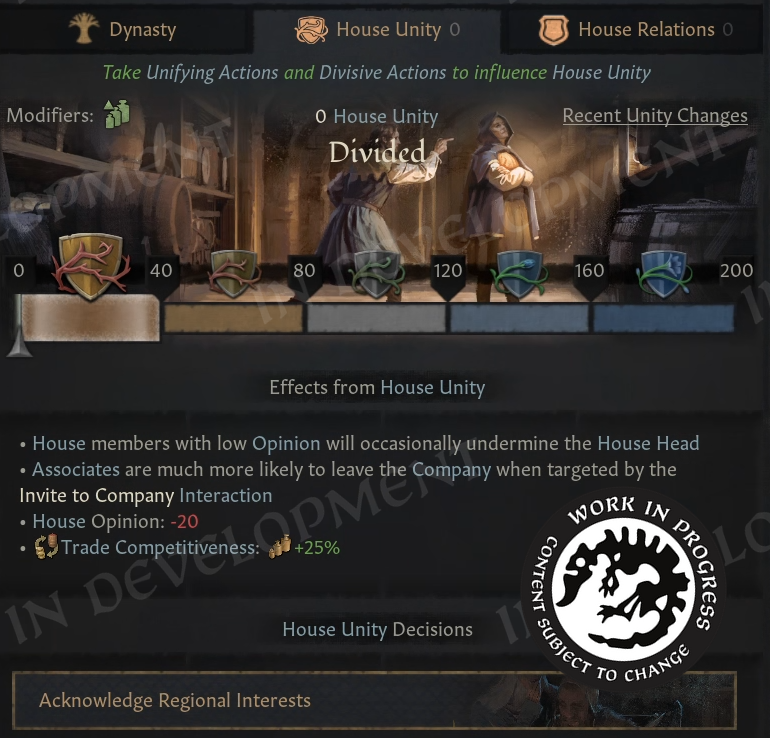

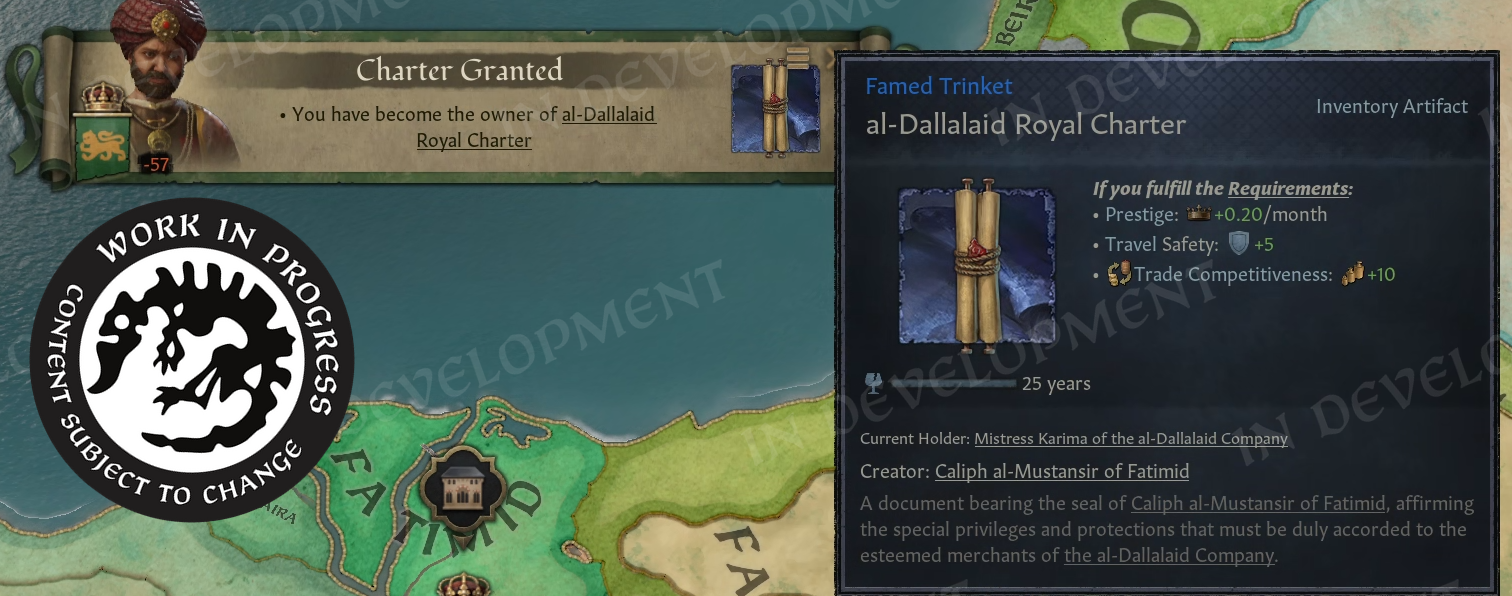
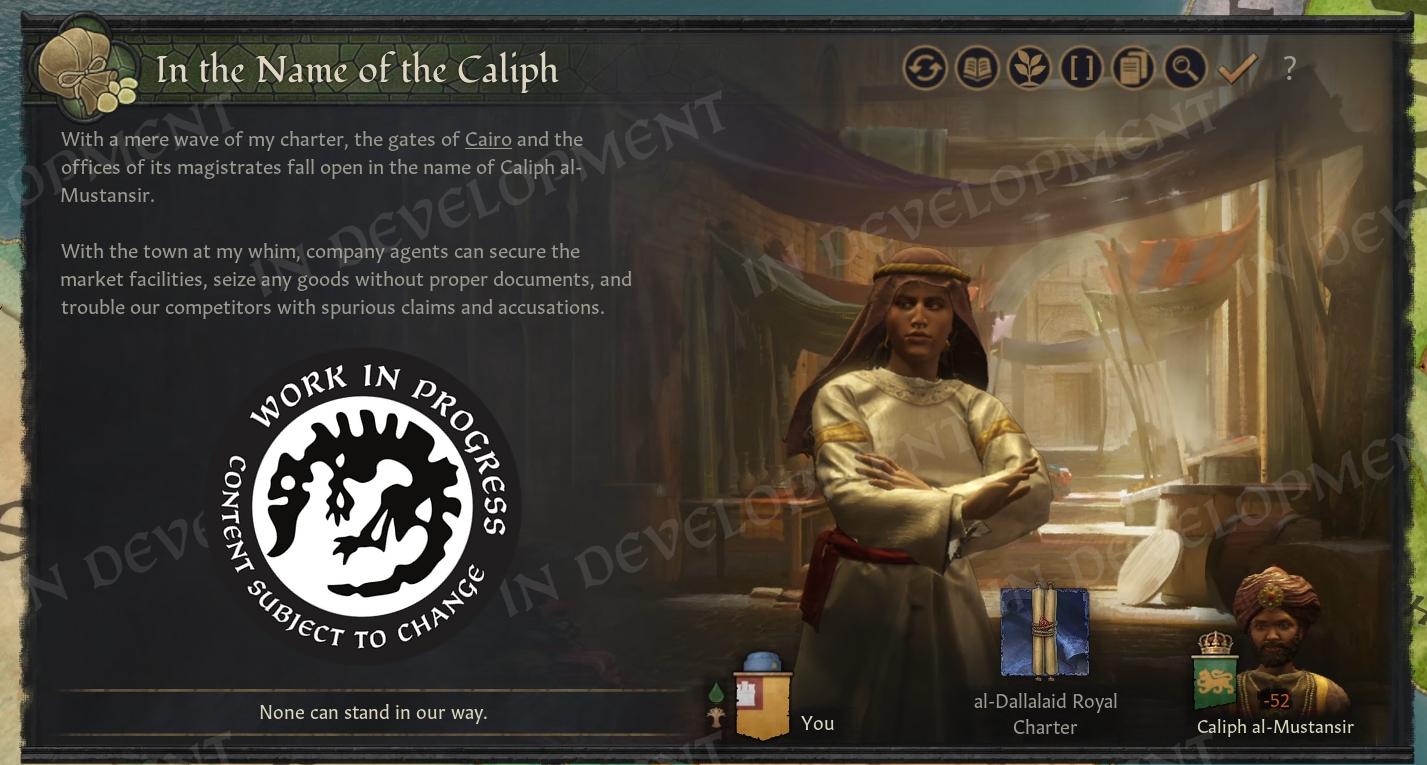

Update 1.19.0.6
Hello everyone! We have a small update today to address some issues reported to us by the community. Check the changelog below for more information.
Update 1.19.0.6 Changelog
Bug Fixes
•
Fixed an issue preventing players from manually inviting agents to schemes
•
Fixed an issue causing epidemics and natural disasters to be less lethal than intended
Update 1.19.0.6 Changelog
Bug Fixes
•
Fixed an issue preventing players from manually inviting agents to schemes
•
Fixed an issue causing epidemics and natural disasters to be less lethal than intended
By God Alone Dev Diary #3 - Ecclesiastical Power & Rites
Happy Tuesday! Mikael here with another By God Alone update. Last time we walked through Ecclesiastical Titles and Rites and while we shone a light on clerical gameplay and faith mechanics, we did not really touch on how a secular character - who you as the player, most often control - can harness said clerical mechanics.
So let's go there!
The year is 1075. You are the King of West Francia, and one of your grouchiest dukes - the one you've stubbornly refused a council seat for decades - has become too big for his britches. He has virtually stopped pretending he isn't preparing a revolt, and you would like him stripped of his vassal oaths before it gets there. The Papacy, however, has made it clear that complaints from secular kings about which of their unruly dukes is or isn't in good standing with God are not, presently, one of Rome's priorities.
Mercifully, you do have a Court Chaplain. Who happens to be the Archbishop! Who, by the strength of a Hook your spymaster fabricated last spring, owes you a favor large enough to impose an Excommunication order all on his own, which would in turn permit you to revoke his title without causing an upset with your other vassals. The duke, after all, falls under the Archbishop's spiritual jurisdiction as well. A brief letter to Rome (on your behalf), and your uppity duke has learned what can happen if he goes against his King's will.
This week is about Puppets - the system by which you, the secular ruler, get clerical levers to move on your behalf - and Playable Theocracies, the answer to the question "what if I just played the clergyman myself?".
Standard caveat: all of this is work in progress, nothing you see here is final, and we'd love your feedback.
A Puppet is a real character, who behaves in accordance with how NPCs typically act in Crusader Kings III. However, by virtue of your hold over them you can also make them act according to your ideas of what they should do. In By God Alone, we are introducing two puppet types which relate specifically to organized religions. The system itself is open both to future expansion and to modders, and is not fundamentally tied to religious matters as such.
When puppets take action at their master's command, the game reads this action as originating from the puppet. Costs and consequences are levied on them, not on you. For the modders out there, this does involve some minimal setup per action (e.g. Character interaction, Decision, Great Project) to ensure the initiator is distinguished from the one actually executing it, but the system is designed to be as designer- and modder-friendly as possible.
In By God Alone, your Court Chaplain is your persistent puppet candidate. To make them Compliant requires meeting some condition, the most obvious one being having a Hook on them, but a variety of other conditions can also be leveraged to ensure compliance: having a very high Level of Devotion yourself, having them as your friend (or… lover), if they sufficiently fear you, or if you are family. Having your dynasty deeply embroiled with the church machinery can be a powerful move.
\
Currently, you can work through your puppeted Court Chaplain to do the following:
•
Found a Rite - the secular ruler's only legal route into the Rite system you saw last time. Now you know who's holding the pen.
•
Plan and Construct a Grand Cathedral as a Great Project, funded out of the Church Treasury rather than your purse.
•
Mass-convert neighboring pagans through a Great Project.
•
Excommunicate a character in the same Archdiocese, with the request lodged under his name rather than yours.
•
Request a new Ecclesiastical Title, splitting their current region in two
•
Request an Elevation to the See for your Puppet, i.e. make them an Archbishop or Patriarch.
•
Turn him into the Head of Faith of a Faith that doesn't currently have one (such as 867+ Chalcedonian Christianity).
Virtually every new action we're making available to theocratic characters, we're also making available through the puppet system. We're not looking to duplicate actions you can normally do yourself, though - the actions you can take through your Puppet is typically limited to that which you do not have direct control over.
The other Puppet type we're adding is the Pope. If you somehow manage to elevate your Puppet to this position, or declare your Puppet the true (anti)pope and depose the pretender, you will have the Pope himself under your thumb via the same system. More on this (and Antipopes) later!
There is, of course, a more elegant solution to the problem of an uncooperative Court Chaplain (if his Superior won't accede to your demands of replacing him). Which is to be your own clergyman.
Theocratic characters - Prince-Bishops; landed Archbishops, Patriarchs, and Cardinals; and even the Pope himself - are now playable. Theocratic government has been in the codebase since launch, but the title-holders have always been NPCs whose succession went into a black box. With By God Alone you can play them, inherit through them in the limited sense theocrats inherit, or continue your dynasty's story through them rather than around them.
There's been a lot of speculation over the years around how theocracies could be made playable, and even if they should be made playable, given they don't follow dynastic inheritance. Well, Crusader Kings III has evolved a lot over the years, with landless play, administrative realms, and Choose Your Destiny type features already transforming what the core play experience looks like. So it's time to rip off the band-aid and give you a new type of player succession, along organizational rather than dynastic lines.
Simply, when playing a theocracy, if you die without a member of your dynasty set to inherit your title, you will instead resume playing the next clergyman in line for your title.
However, while clerical dynasty building was certainly something both the Christian Church and secular rulers tried to crack down on throughout history, it was not unheard of. With the faith's evolution over centuries of tumult modelled in By God Alone, particularly in the early start date both getting your cake and eating it too is far from impossible, as I'll outline below.
But before we go too far, let's talk about what you can actually do as a theocratic ruler. Within Christianity this is done within the confines of a new government type, Ecclesiastical Government - similar to but not identical to Theocratic Government. Succession is appointment-based: when a theocrat dies, the next holder is selected from local clergy, with weights based on how good of a Christian they are (or appear to be) and how well they have served the faith.
A theocratic ruler:
•
Has a Treasury (which belongs to the Church, and works similarly to Treasury in admin realms), as distinct from their Gold
•
Has a personal clerical domicile, they can build up to better see to the needs of their flock
•
Appoints subordinates (bishops) within their own ecclesiastical hierarchy
•
Often serves as the Court Chaplain of local secular rulers
•
Cannot start wars against Christian rulers, but can gain land from Christian rulers by exploiting their inheritance laws
•
Maintains their own Church Authority law-group, the theocratic parallel to a feudal lord's Crown Authority. Raising it costs Piety but unlocks abilities, most notably the legal precondition for establishing a theocratic dynasty. Letting it slip exposes you to a new Humiliation CB that Christian neighbors with higher authority or Piety can declare (at considerable consequences, of course)
•
They remain a political actor. They can still rise, fall, and be schemed against
What you don't get is automatic direct dynastic continuity through children, the way a feudal duke does. Most theocrats are ostensibly sworn to celibacy, and the canonical succession model is appointment to a related-or-promising clergy character rather than to your bloodline. We've leaned into this rather than around it: the dynasty-building loop for a theocrat is about ensuring the next holder of your See is also of your house, by mentoring and elevating eligible nephews and protégés in time for them to be on the appointment shortlist when you die.
\
The extreme case is the Holy Father himself.
As Pope, you sit on top of the central Church Treasury, funded by tithes from every Catholic church in Christendom, and quite possibly the largest single pot of gold in the game - at least when the Church is healthy. You hold the levers a secular player can only influence through their Puppets:
•
You appoint (and pay) Cardinals, and give them Orders
•
You call Ecumenical Councils and decide what they are about
•
You Excommunicate rulers who displease you, with all the secondary consequences that cascade through the political map
•
You approve Holy Sites for Catholicism
•
You issue Papal Bulls, powerful edicts underwritten by Rome. These include the ability to launch a targeted crusade, declaring a Rite heretical, or declaring a certain Tenet permitted or forbidden.
\
Of course, every secular Christian ruler is, at some level, trying to influence you. Christian Kings and Emperors will line up at the Apostolic Palace to request some favor or another. It's up to you to decide who to hear, and whose wishes align with the will of God. Note that we will no longer direct every request for divine grace through the Pope - many concerns can be handled by the Church's local representatives (e.g. Archbishops), to avoid spamming a player whenever some local count thinks their half-brother is an affront to God
Speaking of the Apostolic Palace, this will be a new Throne Room which you will see (and have to maintain) both when playing as the Pope, and when visiting Rome to ask the Papacy to grace you in various ways. Visuals will be coming later, I promise!
With the ability to play as the Pope, it also makes the question of who becomes the next Pope that much more relevant.
While there were certainly times in the history of Catholicism when it took quite a long time for a Pope to get elected (the record held by the election of Pope Gregory X in 1271, after over 1000 days of divisive debates resulting in the locals locking the cardinals up and restricting their access to food and shelter until they came to an agreement, thus establishing the conclave tradition we know today), CK3 isn't really paced for tactical plotting over a short period of days or weeks. As such, the College is always considered to be deliberating over who will take the seat next, and cardinals can be influenced at any time.
There are always three candidates for the seat, selected based on the following criteria:
•
The obvious choice (Cardinal most entrenched in the Church power structure)
•
The pious choice (Cardinal with the highest level of Devotion)
•
The powerful choice (Rite Head with the largest flock)
Of these selected candidates, cardinals will select their preferred option based on typical parameters like opinion, but also how their teachings align with the cardinal's traits. Every papal candidate has the opportunity to switch one Core Tenet as they rise to the seat, and if this change sits well with a particular cardinal, they're more likely to align with that candidate. Spiritual Fulfillment thereby becomes the driving force of the evolution of the Christian faith.
\
Oh, and should you manage to get elected, you may of course select what Christendom will henceforth know you as.
\
The Puppet system is faith-agnostic at the framework level. The same compliance check would carry over to any organized religion with a realm priest. However, a lot of the new actions we're making for By God Alone are specifically geared towards Christianity - manipulating the Archdiocese titles, asking for a Cardinalate, building Cathedrals. As such, the applicability of non-Christian realm priest puppets will be a bit lower.
Playable Theocracies are the more broadly applicable half. The pre-existing Theocracy government type covers clergy-as-ruler arrangements outside Christianity. What does not generalize is the centralized Christian institutional spine: the Curia, the College of Cardinals, the Papal Bull, the Ecclesiastical Title hierarchy. Those remain Christian-only because that's primarily what the expansion is modelling.
See you next time!
So let's go there!
The year is 1075. You are the King of West Francia, and one of your grouchiest dukes - the one you've stubbornly refused a council seat for decades - has become too big for his britches. He has virtually stopped pretending he isn't preparing a revolt, and you would like him stripped of his vassal oaths before it gets there. The Papacy, however, has made it clear that complaints from secular kings about which of their unruly dukes is or isn't in good standing with God are not, presently, one of Rome's priorities.
Mercifully, you do have a Court Chaplain. Who happens to be the Archbishop! Who, by the strength of a Hook your spymaster fabricated last spring, owes you a favor large enough to impose an Excommunication order all on his own, which would in turn permit you to revoke his title without causing an upset with your other vassals. The duke, after all, falls under the Archbishop's spiritual jurisdiction as well. A brief letter to Rome (on your behalf), and your uppity duke has learned what can happen if he goes against his King's will.
This week is about Puppets - the system by which you, the secular ruler, get clerical levers to move on your behalf - and Playable Theocracies, the answer to the question "what if I just played the clergyman myself?".
Standard caveat: all of this is work in progress, nothing you see here is final, and we'd love your feedback.
A Puppet is a real character, who behaves in accordance with how NPCs typically act in Crusader Kings III. However, by virtue of your hold over them you can also make them act according to your ideas of what they should do. In By God Alone, we are introducing two puppet types which relate specifically to organized religions. The system itself is open both to future expansion and to modders, and is not fundamentally tied to religious matters as such.
When puppets take action at their master's command, the game reads this action as originating from the puppet. Costs and consequences are levied on them, not on you. For the modders out there, this does involve some minimal setup per action (e.g. Character interaction, Decision, Great Project) to ensure the initiator is distinguished from the one actually executing it, but the system is designed to be as designer- and modder-friendly as possible.
In By God Alone, your Court Chaplain is your persistent puppet candidate. To make them Compliant requires meeting some condition, the most obvious one being having a Hook on them, but a variety of other conditions can also be leveraged to ensure compliance: having a very high Level of Devotion yourself, having them as your friend (or… lover), if they sufficiently fear you, or if you are family. Having your dynasty deeply embroiled with the church machinery can be a powerful move.
\
Currently, you can work through your puppeted Court Chaplain to do the following:
•
Found a Rite - the secular ruler's only legal route into the Rite system you saw last time. Now you know who's holding the pen.
•
Plan and Construct a Grand Cathedral as a Great Project, funded out of the Church Treasury rather than your purse.
•
Mass-convert neighboring pagans through a Great Project.
•
Excommunicate a character in the same Archdiocese, with the request lodged under his name rather than yours.
•
Request a new Ecclesiastical Title, splitting their current region in two
•
Request an Elevation to the See for your Puppet, i.e. make them an Archbishop or Patriarch.
•
Turn him into the Head of Faith of a Faith that doesn't currently have one (such as 867+ Chalcedonian Christianity).
Virtually every new action we're making available to theocratic characters, we're also making available through the puppet system. We're not looking to duplicate actions you can normally do yourself, though - the actions you can take through your Puppet is typically limited to that which you do not have direct control over.
The other Puppet type we're adding is the Pope. If you somehow manage to elevate your Puppet to this position, or declare your Puppet the true (anti)pope and depose the pretender, you will have the Pope himself under your thumb via the same system. More on this (and Antipopes) later!
There is, of course, a more elegant solution to the problem of an uncooperative Court Chaplain (if his Superior won't accede to your demands of replacing him). Which is to be your own clergyman.
Theocratic characters - Prince-Bishops; landed Archbishops, Patriarchs, and Cardinals; and even the Pope himself - are now playable. Theocratic government has been in the codebase since launch, but the title-holders have always been NPCs whose succession went into a black box. With By God Alone you can play them, inherit through them in the limited sense theocrats inherit, or continue your dynasty's story through them rather than around them.
There's been a lot of speculation over the years around how theocracies could be made playable, and even if they should be made playable, given they don't follow dynastic inheritance. Well, Crusader Kings III has evolved a lot over the years, with landless play, administrative realms, and Choose Your Destiny type features already transforming what the core play experience looks like. So it's time to rip off the band-aid and give you a new type of player succession, along organizational rather than dynastic lines.
Simply, when playing a theocracy, if you die without a member of your dynasty set to inherit your title, you will instead resume playing the next clergyman in line for your title.
However, while clerical dynasty building was certainly something both the Christian Church and secular rulers tried to crack down on throughout history, it was not unheard of. With the faith's evolution over centuries of tumult modelled in By God Alone, particularly in the early start date both getting your cake and eating it too is far from impossible, as I'll outline below.
But before we go too far, let's talk about what you can actually do as a theocratic ruler. Within Christianity this is done within the confines of a new government type, Ecclesiastical Government - similar to but not identical to Theocratic Government. Succession is appointment-based: when a theocrat dies, the next holder is selected from local clergy, with weights based on how good of a Christian they are (or appear to be) and how well they have served the faith.
A theocratic ruler:
•
Has a Treasury (which belongs to the Church, and works similarly to Treasury in admin realms), as distinct from their Gold
•
Has a personal clerical domicile, they can build up to better see to the needs of their flock
•
Appoints subordinates (bishops) within their own ecclesiastical hierarchy
•
Often serves as the Court Chaplain of local secular rulers
•
Cannot start wars against Christian rulers, but can gain land from Christian rulers by exploiting their inheritance laws
•
Maintains their own Church Authority law-group, the theocratic parallel to a feudal lord's Crown Authority. Raising it costs Piety but unlocks abilities, most notably the legal precondition for establishing a theocratic dynasty. Letting it slip exposes you to a new Humiliation CB that Christian neighbors with higher authority or Piety can declare (at considerable consequences, of course)
•
They remain a political actor. They can still rise, fall, and be schemed against
What you don't get is automatic direct dynastic continuity through children, the way a feudal duke does. Most theocrats are ostensibly sworn to celibacy, and the canonical succession model is appointment to a related-or-promising clergy character rather than to your bloodline. We've leaned into this rather than around it: the dynasty-building loop for a theocrat is about ensuring the next holder of your See is also of your house, by mentoring and elevating eligible nephews and protégés in time for them to be on the appointment shortlist when you die.
\
The extreme case is the Holy Father himself.
As Pope, you sit on top of the central Church Treasury, funded by tithes from every Catholic church in Christendom, and quite possibly the largest single pot of gold in the game - at least when the Church is healthy. You hold the levers a secular player can only influence through their Puppets:
•
You appoint (and pay) Cardinals, and give them Orders
•
You call Ecumenical Councils and decide what they are about
•
You Excommunicate rulers who displease you, with all the secondary consequences that cascade through the political map
•
You approve Holy Sites for Catholicism
•
You issue Papal Bulls, powerful edicts underwritten by Rome. These include the ability to launch a targeted crusade, declaring a Rite heretical, or declaring a certain Tenet permitted or forbidden.
\
Of course, every secular Christian ruler is, at some level, trying to influence you. Christian Kings and Emperors will line up at the Apostolic Palace to request some favor or another. It's up to you to decide who to hear, and whose wishes align with the will of God. Note that we will no longer direct every request for divine grace through the Pope - many concerns can be handled by the Church's local representatives (e.g. Archbishops), to avoid spamming a player whenever some local count thinks their half-brother is an affront to God
Speaking of the Apostolic Palace, this will be a new Throne Room which you will see (and have to maintain) both when playing as the Pope, and when visiting Rome to ask the Papacy to grace you in various ways. Visuals will be coming later, I promise!
With the ability to play as the Pope, it also makes the question of who becomes the next Pope that much more relevant.
While there were certainly times in the history of Catholicism when it took quite a long time for a Pope to get elected (the record held by the election of Pope Gregory X in 1271, after over 1000 days of divisive debates resulting in the locals locking the cardinals up and restricting their access to food and shelter until they came to an agreement, thus establishing the conclave tradition we know today), CK3 isn't really paced for tactical plotting over a short period of days or weeks. As such, the College is always considered to be deliberating over who will take the seat next, and cardinals can be influenced at any time.
There are always three candidates for the seat, selected based on the following criteria:
•
The obvious choice (Cardinal most entrenched in the Church power structure)
•
The pious choice (Cardinal with the highest level of Devotion)
•
The powerful choice (Rite Head with the largest flock)
Of these selected candidates, cardinals will select their preferred option based on typical parameters like opinion, but also how their teachings align with the cardinal's traits. Every papal candidate has the opportunity to switch one Core Tenet as they rise to the seat, and if this change sits well with a particular cardinal, they're more likely to align with that candidate. Spiritual Fulfillment thereby becomes the driving force of the evolution of the Christian faith.
\
Oh, and should you manage to get elected, you may of course select what Christendom will henceforth know you as.
\
The Puppet system is faith-agnostic at the framework level. The same compliance check would carry over to any organized religion with a realm priest. However, a lot of the new actions we're making for By God Alone are specifically geared towards Christianity - manipulating the Archdiocese titles, asking for a Cardinalate, building Cathedrals. As such, the applicability of non-Christian realm priest puppets will be a bit lower.
Playable Theocracies are the more broadly applicable half. The pre-existing Theocracy government type covers clergy-as-ruler arrangements outside Christianity. What does not generalize is the centralized Christian institutional spine: the Curia, the College of Cardinals, the Papal Bull, the Ecclesiastical Title hierarchy. Those remain Christian-only because that's primarily what the expansion is modelling.
See you next time!

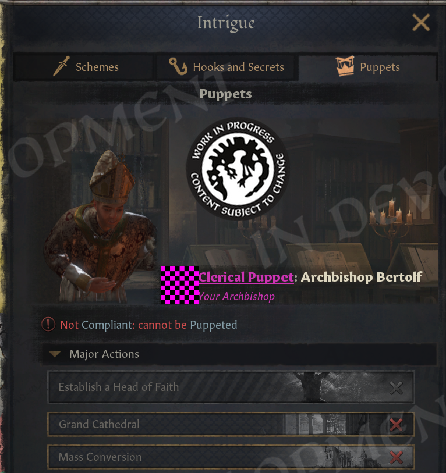

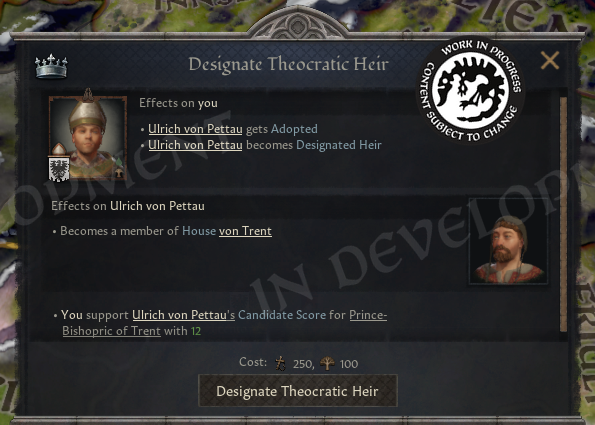

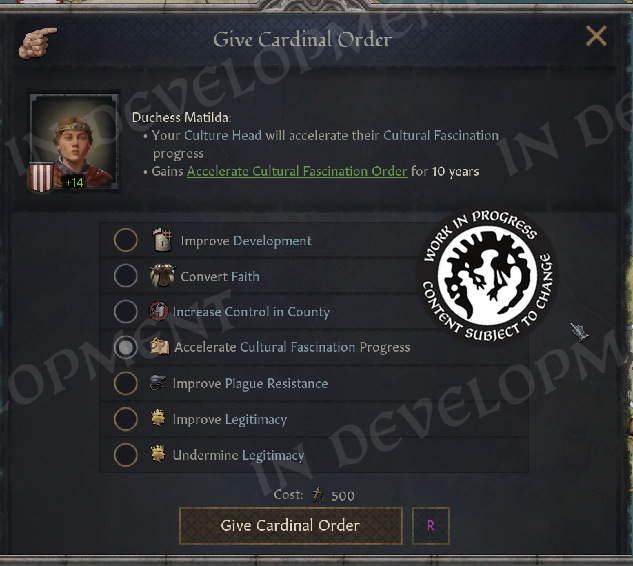

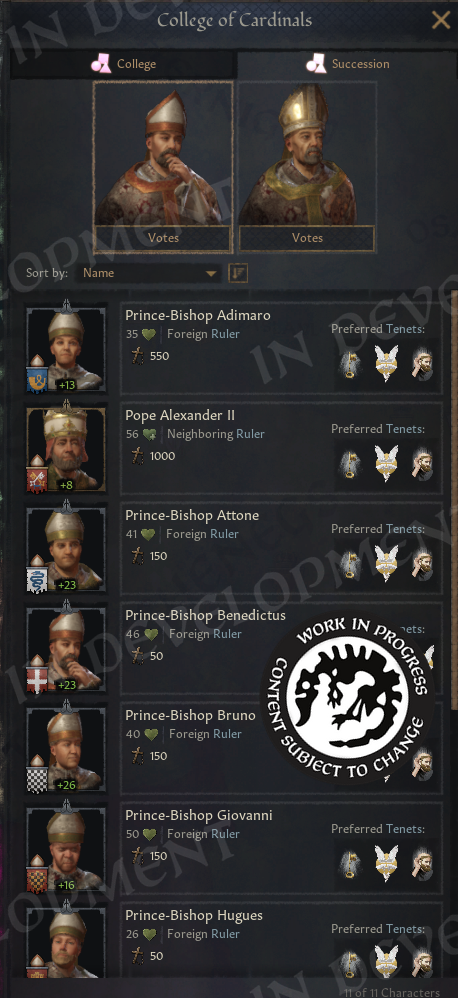
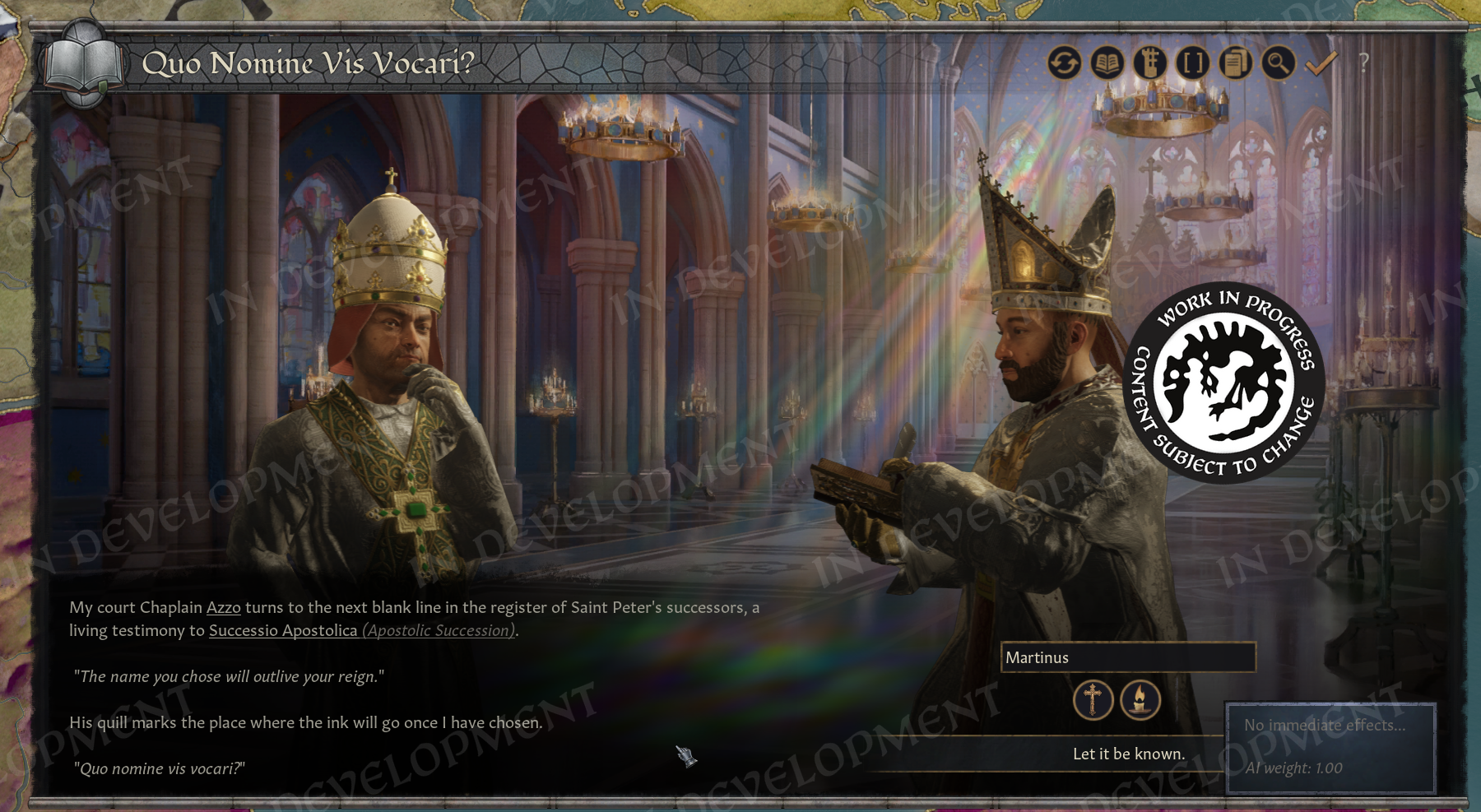

Silk & Silver Dev Diary #2 - Trade Vision
Greetings!
I’ll be following up on the overall vision dev diary with a deeper dive into our design for the Trade System. We’re starting our feature-specific dev diaries with Trade because, as you’ll see, it is connected to nearly every other feature we’re developing for Silk & Silver. But before we get into it, remember that all screenshots are work-in-progress and we are in the middle of development. Everything is subject to change.
Trade is a new layer that not only provides a new mechanic primarily used by Mercantile Governments, but more importantly, makes economic play more strategic for all characters and connects buildings on the map to actual gameplay. It’s where the other features in Silk & Silver meet and clash, where mercantile empires and trade leagues are born.
When you start your first Trade Route in Silk & Silver, the economic engines of the medieval world will already be turning. Your job is to muscle your way in and carve out your niche.
Before we get into how Trade plays out moment-to-moment, let's lay out all the levers we will have at our disposal. The Trade system is built from a handful of core concepts: Markets, Goods, Categories, Routes, and Monopolies. Each has a clear function, but they interact constantly. We'll take each in turn.
Trade Markets
The world is filled with over 900 Trade Markets, one for each de jure duchy on the map. Each Market is located in the capital barony of its de jure duchy and serves all of its constituent holdings inside that duchy area. These are defined on game start and do not move.
Trade Markets track the overall Trade Good Productions and Needs of their constituent holdings. They are the mercantile hub of the area. Holding the de jure duchy capital where the Market is located provides you with some bonuses like being able to hand out Monopolies (discussed below).
Trade Goods
At time of writing, there are over 40 types of Trade Goods scripted in the game. These are entirely defined by script, so yes, modders, you can go wild.
Trade Goods are primarily produced in Resource Production Districts and their associated Buildings. We track Production via modifiers on provinces. The system is designed to be quite flexible to allow for content and other systems to affect production, buy/sell price, and other factors.
Trade Categories
When a building needs grain to feed its workers, it doesn't really care whether it gets grain, millet, or rice. What it really wants is cereals. Cue Trade Categories.
Trade Categories group related goods together so the system can express needs at the right level of abstraction. Some categories are simple: Salt is a single-good category. Others, like Cereals or Meats, can be filled by any of several substitutable goods. This becomes important in two places: when buildings broadcast what they want, and when monopolies claim an entire slice of the market, but more on those below.
Trade Routes
Trade Stats
•
Max Routes — how many routes you can run simultaneously.
•
Max Markets per Route — how many stops a single route can string together.
•
Range — how far from your home market a route can reach.
•
Capacity — how much a single route can carry in terms of Trade Good quantity.
•
Competitiveness — how aggressively the route claims its share when contested. (Big enough topic that we'll come back to it below.)
Most of these grow as you invest in the trader assigned to the Route, your Domicile buildings, and your route history. Specialization and commitment compound.
Primary Goods & Trade Expertise
Every Trade Route designates one of its goods as the route's Primary Good. This is the route's specialty, the thing it gets better at over time. Trading a Primary Good earns Trade Expertise in that good's category, and as a category levels up, the merchant gains stacking bonuses to how well they trade goods in that category.
A merchant who's mongered cheese for forty years isn't just a simple cheese trader. They're the Cheesemonger of Europe, and the system is built to reward exactly that kind of patience. Pick a good, stick with it, and let the years compound.
Trade Expertise lives on the merchant's title rather than directly on the character, so progression survives succession. Your heir inherits the family's hard-won reputation and resumes the work.
Acumen
Acumen represents a Merchant's business savvy. It grows month by month based on the profit they actually pull in, not the volume they move or how many routes they run. At higher levels, Acumen unlocks personal bonuses that lift every Trade Route the Merchant owns. The intent is a subtle pressure to stay profitable and reward sharp deals.
Traders
The quotidian tasks of a Trade Route are managed by a Trader. Traders are characters you assign from your Associates or family members. A Trader's skills shape what their route is good at, affecting things like Competitiveness, for example. A well-rounded Merchant Company means you can maximize the effectiveness of all your Trade Routes
Competitiveness
When more than one merchant tries to sell salt in the same market, who wins? Cue Competitiveness. Each route's share of a market's trade is determined by its Competitiveness relative to the Competitiveness of other Trade Routes trading that same good.
You don't get exclusivity without a Monopoly (discussed below). Instead, you get a slice proportional to your Competitiveness score. That makes Competitiveness the single most contested stat in the system. Investing in your Competitiveness is a key way to garner success as a Merchant and ensure that you are able to buy and sell up to your maximum potential.
Monopolies
A Monopoly is the ultimate version of Competitiveness. Where Competitiveness lets you compete for a share, a Monopoly locks the market down entirely. Other traders simply cannot move that category of goods through a market you have monopolized.
Monopolies are granted by the holder of the market's capital, and they can be granted to a specific merchant, to a republic, or to an entire Trade League whose members all share the privilege. Two types exist:
•
Normal monopolies respect local needs and claim the entire surplus.
•
Exploitative monopolies pull goods from local demand too, enriching the monopoly holder at the expense of the markets.
Both of these types can be on a single Category, or extended over an entire Market, making it a complete market monopoly.
The Trade Loop Overview
Trade connects Trade Markets and balances their surplus productions with needed goods. Once a month, every market in the world calculates what it produces and what its buildings need. Routes then look at those balances and propose trades: buy up some surplus from one market, sell it for a tidy profit (if you have a Mercantile government) in a market with a deficit. The system resolves all of these proposals, adjusts balances across all the markets, settles the profit accumulated, and marks which Buildings' Needs are fulfilled.
Needs & Productions
Needs come from buildings. Many buildings require certain trade good types or categories: grain, leather, iron, dyes, etc. That demand is rolled into its market's monthly Needs.
Production comes from Resource Production Districts and their associated Buildings.
When Production exceeds Need, the market has a Surplus available to export. When Need exceeds Production, the market has a Deficit waiting to be filled. Buildings sit at the heart of the new economy and your decisions about which buildings to construct directly shape how markets behave and, consequently, what the trade landscape looks like from game to game.
Trade for Landed Rulers
If you're playing a settled ruler with land to manage, Trade is mostly something that happens to you. You don't profit from trade routes, and you can't really go toe-to-toe with merchants for market share. What you can do is run what we're currently calling Acquisition Routes (the name is still in flux): routes that exist purely to move goods into your lands so your buildings get what they need.
These are incredibly limited, though, and you'll rely on Merchants to fulfill the vast majority of your Needs. They're the ones who'll actually fill your markets at scale. So you build relationships: invite merchants to your court, grant them concessions, contract them to fulfill a certain Need, etc. How you interact with them is entirely up to you, but remember that the carrot usually works better than the stick.
Trade For Merchants & Republics
If you're a Merchant or a Republic, Trade is your whole world. You run Profit Routes with the goal of buying low in surplus markets, selling high in deficit markets, and most importantly, profiting. You compete with market rivals, lobby for Monopolies, level up Trader skills, build Acumen, and stitch together a network of Markets that compounds over generations.
Setting up a Trade Route
Setting up a route is the central action of mercantile gameplay. You pick a chain of markets you want to connect, choose which goods you'll move, designate one as your Primary Good (the route's specialty, and the category for which you'll earn experience in), and assign a Trader to run it. The route then becomes a persistent thing in the world, visible on the map, generating gold (only for mercantile characters), aging, leveling, and over time perhaps even paving roads as it goes.
Routes require a certain level of commitment. You can edit them, sure, but you can't shuffle them around entirely or replace a route so completely that it becomes the Route of Theseus. A route's defining characteristics matter.
Monthly Recurring Trade
Once a route is running, it's largely self-driving. Each month, every active route ticks: it buys from its source markets, sells in its destination markets, settles the books, and credits your treasury. You don't need to micromanage, though you very well can and should if you want to squeeze every last piece of gold out of the economy.
Wars, plagues, building changes, and competitor pressure all shift the numbers month-to-month. A perspicacious merchant will notice when a profitable route starts slipping and intervene before it breaks; one who doesn't may simply wonder why their income is quietly eroding as the months pass by.
Trade Posts
Trade Posts are the long arm of a Republic. A Republic ruler can establish Trade Posts in county capitals across the world. Trade Posts host their own buildings (which benefit the Republic owner, not the local ruler) and let a Republic project economic power into territories it doesn't actually control. You'll hear more about these in a future dev diary.
Roads
Trade leaves marks on the map. Where routes run consistently between two Markets year after year, roads emerge: first as worn paths, then proper roads, climbing through tiers as the routes hold their course. Each tier moves armies a bit faster, makes travel a bit safer, and adds a variety of modifiers along the way. Stop trading, and the road decays. We'll dig into roads further in a future dev diary.
One question we know we'll get is: How will the AI handle all this? This, along with economy balancing, is something we are seriously iterating on as we develop the expansion. Merchant and Republic AI characters create routes, pick goods, assign Traders, lobby for monopolies, and compete with you for market share. Currently, the new system feels populated: markets aren't empty until you show up to trade in them; they're already busy, and your job is to muscle in.
We're still tuning, and will continue to do so until release. The AI doesn't yet do everything we want it to, and we'll keep iterating through the rest of the production cycle. But the foundation, i.e. AI characters being real participants in the economic world instead of background scenery, is in.
Other areas we have a keen eye on are ensuring the AI has competitive strategies for determining building chains to construct and, on the flip side, that AI Merchants make smart trades without min/maxing like some players might.
That's the vision. Trade in Silk & Silver is the layer where buildings, characters, geography, and politics all push against each other. It's a system that wants you to build empires of cheese, medicaments, salami, and silk; one that rewards specialization and patience; and one that makes the world feel populated with economic competitors and allies.
We've left out some detail here on purpose. A more technical dev diary will follow closer to release where we'll dig into the mechanics, modifiers, script, etc. For now, we wanted to give you the shape of the system and a sense of how it'll feel to play. See you in the comments.
I’ll be following up on the overall vision dev diary with a deeper dive into our design for the Trade System. We’re starting our feature-specific dev diaries with Trade because, as you’ll see, it is connected to nearly every other feature we’re developing for Silk & Silver. But before we get into it, remember that all screenshots are work-in-progress and we are in the middle of development. Everything is subject to change.
Trade is a new layer that not only provides a new mechanic primarily used by Mercantile Governments, but more importantly, makes economic play more strategic for all characters and connects buildings on the map to actual gameplay. It’s where the other features in Silk & Silver meet and clash, where mercantile empires and trade leagues are born.
When you start your first Trade Route in Silk & Silver, the economic engines of the medieval world will already be turning. Your job is to muscle your way in and carve out your niche.
Before we get into how Trade plays out moment-to-moment, let's lay out all the levers we will have at our disposal. The Trade system is built from a handful of core concepts: Markets, Goods, Categories, Routes, and Monopolies. Each has a clear function, but they interact constantly. We'll take each in turn.
Trade Markets
The world is filled with over 900 Trade Markets, one for each de jure duchy on the map. Each Market is located in the capital barony of its de jure duchy and serves all of its constituent holdings inside that duchy area. These are defined on game start and do not move.
Trade Markets track the overall Trade Good Productions and Needs of their constituent holdings. They are the mercantile hub of the area. Holding the de jure duchy capital where the Market is located provides you with some bonuses like being able to hand out Monopolies (discussed below).
Trade Goods
At time of writing, there are over 40 types of Trade Goods scripted in the game. These are entirely defined by script, so yes, modders, you can go wild.
Trade Goods are primarily produced in Resource Production Districts and their associated Buildings. We track Production via modifiers on provinces. The system is designed to be quite flexible to allow for content and other systems to affect production, buy/sell price, and other factors.
Trade Categories
When a building needs grain to feed its workers, it doesn't really care whether it gets grain, millet, or rice. What it really wants is cereals. Cue Trade Categories.
Trade Categories group related goods together so the system can express needs at the right level of abstraction. Some categories are simple: Salt is a single-good category. Others, like Cereals or Meats, can be filled by any of several substitutable goods. This becomes important in two places: when buildings broadcast what they want, and when monopolies claim an entire slice of the market, but more on those below.
Trade Routes
Trade Stats
•
Max Routes — how many routes you can run simultaneously.
•
Max Markets per Route — how many stops a single route can string together.
•
Range — how far from your home market a route can reach.
•
Capacity — how much a single route can carry in terms of Trade Good quantity.
•
Competitiveness — how aggressively the route claims its share when contested. (Big enough topic that we'll come back to it below.)
Most of these grow as you invest in the trader assigned to the Route, your Domicile buildings, and your route history. Specialization and commitment compound.
Primary Goods & Trade Expertise
Every Trade Route designates one of its goods as the route's Primary Good. This is the route's specialty, the thing it gets better at over time. Trading a Primary Good earns Trade Expertise in that good's category, and as a category levels up, the merchant gains stacking bonuses to how well they trade goods in that category.
A merchant who's mongered cheese for forty years isn't just a simple cheese trader. They're the Cheesemonger of Europe, and the system is built to reward exactly that kind of patience. Pick a good, stick with it, and let the years compound.
Trade Expertise lives on the merchant's title rather than directly on the character, so progression survives succession. Your heir inherits the family's hard-won reputation and resumes the work.
Acumen
Acumen represents a Merchant's business savvy. It grows month by month based on the profit they actually pull in, not the volume they move or how many routes they run. At higher levels, Acumen unlocks personal bonuses that lift every Trade Route the Merchant owns. The intent is a subtle pressure to stay profitable and reward sharp deals.
Traders
The quotidian tasks of a Trade Route are managed by a Trader. Traders are characters you assign from your Associates or family members. A Trader's skills shape what their route is good at, affecting things like Competitiveness, for example. A well-rounded Merchant Company means you can maximize the effectiveness of all your Trade Routes
Competitiveness
When more than one merchant tries to sell salt in the same market, who wins? Cue Competitiveness. Each route's share of a market's trade is determined by its Competitiveness relative to the Competitiveness of other Trade Routes trading that same good.
You don't get exclusivity without a Monopoly (discussed below). Instead, you get a slice proportional to your Competitiveness score. That makes Competitiveness the single most contested stat in the system. Investing in your Competitiveness is a key way to garner success as a Merchant and ensure that you are able to buy and sell up to your maximum potential.
Monopolies
A Monopoly is the ultimate version of Competitiveness. Where Competitiveness lets you compete for a share, a Monopoly locks the market down entirely. Other traders simply cannot move that category of goods through a market you have monopolized.
Monopolies are granted by the holder of the market's capital, and they can be granted to a specific merchant, to a republic, or to an entire Trade League whose members all share the privilege. Two types exist:
•
Normal monopolies respect local needs and claim the entire surplus.
•
Exploitative monopolies pull goods from local demand too, enriching the monopoly holder at the expense of the markets.
Both of these types can be on a single Category, or extended over an entire Market, making it a complete market monopoly.
The Trade Loop Overview
Trade connects Trade Markets and balances their surplus productions with needed goods. Once a month, every market in the world calculates what it produces and what its buildings need. Routes then look at those balances and propose trades: buy up some surplus from one market, sell it for a tidy profit (if you have a Mercantile government) in a market with a deficit. The system resolves all of these proposals, adjusts balances across all the markets, settles the profit accumulated, and marks which Buildings' Needs are fulfilled.
Needs & Productions
Needs come from buildings. Many buildings require certain trade good types or categories: grain, leather, iron, dyes, etc. That demand is rolled into its market's monthly Needs.
Production comes from Resource Production Districts and their associated Buildings.
When Production exceeds Need, the market has a Surplus available to export. When Need exceeds Production, the market has a Deficit waiting to be filled. Buildings sit at the heart of the new economy and your decisions about which buildings to construct directly shape how markets behave and, consequently, what the trade landscape looks like from game to game.
Trade for Landed Rulers
If you're playing a settled ruler with land to manage, Trade is mostly something that happens to you. You don't profit from trade routes, and you can't really go toe-to-toe with merchants for market share. What you can do is run what we're currently calling Acquisition Routes (the name is still in flux): routes that exist purely to move goods into your lands so your buildings get what they need.
These are incredibly limited, though, and you'll rely on Merchants to fulfill the vast majority of your Needs. They're the ones who'll actually fill your markets at scale. So you build relationships: invite merchants to your court, grant them concessions, contract them to fulfill a certain Need, etc. How you interact with them is entirely up to you, but remember that the carrot usually works better than the stick.
Trade For Merchants & Republics
If you're a Merchant or a Republic, Trade is your whole world. You run Profit Routes with the goal of buying low in surplus markets, selling high in deficit markets, and most importantly, profiting. You compete with market rivals, lobby for Monopolies, level up Trader skills, build Acumen, and stitch together a network of Markets that compounds over generations.
Setting up a Trade Route
Setting up a route is the central action of mercantile gameplay. You pick a chain of markets you want to connect, choose which goods you'll move, designate one as your Primary Good (the route's specialty, and the category for which you'll earn experience in), and assign a Trader to run it. The route then becomes a persistent thing in the world, visible on the map, generating gold (only for mercantile characters), aging, leveling, and over time perhaps even paving roads as it goes.
Routes require a certain level of commitment. You can edit them, sure, but you can't shuffle them around entirely or replace a route so completely that it becomes the Route of Theseus. A route's defining characteristics matter.
Monthly Recurring Trade
Once a route is running, it's largely self-driving. Each month, every active route ticks: it buys from its source markets, sells in its destination markets, settles the books, and credits your treasury. You don't need to micromanage, though you very well can and should if you want to squeeze every last piece of gold out of the economy.
Wars, plagues, building changes, and competitor pressure all shift the numbers month-to-month. A perspicacious merchant will notice when a profitable route starts slipping and intervene before it breaks; one who doesn't may simply wonder why their income is quietly eroding as the months pass by.
Trade Posts
Trade Posts are the long arm of a Republic. A Republic ruler can establish Trade Posts in county capitals across the world. Trade Posts host their own buildings (which benefit the Republic owner, not the local ruler) and let a Republic project economic power into territories it doesn't actually control. You'll hear more about these in a future dev diary.
Roads
Trade leaves marks on the map. Where routes run consistently between two Markets year after year, roads emerge: first as worn paths, then proper roads, climbing through tiers as the routes hold their course. Each tier moves armies a bit faster, makes travel a bit safer, and adds a variety of modifiers along the way. Stop trading, and the road decays. We'll dig into roads further in a future dev diary.
One question we know we'll get is: How will the AI handle all this? This, along with economy balancing, is something we are seriously iterating on as we develop the expansion. Merchant and Republic AI characters create routes, pick goods, assign Traders, lobby for monopolies, and compete with you for market share. Currently, the new system feels populated: markets aren't empty until you show up to trade in them; they're already busy, and your job is to muscle in.
We're still tuning, and will continue to do so until release. The AI doesn't yet do everything we want it to, and we'll keep iterating through the rest of the production cycle. But the foundation, i.e. AI characters being real participants in the economic world instead of background scenery, is in.
Other areas we have a keen eye on are ensuring the AI has competitive strategies for determining building chains to construct and, on the flip side, that AI Merchants make smart trades without min/maxing like some players might.
That's the vision. Trade in Silk & Silver is the layer where buildings, characters, geography, and politics all push against each other. It's a system that wants you to build empires of cheese, medicaments, salami, and silk; one that rewards specialization and patience; and one that makes the world feel populated with economic competitors and allies.
We've left out some detail here on purpose. A more technical dev diary will follow closer to release where we'll dig into the mechanics, modifiers, script, etc. For now, we wanted to give you the shape of the system and a sense of how it'll feel to play. See you in the comments.

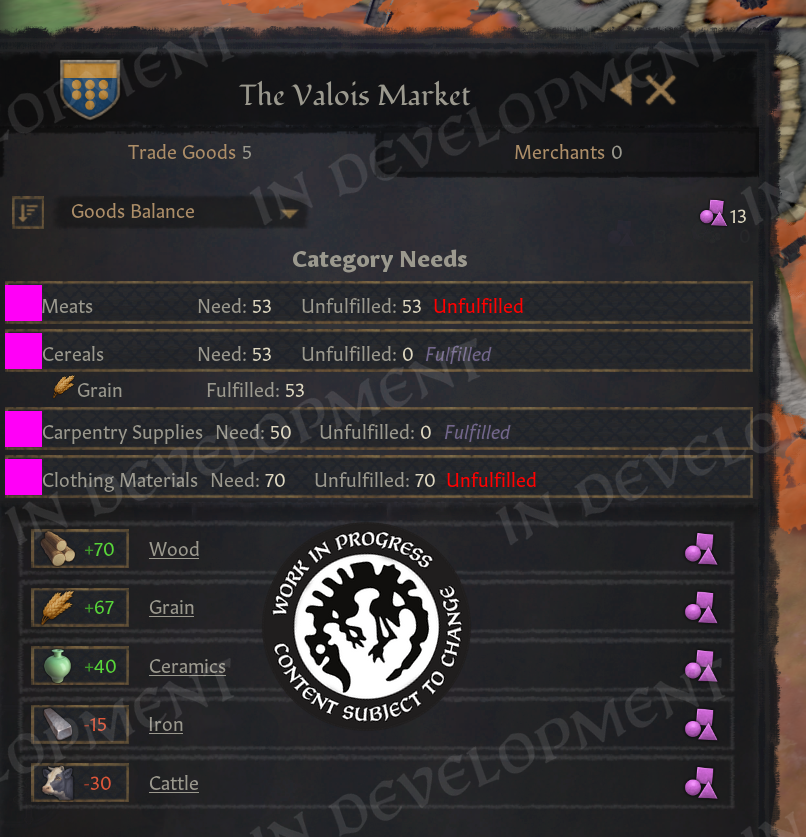
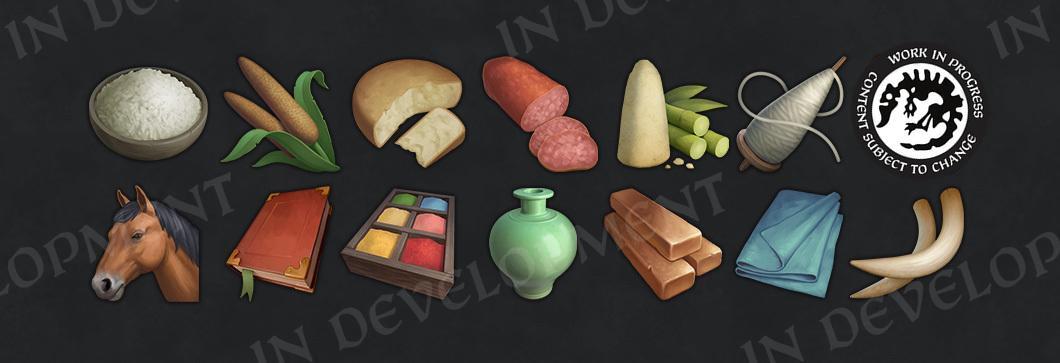
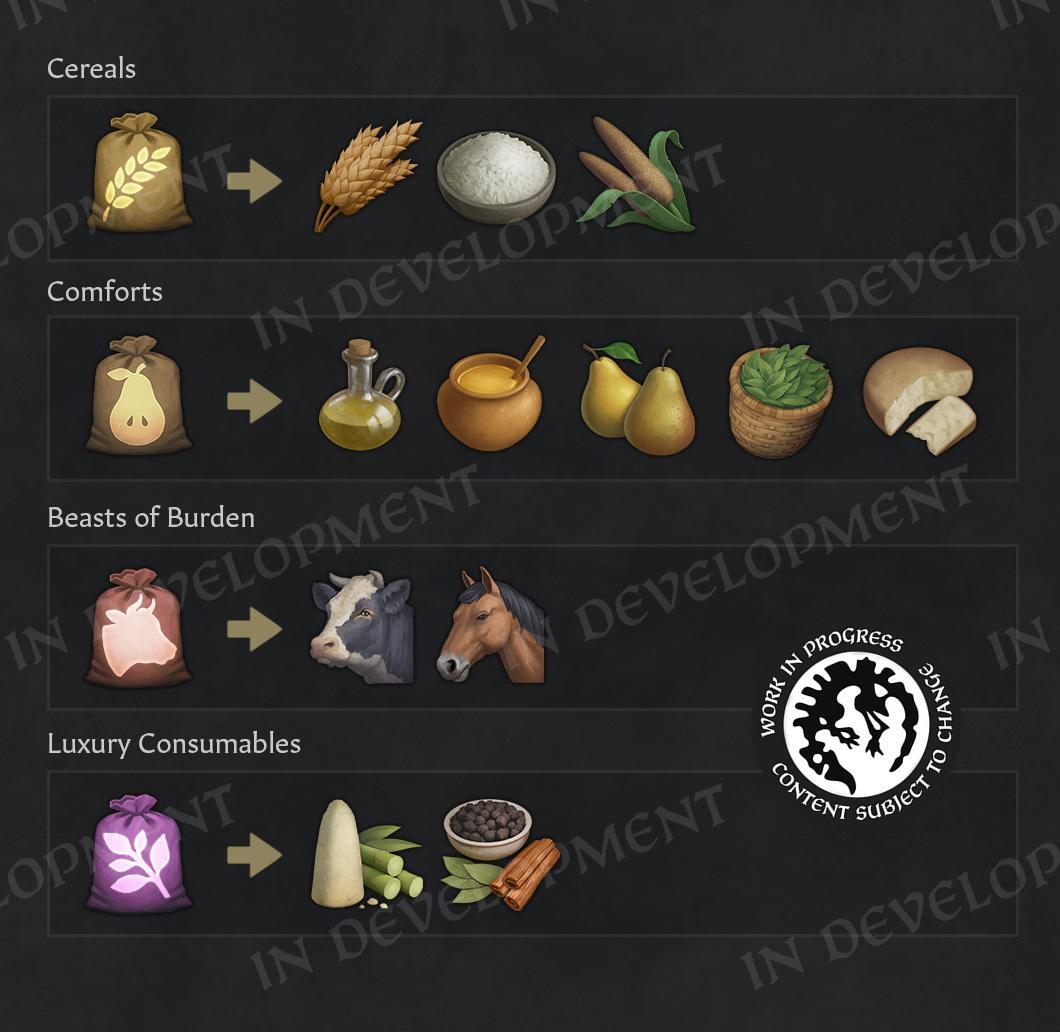
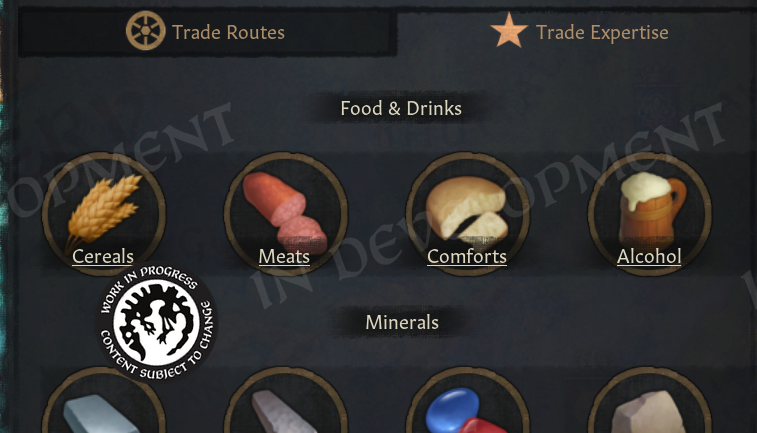
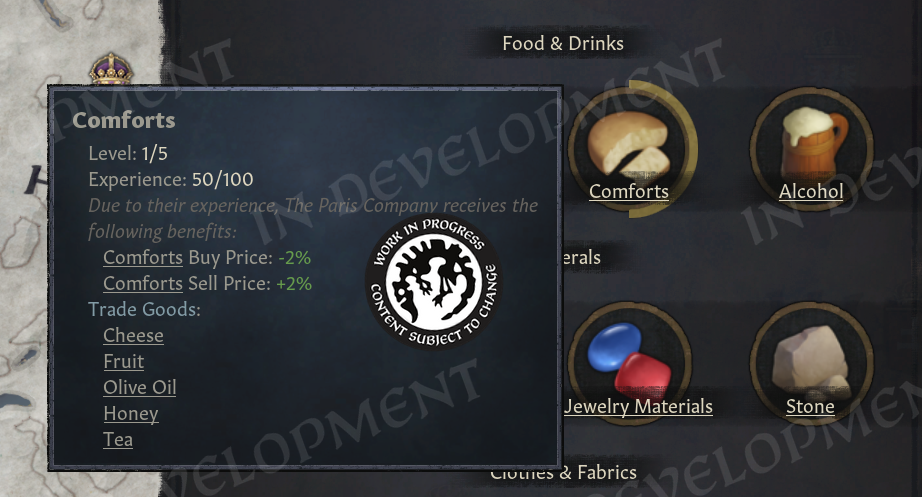
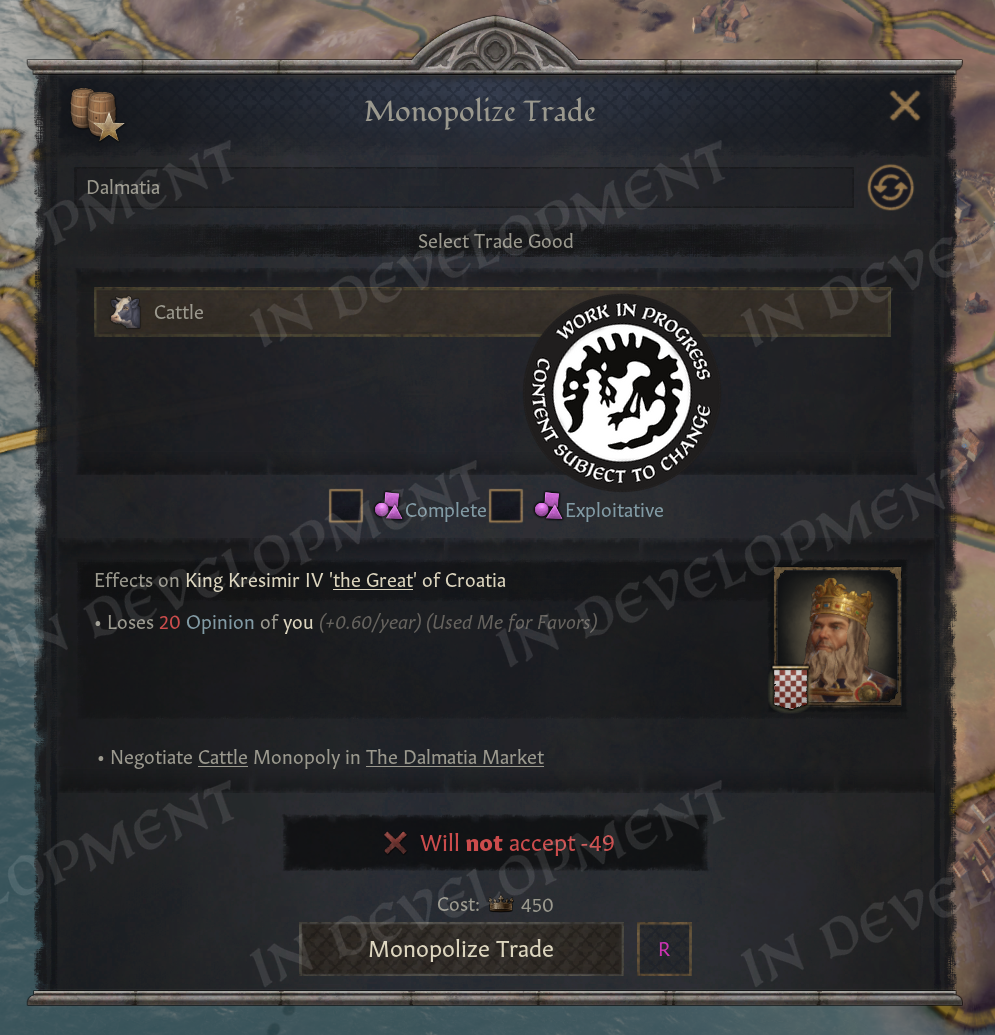

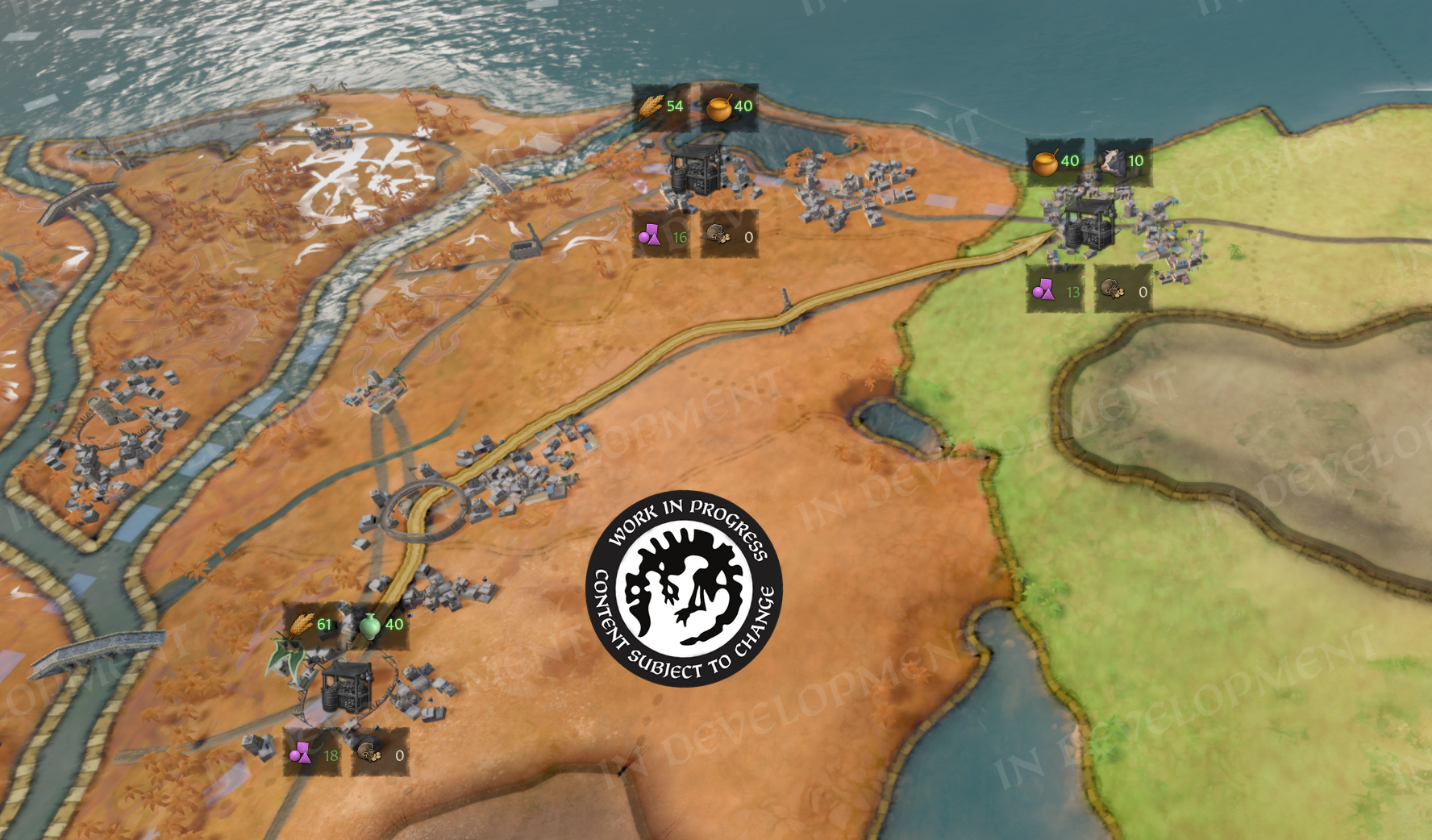
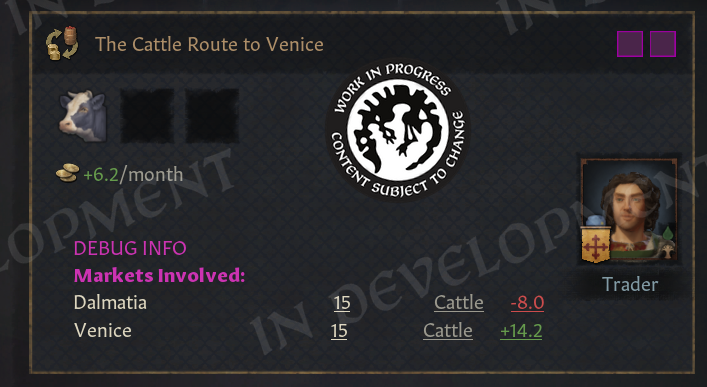


讨论板块
游戏服务器
暂无服务器